Beyond the Breaking Point
Learning Disabled Advocates Challenge Westminster on Welfare and a Failing System
Introduction: A Voice in the Storm
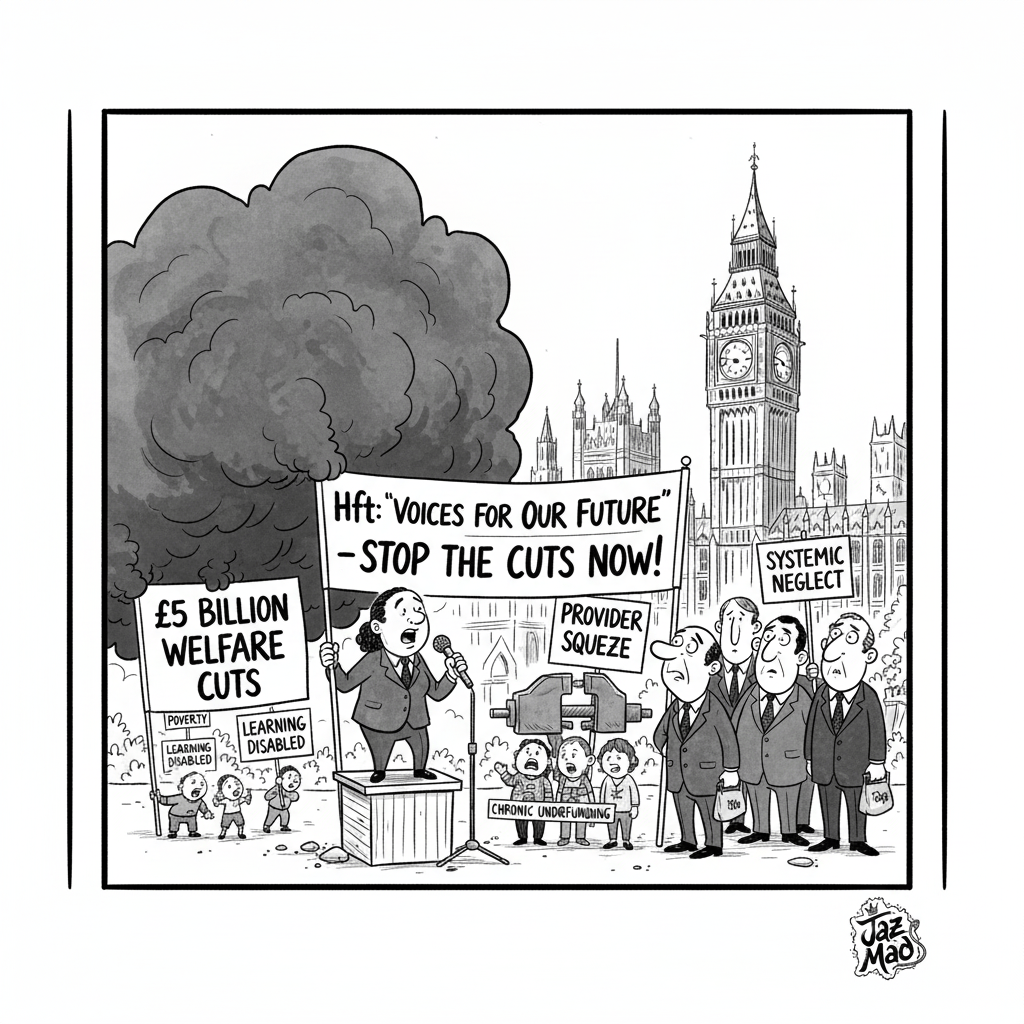
In the ornate halls of Westminster, where policy is debated in billions and soundbites, the voice of one individual, Rachael, cut through the noise. A learning disabled adult supported by the charity Hft, she stood before MPs and Peers to offer a direct, personal challenge to a system at breaking point. Her act of advocacy at the launch of Hft’s ‘Voices for Our Future’ campaign stands in stark contrast to the vast, impersonal policy crisis engulfing social care. Providers are buckling under immense financial pressures, while the threat of welfare cuts—estimated to slash social security expenditure by £5 billion annually by 2029/30—risks pushing tens of thousands into poverty. Rachael’s presence in Parliament was more than a campaign launch; it was a critical moment of clarity, crystallising the human cost of political inaction for the entire UK charity sector.
The Campaign at the Heart of Power
In a climate of existential threat, the strategic importance of charities engaging directly with policymakers cannot be overstated. It was against this backdrop that Hft, a national charity supporting over 2,500 learning disabled adults, brought its mission to the House of Commons. The event marked the official launch of ‘Voices for Our Future’, a five-year advocacy campaign designed to drive meaningful change on the key issues affecting the lives of learning disabled people.
Central to the event’s power was the testimony of individuals like Rachael, a finalist in the prestigious Learning Disability and Autism Leaders’ List Awards. Motivated by a desire to be an “advocate for change and help to make things better for people,” she spoke candidly to lawmakers about her own experiences of bullying and prejudice, eloquently highlighting the urgent need for a fundamental shift in societal attitudes. Her reflection on the experience—”It was amazing, I’d do it again if I could”—underscores the profound impact of being seen and heard in the corridors of power.
Rachael’s testimony was not delivered in a vacuum; it was a preemptive strike against the storm of policy changes and systemic pressures bearing down on the entire social care sector.
Context: A System at Breaking Point
Hft’s parliamentary intervention is a calculated response to a perfect storm of immediate policy threats and a long-term, systemic crisis. This impending policy storm is not a random weather event; it is breaking over a social care infrastructure already hollowed out by decades of political neglect, as detailed in the Just Group’s damning ‘Care Report 2025’. The welfare reforms and provider squeeze are acute symptoms of this chronic disease of political inaction, creating a hostile environment for the most vulnerable.
- Welfare Reform Headwinds: The government has signalled its intent to introduce the biggest cuts to sickness and disability benefits in a generation, expected to reduce social security expenditure by £5 billion a year by 2029/30. Key concerns include the tightening of eligibility for Personal Independence Payment (PIP) and changes to the Motability scheme. Hft’s CEO, Steve Veevers, warns that this could make essential transport unaffordable for disabled households already facing average extra monthly living costs of over £ 1,000. This comes despite the government’s own data showing fraud in PIP is effectively zero, a fact that intensifies sector concerns about the true motive behind the reforms.
- The Provider Squeeze: Financial pressures on care providers are becoming untenable. Unfunded policy changes, such as the rise in Employers’ National Insurance Contributions, added over £2.6 million to Hft’s annual costs alone. This relentless squeeze is forcing providers into “last resort” measures, with many curbing investment, closing down essential programmes, or handing back contracts to local authorities, leaving vulnerable people with fewer options.
- A Legacy of Neglect: The immediate crisis is built on a foundation of chronic inaction. The “Care Report 2025” paints a grim picture of a system stalled by decades of abandoned government proposals. This has eroded public trust, with a stark survey finding that nearly two-thirds of those with experience of the care system do not believe later life care provision is fit for purpose. This history of abandoned plans has fostered deep public cynicism; the Just Group report notes that public engagement is waning, not because the issue is unimportant, but because many have ‘stopped believing that progress is possible’.
These converging failures place the fundamental right of learning disabled individuals to live with dignity and independence under direct threat.
The Human Impact: Beyond Policy and Budgets
The true cost of this crisis cannot be measured in budgets and balance sheets alone; it is counted in diminished lives and lost opportunities. The abstract figures of policy reform translate into tangible barriers that reinforce exclusion and deepen poverty for learning disabled people across the country.
The statistics paint a damning picture of systemic inequality. The employment gap is a chasm: only 26.7% of learning disabled people are in paid work, compared to 80% of the non-disabled population. This disparity is a key driver of poverty, with half of all learning disabled people already living below the poverty line and disabled people as a whole being twice as likely to experience financial hardship. The proposed welfare changes threaten to worsen this dramatically; analysis from the Child Poverty Action Group projects they will push an additional 50,000 children into poverty.
These are not just numbers; they represent blocked pathways to independence. As Steve Veevers highlights, the social care services that bridge this gap are often the first to go when finances are strained. “Essential programs like these are often the first to be cut when funding is stretched,” he states. “These services are not luxuries—they are the missing link between disabled people and the workforce.” He warns that to cut financial support without simultaneously strengthening these employment pathways is not reform; it is, in his words, “a rollback of opportunity.”
A Call for Vision, Not Just Survival
Hft’s ‘Voices for Our Future’ campaign, powerfully personified by advocates like Rachael, is more than a plea for survival; it is a vital challenge to a policy landscape that risks compounding decades of neglect. It serves as a stark reminder that behind every proposed cut and delayed reform are individuals whose independence, well-being, and future are at stake. This is not a story of despair, but a clear and urgent call to action.
The path forward demands a radical shift in perspective. As Steve Veevers argues, true reform must do more than simply reshape benefits; it “must reshape the way society includes and values disabled people.” This requires holding employers accountable, properly funding social care, and ensuring assessments of need are based on the complex reality of people’s lives. The question for the sector now is how to echo Rachael’s voice in every constituency, ensuring that the next government confronts not just the balance sheets, but the human deficit of a system that has been neglected for far too long.