Beyond the Bucket Shake: The Vital, Varied Work of Britain’s Charity Sector
The Unseen Ecosystem
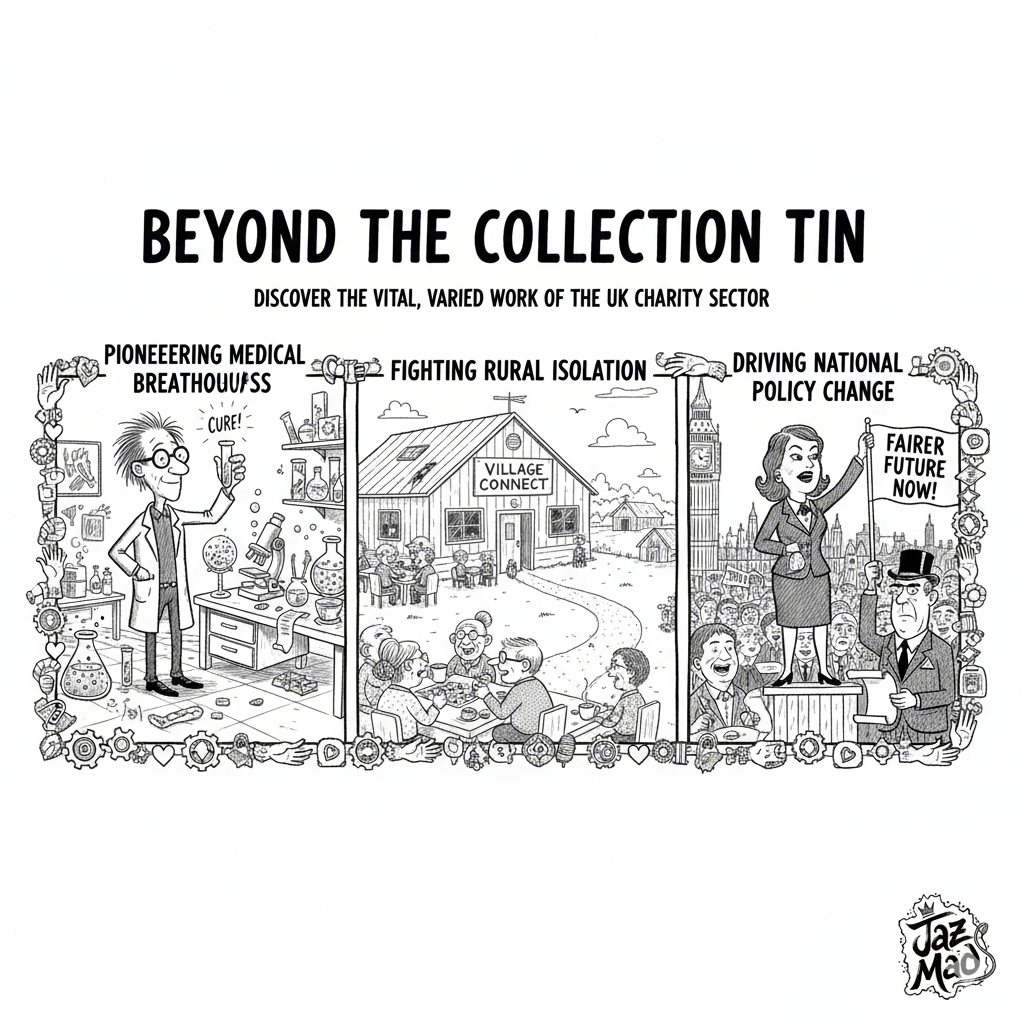
Beyond the household names and high-street collection tins lies a dynamic and diverse ecosystem of organisations that form the backbone of the UK’s third sector. This is a world where cutting-edge medical innovation, celebrated at the Air Ambulances UK Awards, coexists with the deeply local, human-scale work of charities like Growing Well, which is fundraising for a community minibus to combat rural isolation in Cumbria. It is a sector where campaigners fight for policy change on a national stage while peer-support groups create safe spaces in local community hubs. This remarkable diversity is the sector’s greatest strength, enabling it to respond to complex challenges with a powerful combination of tailored, innovative, and deeply compassionate solutions that are essential to the nation’s social fabric.
Pioneering New Frontiers in Health and Wellbeing
A key role of the charity sector is not just to deliver care, but to actively pioneer new models of support and medical innovation. Often driven by powerful personal experience and specialised expertise, these organisations push the boundaries of what is possible, filling critical gaps and challenging the status quo in healthcare from the roadside to recovery.
This spirit of innovation is vividly demonstrated in the pre-hospital and aftercare services provided by the UK’s air ambulance charities. At the recent Air Ambulances UK Awards, Stephen Westbrook of Dorset and Somerset Air Ambulance was recognised for his outstanding clinical leadership, which included creating a voluntary responder scheme that has already reached 45 critically ill patients. At East Anglian Air Ambulance, Dr Paul Rees is celebrated as a visionary clinician transforming out-of-hospital cardiac arrest care, leading national trials and enabling medics to deliver interventions previously only possible in a hospital. This focus extends beyond the initial crisis, with aftercare a growing priority. Adam Crosby of Thames Valley Air Ambulance was named Aftercare Supporter of the Year for his work in strengthening patient support, a service that provides crucial advocacy and reassurance to patients and their families.
This drive to create new support systems is frequently born from lived experience. Following her own stage 4 cancer diagnosis in 2017, Jen Hardy founded Cancer Card as an “umbrella organisation” to help patients navigate the bewildering landscape of support services. After finding there was no single place listing the hundreds of providers available, she created a one-stop online directory. Her work, which has been recognised with an MBE and an honorary doctorate from Heriot-Watt University, has led to Cancer Card being recognised by NHS Inform as a trusted source.
Before founding the charity, Jen Hardy’s personal experience also fuelled a successful campaign to make the life-extending drug Pertuzumab available on NHS Scotland. This dual role—as both an innovator and a campaigner—is characteristic of the sector. It is part of a wider collaborative effort in health, exemplified by the network of bowel cancer charities such as the Bobby Moore Fund and the Bowelbabe Fund, which work alongside Cancer Research UK to drive research, raise awareness, and tackle the stigma surrounding the disease. From life-saving interventions in the field to creating compassionate roadmaps for those navigating illness, these organisations demonstrate a relentless commitment not only to treating crises but to building better systems of care.
Weaving the Social Fabric: Community, Connection, and Care
While some charities pioneer medical frontiers, others perform the equally vital work of strengthening community bonds and combating the silent epidemic of isolation. They operate at a hyper-local level, creating spaces for connection and providing practical, timely support where statutory services, often overstretched, may not reach. Their work is the essential thread that weaves together the social fabric of towns, cities, and rural areas across the UK.
Charities excel at developing practical, localised solutions to complex problems like isolation. In Cumbria, where Chief Executive Mary Smith notes that mental health challenges are “higher than the national average,” the mental health charity Growing Well has launched an appeal for a new minibus. This is not simply a vehicle; it is a lifeline designed to overcome the transport barriers that entrench rural isolation. For participants who can access the charity’s services within two weeks, rather than the potential NHS waiting times of up to two years, the shared journey is a crucial part of their recovery.
This community-building work takes many forms. In Shropshire, PCAS (Person Centred Advocacy and Support) provides a lifeline for vulnerable adults and has recently signed the Armed Forces Covenant to formalise its commitment to supporting veterans, a group that often faces unique challenges in adjusting to civilian life. Elsewhere, the MK Dons Community Trust demonstrates the power of sport to bring people together, hosting coffee mornings across its four community hubs in aid of Macmillan and showing how partnership can amplify impact.
A cornerstone of this community-centric approach is the strategic use of peer support, now recognised as a vital tool for mental health. In Scotland’s Creating Hope Together suicide prevention strategy, peer support is a core component. A recent impact report from the Creating Hope with Peer Support project highlighted its effectiveness, with Minister Tom Arthur stating that it can make a “lifesaving difference.” Organisations like The Hive Kirkcaldy exemplify this by creating safe, affirmative spaces where marginalised groups can access immediate support from those with shared lived experience. This work, rooted in empathy and mutual understanding, is fundamental to building resilient communities from the ground up.
Championing Systemic Change: From Grassroots Advocacy to National Policy
Beyond delivering frontline services, the charity sector functions as a powerful engine for systemic change. By harnessing evidence, mobilising public support, and engaging in direct advocacy, these organisations work to influence legislation, shape public consciousness, and secure the policy frameworks needed to address the root causes of society’s most pressing issues.
The rewilding movement offers a compelling case study in successful, multifaceted advocacy. With an ambitious goal of seeing 30% of Britain’s land and sea rewilded by 2030, Rewilding Britain has built a powerful campaign from the ground up. Key to their success is building a grassroots movement, with their Rewilding Network now uniting over 1,000 practitioners. This community provides the foundation for powerful public mobilisation, such as their pivotal role in the Restore Nature Now march, which saw 60,000 people take to the streets, and the launch of a “Rewilding Manifesto” to push the issue onto the 2024 general election agenda. This is amplified by high-profile influencer support; the affiliated Scottish Rewilding Alliance has galvanised backing for its “Rewilding Nation” campaign from actors Brian Cox, Alan Cumming, Leonardo DiCaprio, and comedian Nish Kumar, who use their platforms to reach millions. This persistent, multi-layered advocacy has yielded concrete results, most notably when Westminster legislators amended the law to permit the release of licensed wild beavers in England—a major policy success.
This model of change-making extends across the sector. Step by Step, a charity supporting young people leaving the care system, highlighted a critical policy flaw through its “18 Isn’t Cheaper” campaign. Collaborating with Solent Creatives, the university’s student-powered agency, they produced a film capturing the lived experiences of care leavers to advocate for a review of Universal Credit rates for 18 to 24-year-olds. The project gave an authentic voice to those directly affected, creating a powerful tool to engage policymakers and the public. These campaigns demonstrate how charities can transform grassroots experience into national conversations, driving tangible progress on critical social and environmental issues.
Tackling the Toughest Challenges: Research, Inclusion, and Global Reach
Charities often step into the most complex, challenging, and under-resourced areas of society. They are uniquely positioned to conduct vital research into overlooked issues, champion the inclusion of marginalised groups, and extend their reach to address global crises, demonstrating a scope and ambition that is both profoundly local and truly international.
The sector’s role in building an evidence base is crucial for identifying “hidden” barriers to wellbeing. A recent report from the Mental Health Foundation, funded by Motability, examined the link between transport and public mental health. Its research revealed the significant challenges faced by people with mental health conditions, from the sensory overload of noisy trains to the fear of abuse on buses. Crucially, the report went beyond identifying problems to propose concrete solutions for government and travel companies, such as co-producing staff training with people with lived experience and raising public awareness about hidden disabilities.
This focus on inclusion is also driving transformative change in education and employment. Petty Pool, a specialist further education college for young people with special educational needs and disabilities (SEND), provides a powerful example. In a society where the national average for adults with learning disabilities in paid employment is just 5%, Petty Pool achieves remarkable outcomes. The college boasts impressive outcomes: in the year to July 2025, 41% of its leavers progressed into paid or supported employment. The success story of Megan, a former student who overcame a lack of confidence to secure a permanent job at Leighton Hospital, illustrates the life-changing impact of its tailored, supportive programmes.
The UK charity sector’s influence also extends far beyond national borders. In the face of severe international aid cuts, organisations like acet UK are continuing their critical work in HIV education and prevention. As Pam Nyathi, director of acet UK’s partner project in Zimbabwe, explains, the context is stark: “Over the last 12 months, there has been an unprecedented reduction in US and UK AIDS spending that has had a huge impact on HIV care programmes.” In response, acet UK focuses its efforts on underserved communities in sub-Saharan Africa, working with high-risk groups to prevent transmission and ensure those with a positive diagnosis can access the help they need. This work is a poignant reminder of the sector’s global conscience and its commitment to tackling humanity’s toughest challenges, wherever they may be.
An Indispensable and Diverse Sector
The true value of the UK charity sector is revealed not in any single act, but in its incredible, sprawling diversity. It is an ecosystem populated by rewilding advocates working to restore Britain’s lost habitats, and by peer support networks offering a quiet, lifesaving connection to those in despair. It is home to specialist educators unlocking the potential of young people with learning disabilities, and to global health campaigners fighting to end HIV in the face of dwindling international aid. This sheer variety of mission, scale, and method is its defining feature and its most powerful asset. Yet this vital ecosystem faces persistent challenges, from the funding pressures highlighted by Rewilding Britain to the aid cuts impacting acet UK. Recognising and supporting the sector in all its varied forms is not just philanthropy; it is an essential investment in a more resilient, compassionate, and hopeful future for everyone.