System Failure: Why Bloody Good Period’s Collapse is a Bellwether for Every UK Charity
Introduction: A Bellwether for a Sector in Crisis
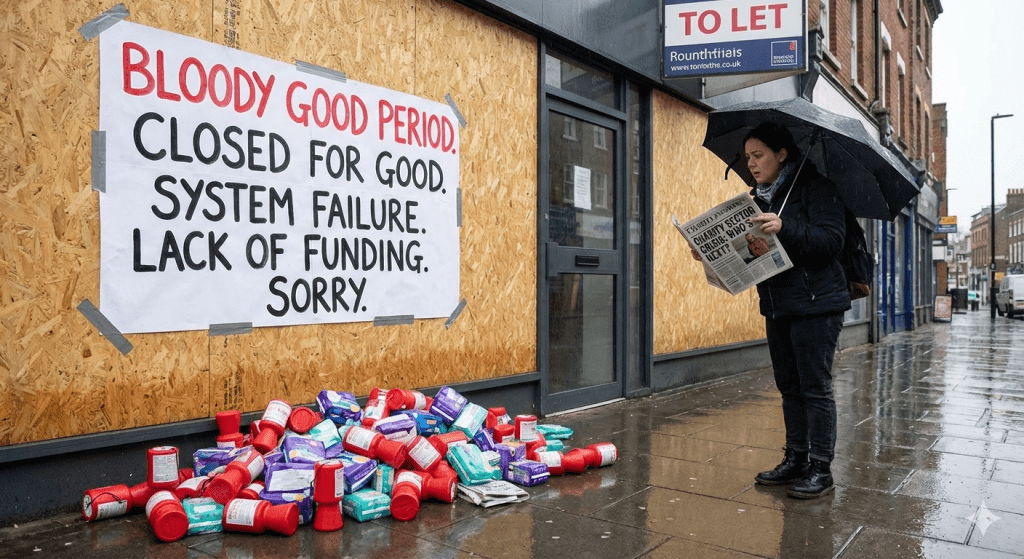
The recent closure of Bloody Good Period (BGP), a prominent and high-impact menstrual equity charity, has sent a shockwave through the UK’s third sector. Citing “severe financial pressures,” the organisation’s collapse is far more than an isolated tragedy; it is a critical symptom of a sector-wide crisis that demands immediate attention. As BGP’s own closing statement noted, their story “reflects the severe financial pressures facing the wider sector.” The charity’s own analysis crystallises the Charity Commission’s stark assessment of a “triple threat” confronting organisations across the country: soaring public demand for services, escalating operational costs, and a simultaneous decline in income. For charity professionals, trustees, and policymakers, the demise of Bloody Good Period is not just news—it is a bellwether, signalling a systemic vulnerability that demands urgent attention.
The Core Story: The Rise and Fall of a High-Impact Charity
To fully grasp the magnitude of this loss, it is essential to understand the journey and impact of Bloody Good Period. Its story is one of rapid growth driven by an urgent, unmet need, which makes its sudden closure all the more jarring for the communities it served and the sector it inspired.
Founded in 2016 by Gabby Jahanshahi-Edlin, BGP began as a simple Facebook appeal after she discovered that period products were rarely provided at food banks and asylum seeker drop-in centres. From these grassroots origins, it grew into a leading voice for menstrual equity, with its income doubling between 2021 and 2023. The charity’s impact was profound and tangible. In 2023 alone, it distributed 90,000 packs of period products through a network of over 100 partner organisations across England and Wales. The demand was relentless; at the time of its closure, BGP had an “unprecedented” waiting list of over 80 more organisations it did not have the resources to help.
BGP’s work was laser-focused on society’s most vulnerable communities, particularly asylum seekers and refugees. Many of these individuals have no recourse to public funds and receive a weekly allowance of just under £40, making the average monthly cost of period products—around £10—an impossible expense. Its closure, announced in November 2025, resulted in the loss of six employee roles and has left a significant void. The organisation is now working with insolvency practitioners, and its 2024 accounts are currently overdue. The impact of this closure on the communities it served is profound and cannot be overstated.
The human cost of the closure was palpable in the charity’s final announcement:
“This is a deeply sad day for everyone connected with our organisation… No one who shares our belief in a better world for menstruation ever wanted this outcome.”
BGP’s journey from a social media whip-round to a nationally recognised charity demonstrates the power of grassroots action. Its ultimate collapse, however, reveals the brutal reality of the external forces now bearing down on the entire voluntary sector.
Analysis: A Perfect Storm of Soaring Need and Squeezed Resources
Bloody Good Period did not fail in isolation; it was consumed by a perfect storm of unprecedented economic and social pressures. Understanding these forces is crucial for every charity leader seeking to navigate the current volatile environment.
First, the demand for free period products skyrocketed. In the first quarter of 2022, BGP itself saw a staggering 78% increase in requests compared to the same period in 2020. This reflects a national crisis. By 2023, one in five people who menstruate in the UK—some 2.8 million individuals—were struggling to afford period products, a 75% increase from the previous year. This surge in “period poverty”, a lack of access to sanitary products due to financial constraints, is a direct consequence of the wider cost-of-living crisis, forcing households to make impossible choices between heating, food, and basic hygiene.
Simultaneously, the cost of delivering services spiralled. Since 2022, the price of essential period products has increased by up to 57%. BGP directly experienced this inflation in the most visceral terms. A typical order of pads for a community partner that cost £130.05 in November 2023 was costing £219.30 by December—a 69% increase in a single month. As the Economics Observatory notes, these supermarket price hikes have effectively “wiped out” any financial relief gained from the 2021 abolition of the ‘tampon tax’, a 5% tax on sanitary products that was removed in 2021.
While demand and costs surged, the third element of the storm hit: falling income. BGP relied primarily on public fundraising to fuel its operations. However, the Charity Commission’s own research highlights a sector-wide decline in donations as household budgets are squeezed, leaving charities like BGP competing for a shrinking pool of public support.
These pressures were compounded by what many saw as a policy vacuum. Despite a 2019 government pledge to end period poverty, frontline organisations felt abandoned. Staff from BGP and its partners reported that small charities were left to “plug the gap” amid a “silent” government response. As BGP’s Emma Defoe stated bluntly, there is “no meaningful commitment nor funding to provide essential period products for people who can’t afford them.” This combination of soaring need, rising costs, dwindling donations, and insufficient government action created an unsustainable environment, ultimately proving fatal for a vital organisation. The situation calls for immediate and systemic policy changes to prevent further closures.
Implications: Urgent Lessons for Charity Governance and Survival
The closure of a successful, high-impact organisation like Bloody Good Period offers a powerful and urgent case study for charity trustees and leaders across the UK. It underscores the critical need for robust financial management and strategic foresight in an era of unprecedented volatility.
A key concept for boards to grasp is the “cost-recovery gap”—the chasm between a charity’s income and the true cost of delivering its services. As consultants at Moore Kingston Smith highlight, many charities struggle to be transparent with funders about these real costs, creating a fundamental vulnerability. When income fails to cover expenditure, even the most impactful services become financially unsustainable.
From this crisis, several core governance principles emerge as essential for survival. The board’s role in maintaining stringent and transparent financial oversight is non-negotiable, in both good times and bad, to enable proactive and collective decision-making. While it is tempting to hide financial challenges, this approach blocks potential solutions; funders are invested in an organisation’s success and can become valuable partners if brought into a candid conversation early. This underscores the critical importance of immediate, frank discussions with all key stakeholders when problems first arise. Waiting to present a “perfect” solution can leave one “blindsided into crisis mode,” severely limiting options and leading to a disorderly outcome.
This advice is echoed by the UK Charity Commission, which urges boards to spot “early warning indicators” of financial distress. Doing so, the regulator advises, gives trustees a much better range of options to recover and avoid insolvency. The lessons from BGP’s closure are clear: vigilance, transparency, and early action are no longer just best practice; they are essential for survival.
Conclusion: Beyond One Charity’s Closure, A Call to Action
The end of the Bloody Good Period is a tragic loss for the communities it served and a stark warning to the entire voluntary sector. Its story is a case study in the devastating impact of the “triple threat” of soaring demand, rising costs, and falling income—a storm that is battering charities nationwide. The pressures that BGP succumbed to are not unique; they are being felt in hospices, food banks, and community centres across the country. While its closure provides urgent lessons in financial governance and the critical need for trustee oversight, it also points to a deeper, systemic failure. What must change at a policy and funding level to ensure that our most essential, high-impact charities are not simply left to “plug the gap” until they, too, are stretched beyond the breaking point? Bloody Good Period’s legacy must be a vital wake-up call that prompts a real answer to that question.