East London Mosque Run Sparks Sector-Wide Debate on Inclusion and Equality Law
The Flashpoint in Victoria Park
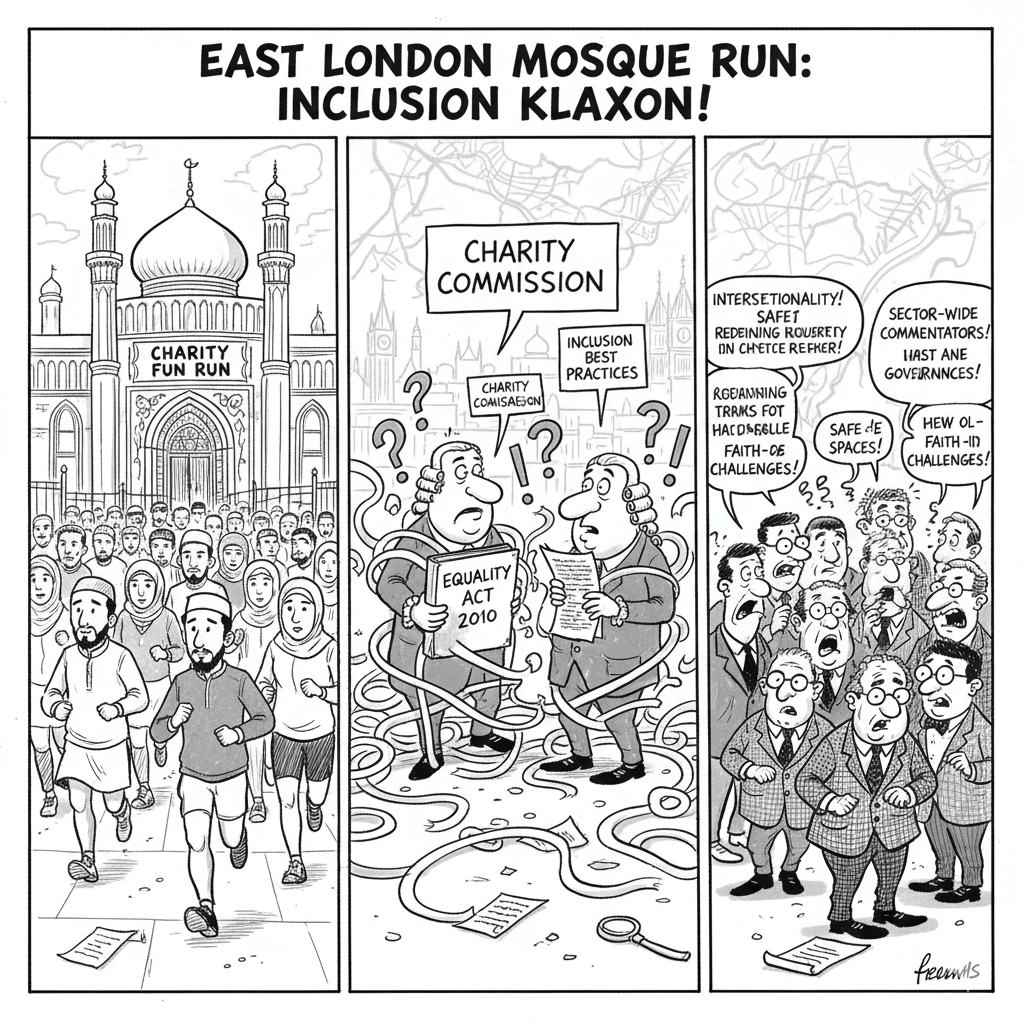
A charity fun run in a London park has become an unexpected flashpoint for the UK charity sector, forcing a difficult conversation about the intersection of religious practice, equality law, and public perception. The East London Mosque Trust’s 12th annual Muslim Charity Run, held in Victoria Park, was publicly promoted as an “inclusive” and “family-friendly” event. However, its entry rules, which excluded women and girls aged 12 and older, sparked immediate and widespread criticism. This incident is far more than a local controversy; it serves as a critical case study for charities across the country. It raises profound questions about the practical application of the Equality Act 2010 to fundraising events, the reputational risks for faith-based organisations, and the immense challenge of navigating conflicting community values and broader public expectations of inclusivity in modern Britain.
The Anatomy of a Controversy
To understand the full impact of this event on the charity sector, it is essential to deconstruct the specifics of the run and the powerful, immediate reactions it provoked from both political and regulatory bodies. The clash between the event’s public messaging and its restrictive rules created a firestorm of scrutiny that quickly escalated beyond the local community.
Inclusive Messaging vs. Exclusive Rules
On Sunday, 15th October 2025, the East London Mosque Trust held its 12th annual Muslim Charity Run, a 5k race that brought together over 40 charities and community groups. On its website, the Trust advertised the event as welcoming “all ages and abilities” and being “family-friendly” and “inclusive”. However, the specific entry criteria stated the run was only “open to men, boys of all ages and girls under 12, but everyone is welcome at the park to cheer on the runners”. This juxtaposition between the language of inclusivity and the reality of exclusion became the central point of contention.
Political and Regulatory Scrutiny
The backlash from public figures was sharp and immediate. Speaking on LBC radio, Communities Secretary Steve Reed branded the exclusion “absolutely unacceptable,” stating unequivocally:
“We don’t want a situation in this country where men are allowed to do things that women are then barred from. We cannot tolerate that.”
This high-level political condemnation was swiftly followed by regulatory interest. The Equality and Human Rights Commission (EHRC) confirmed it was assessing whether the East London Mosque Trust had breached the Equality Act 2010 to determine if intervention was necessary. Simultaneously, Tower Hamlets Council, the local authority, contacted the mosque to seek “urgent clarification” on the age and gender restrictions. The external pressure from politicians and regulators was only one part of the story; a more complex and nuanced debate was also emerging within the Muslim community itself.
Voices from the Community: A Complex Response
Voices from the community reveal a complex picture, emphasizing the need for empathy. Recognizing diverse perspectives within the Muslim community helps charity leaders understand the importance of balancing internal values with external perceptions.
Calls for Inclusive Adjustments
The Muslim Women’s Network UK (MWNUK) expressed concern but offered a pragmatic rather than purely condemnatory critique. Its chief executive, Shaista Gohir, argued that organisers “could have taken practical steps to accommodate women and girls without compromising religious beliefs.” She proposed straightforward solutions that could have averted the controversy entirely:
“For example, women could have participated by starting their run at a different time or in separate groups… Such adjustments would have been straightforward and would have demonstrated a commitment to inclusion while avoiding the reinforcement of negative stereotypes about Muslims.”
Gohir powerfully refuted the idea that separate runs were an absolute religious necessity, framing it instead as a choice with practical alternatives. “It’s worth noting that during the pilgrimage to Makkah, men and women are often in close proximity – far more so than would occur during a charity run,” she added.
The Mosque’s Defence
In response to the criticism, a spokesperson for the East London Mosque Trust mounted a legal defence, citing Section 195 and Schedule 23 of the Equality Act, which permits “Single-gender sporting events”. They strongly denied any breach of equality legislation and pointed to a “long-standing commitment to supporting women and girls,” highlighting the mosque’s Maryam Centre—a purpose-built women’s facility—and a planned women’s fitness and wellness hub. The Trust maintained its goal was “to nurture faith, wellbeing, and social good for everyone in our community.”
An Internal Perspective
Sufia Alam, the mosque’s head of programmes, provided a crucial internal perspective, arguing that the narrative of exclusion was misleading. She asserted that a woman’s race was offered but cancelled due to a near-total lack of interest. “I only got one or two,” she explained, suggesting the format was a direct response to community demand, not a top-down imposition. This highlights a key challenge for faith-based charities: navigating the complex and sometimes contradictory desires within their own communities. For the sector, it poses a difficult question: does low demand for one type of event absolve an organisation of finding other ways to be inclusive, especially when its public messaging claims universality? Alam challenged the external critics directly:
“Critics think they’re sticking up for women’s rights, but they’re dismissing that we have a voice and a choice in what we do.”
Concerns over Media Framing
A secondary, but significant, criticism emerged from both the mosque and Shaista Gohir regarding the nature of the media coverage. Both suggested the intense focus on the run was disproportionate and driven by a wider agenda. Gohir argued that the “disproportionate attention” reflected “levels of hatred towards Muslims” rather than a “genuine concern for Muslim women’s equality.” This perspective frames the controversy not just as a debate over inclusion, but as a symptom of a hostile public environment for Muslim organisations.
These conflicting viewpoints underscore the delicate tightrope charity leaders must walk between legal frameworks, community needs, and public relations.
For charity professionals, the East London Mosque Trust incident highlights that legal compliance alone is insufficient. Upholding ethical standards in communication and practice is essential to protect and enhance sector reputation and public trust.
For charity professionals, the East London Mosque Trust incident underscores the importance of transparency in maintaining public trust. Clear communication about legal and ethical considerations can help organisations navigate controversy effectively, reinforcing confidence in their governance.
The Legal Landscape
The mosque’s primary defence rests on a specific provision within the Equality Act 2010 known as the “charities’ exception.” According to official guidance, Section 8.2 allows for “Men only or women only fundraising,” with the popular Race for Life series cited as a key example. This exception for single-sex sporting events forms the legal foundation of the mosque’s argument that its run was lawful. For many charities, this represents a legitimate tool for targeted fundraising.
The Fundraiser’s Code of Conduct
However, legal defensibility does not exist in a vacuum. The sector’s self-regulatory framework, the Code of Fundraising Practice, demands a higher standard. It requires that all fundraising be “open, honest and respectful” (Rule 1.1.1) and carried out in a way that “reflects positively on fundraising in general” (Rule 1.1.2). Here lies the core of the reputational crisis. By advertising the run with broad, public-facing language like “inclusive” while enforcing exclusive rules, the organisers created a direct conflict with these ethical principles. This perceived disconnect between messaging and reality is precisely what erodes public trust, risking damage not only to the organisation but also to the sector’s reputation as a whole. Relying on a legal loophole while being opaque in public communications is a high-risk strategy.
The Governance Context
The timing of this controversy amplified the reputational damage exponentially. In April 2025, just months before the run, the East London Mosque Trust received an official warning from the Charity Commission for “failing to responsibly manage charity funds,” resulting in a £1m loss. This pre-existing governance concern placed the organisation under heightened scrutiny. Against this backdrop, a public-facing decision that was legally ambiguous but ethically questionable raised profound questions about the charity’s risk management and decision-making processes, creating a perfect storm for public criticism.
Resolution and Reflections for the Sector
The immediate controversy was resolved when the Equality and Human Rights Commission (EHRC) announced it would not take further action after the East London Mosque Trust “committed to reviewing their policies” ahead of the 2026 run. While this concludes the formal investigation, the questions it has raised for the sector will resonate for years to come. The incident starkly reveals the tension between specific religious practices and broader public expectations of inclusivity, exposing the fine line between exercising a lawful exception and incurring profound reputational damage. Ultimately, the East London Mosque serves as a stark reminder for the sector: public trust is not maintained by what is legally defensible, but by what is transparently and ethically practised. In an era of heightened scrutiny, the gap between the two is a reputational chasm that no charity can afford to ignore.