Beyond the Collection Tin: The Youth Alliance Forging Charity’s Future
An analysis of the Rotary-school partnership model and its lessons for building a sustainable volunteer pipeline.
Introduction: The Local Action with National Implications
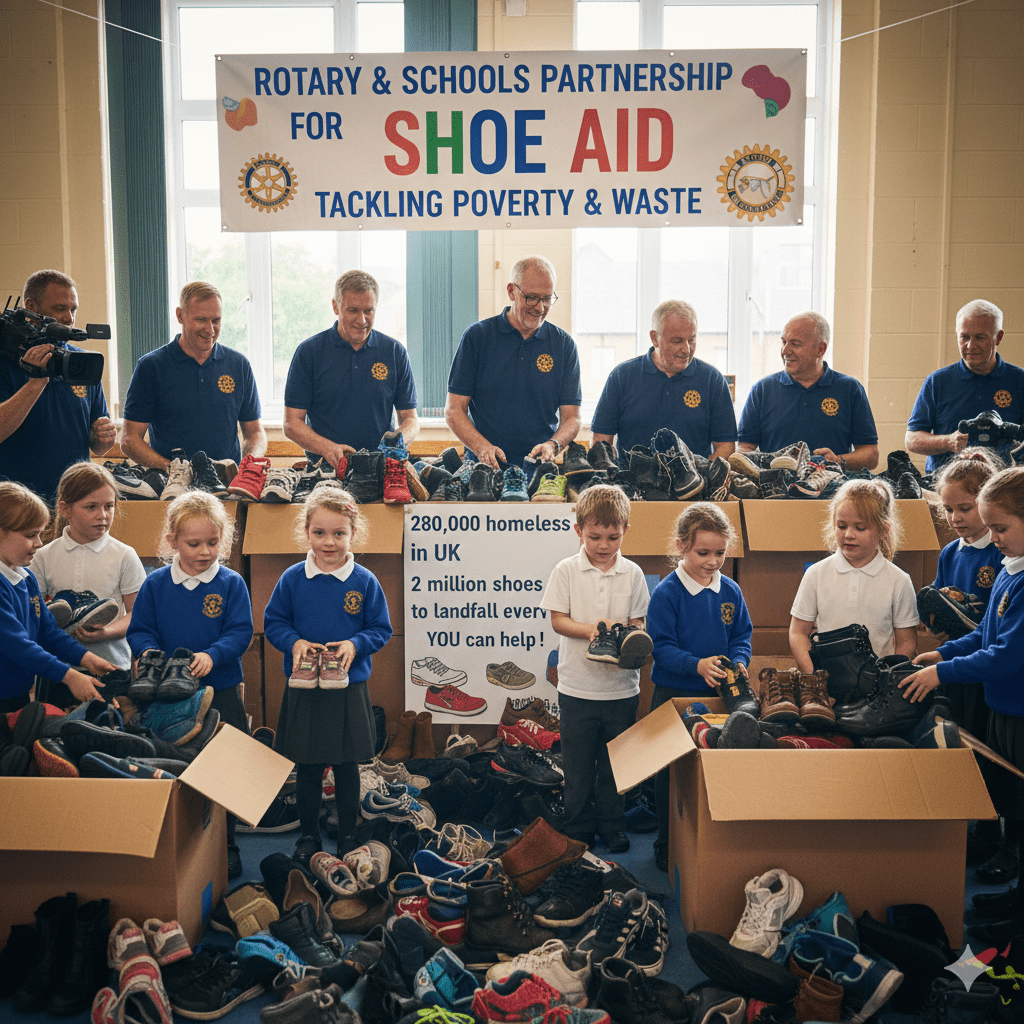
In Solihull, pupils at Hasluck Green Primary and Forest Oak School recently gathered bags of outgrown shoes for a charity appeal. Organised by the local Rotary Club, this act of community-mindedness might seem familiar, but it represents something far more significant. This is not just an isolated school collection; it is a snapshot of a structured collaboration between schools and service organisations such as Rotary. To encourage broader adoption, it is essential to explore how this partnership model can be tailored to diverse community needs and resources across different regions. Understanding this adaptability can help stakeholders see its relevance beyond specific cases and foster wider implementation.
The Core Story: A Tapestry of Community-Led Initiatives
The success of the Rotary-school partnership model is best understood by exploring its application on the ground, which ranges from mobilising direct material aid to embedding a systemic culture of service. Each project is tailored to local needs but contributes to a national pattern of effective, community-led action.
Powerful instances of mobilising direct aid are widespread. In Solihull, a shoe appeal in support of the charity Shoe Aid highlights the model’s ability to address multiple issues at once. As Club President Phil Godfrey noted, the appeal tackles both the stark reality of footwear poverty affecting the UK’s “280,000 homeless people” and the staggering environmental cost of the “2 million shoes… thrown into landfills every week.” Andy Hughes, CEO of Shoe Aid, praised the partnership as “instrumental in collecting shoes from the local community.” He noted the donations have a life-changing impact, supporting “families and individuals up and down the country who are struggling.” This dual-benefit approach—simultaneously tackling poverty and environmental waste—is a hallmark of the model’s efficiency, offering a key lesson for resource-constrained charities seeking to maximise impact.
This is far from a one-off success. In Berkshire, a coalition of five Rotary Clubs partnered with 20 primary schools for the annual BBC Children in Need appeal, raising an impressive £7,000 so far through their coordinated efforts.
Beyond direct aid, the model finds its deepest expression in programmes that embed a sustainable culture of service into school life. The Croesyceiliog Interact Club in Torfaen offers a powerful case study. Recently recognised as the world’s “first Peacebuilder Interact Club,” its 15 student members have driven fundraising for both the global “End Polio Now” campaign and the Jackie School in Uganda. This fusion of hyper-local peace initiatives with contributions to a global health campaign demonstrates a core principle of the model: framing local action as a tangible contribution to global stability and well-being. These achievements are just the beginning, serving as the foundation for a much deeper educational and developmental impact.
Deeper Impact: Forging the Next Generation of Global Citizens
For the charity sector, the most strategic outcome of these partnerships is not merely the immediate funds or goods raised, but the creation of a resilient, hopeful pipeline of future volunteers, donors, and leaders—a vital asset in an era of demographic shifts and declining traditional volunteerism. As principles from an Oxfam fundraising guide suggest, such activities can be a powerful ‘springboard towards supporting young people to become active global citizens.’
While the Oxfam guide provides the philosophical ‘why’ for this educational approach, Rotary provides the operational ‘how’ with a formal, global structure designed to facilitate this development, interact Clubs, for young people aged 12-18, and EarlyAct Clubs, for primary students, are designed to help participants develop leadership skills, personal integrity, and an understanding of service. The scale is immense, with nearly 15,000 Interact clubs operating in 145 countries.
The skills development is tangible and profound. Retired School Principal Julie Mason AM observed that through these programmes, students “honed skills in project management, public speaking, teamwork, fundraising, writing grant applications and marketing.” This is powerfully echoed by the students themselves. Arabella, president of the Croesyceiliog club, reflected on what she had learned:
“Peace isn’t just about avoiding conflict; it’s about creating understanding, listening to others, and standing up for what is right.”
Her peer Matilda described the club as “an incredibly rewarding experience” that helped her “grow both as a person and a leader.”
This impact extends beyond fundraising into direct community service. The Wells Rotary Club’s “Listening Project” sees volunteers provide crucial one-on-one reading support to children aged six to ten. This is supplemented by their Children’s Book Recycling Scheme, which has donated approximately 2,000 books to local junior and infant schools, demonstrating how these partnerships can address core community needs, such as literacy. These diverse activities are not random acts of kindness but are rooted in a clear and compelling organisational strategy.
Context and Strategy: A Blueprint for Purpose-Driven Partnership
These school-level activities reflect a clear strategic focus for Rotary. Aligning grassroots efforts with long-term goals fosters confidence and reassurance, demonstrating that this model is a reliable, scalable approach for sustainable community development.
The Rotary District 5040 Strategic Plan, for example, explicitly identifies the need to “Promote, increase, and support youth programs” as one of its “District Top Key Priorities.” The goal is clear: to build “integration and succession, by continuing to be active in Interact, RYLA and Youth Exchange” and ensure the next generation is ready to lead. This strategic vision connects the actions of a local club in the UK to Rotary’s monumental global objectives.
When students at Croesyceiliog School raise funds for the “End Polio Now” campaign, they are contributing to one of the most significant public health initiatives in history. Rotary, in partnership with the Gates Foundation, has renewed a joint commitment of “up to US450 million**” for this cause. This is part of the **more than US$2.9 billion Rotary has dedicated to polio eradication since 1985. As Rotary International President Stephanie Urchick affirmed, “We remain resolute in delivering on our promise of a polio-free world.” This blend of hyper-local action and global strategic vision provides a compelling and effective model for the wider charity sector.
Conclusion: A Forward Look at a Powerful Alliance
The partnership between Rotary and schools represents a multifaceted and highly effective ecosystem of engagement. It delivers tangible aid to those in need, addresses pressing environmental concerns, and achieves remarkable fundraising goals. Most critically, however, it serves as a powerful incubator for developing the next generation of community leaders and philanthropists. For the UK charity sector, the structured growth of programmes like Interact and EarlyAct represents a vital and sustainable pipeline for social action. This alliance offers a clear blueprint for how charities can move beyond transactional fundraising to build deep, educational, and transformative relationships within their communities, creating lasting change and truly helping to “unite for good.”