New Compass, Old Storm
Can the Charity Commission’s Ambitious Strategy Guide the Sector Through the ‘Big Squeeze’?
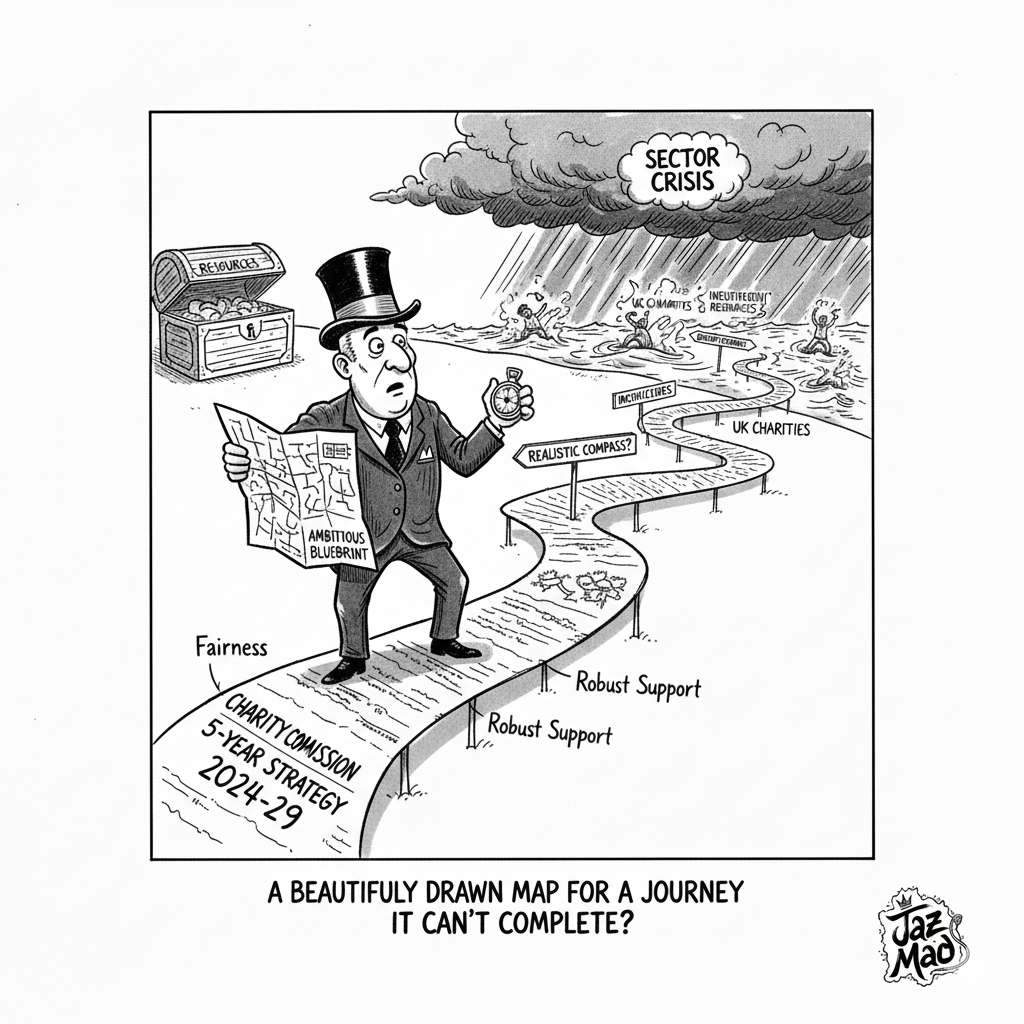
A New Compass for a Sector in a Perfect Storm
The UK’s charity sector is navigating a perfect storm. Battered by the compounding effects of the pandemic and a cost-of-living crisis, organisations are caught in a ‘big squeeze’ of falling income, soaring operational costs, and relentlessly climbing demand for their services. The NCVO’s latest ‘The Road Ahead 2025’ report paints a stark picture, with charities facing greater competition for every pound as public donations dwindle. It is into this volatile and deeply challenging environment that the Charity Commission has launched its new five-year strategy for 2024-29. The regulator’s ambitious blueprint is its definitive response to the crisis, promising fairness, independence, and robust support. The question reverberating through the sector is whether this ambitious blueprint is a realistic compass, or simply a beautifully drawn map for a journey the regulator may not have the resources to complete.
In response to ongoing sector challenges, the Charity Commission’s five-year plan aims to redefine its role, emphasising proactive regulation and sector guidance, as outlined in the February 2024 strategy document, to help charities navigate a complex environment.
In response to a volatile environment, the Charity Commission’s plan aims to support charities to get it right, reassuring sector leaders and trustees that they will receive guidance and backing during tough times.
The core ambition of the 2024-29 strategy is stated unequivocally:
“To be the expert Charity Commission that is fair, balanced, and independent so that charities can thrive.”
To achieve this, the Commission has set its course on five key strategic priorities that will shape its work, culture, and relationship with the thousands of organisations it regulates.
- We will be fair and proportionate in our work and clear about our role.
- We will support charities to get it right, but take robust action where we see wrongdoing and harm.
- We will speak with authority and credibility, free from the influence of others.
- We will embrace technological innovation and strengthen how we use our data.
- We will be the expert Commission – where our people are empowered and enabled to deliver excellence in regulation.
This comprehensive reset, however, is being launched from within a regulator already grappling with immense pressure, a fact that casts a long shadow over its five-year ambition. These priorities signal a significant shift in how the Commission intends to operate, combining a promise of improved support and technological efficiency with a powerful reassertion of its pledged independence.
A Vow of Independence in Divisive Times
A central theme of the new strategy is the Commission’s unwavering commitment to independence, aimed at reassuring sector leaders and trustees that the regulator will remain impartial amid social debates and political pressures.
At the launch of the strategy, the Commission’s Chair, Orlando Fraser KC, made this commitment explicit and powerful. He vowed that he “will not allow the Commission to be misused or weaponised by any army involved in fighting these wars,” whether they are led by interests in politics, the media, or the sector itself. He stressed that the regulator will “march consistently, and confidently, to the beat of another drum, namely the law.”
This robust declaration is a significant reassurance for charities. For organisations navigating complex and often polarising issues, the promise of a regulator that is “beholden to no one” provides a critical shield against undue political or media pressure. This vow of independence underpins the Commission’s dual approach: to act as an impartial enforcer while simultaneously providing the support trustees need to govern effectively.
A Dual Mandate: The Velvet Glove and the Iron Fist
To win the sector’s trust, the Commission knows it must balance the roles of supportive partner and firm enforcer—a high-wire act that will be scrutinised in every high-profile case. The strategy’s second priority articulates this dual-pronged approach: providing robust support to help charities succeed while taking firm, decisive action against misconduct.
On the support side, the Commission pledges to deliver more explicit guidance and resources to help trustees run their charities well. This has been welcomed by sector bodies like the Charity Finance Group (CFG), which praised the commitment to “support efforts to secure trustees and finances for long-term sustainability.” By aiming to make compliance more straightforward, the regulator hopes to empower trustees and reduce accidental errors, allowing them to focus on delivering their charitable mission.
On the enforcement side, the Commission has signalled it will not hesitate to use its powers to tackle serious wrongdoing. The regulator’s investigation into the Captain Tom Foundation serves as a high-profile example of this commitment in action. In its 2025-26 Main Estimate report, the Commission highlighted the conclusion of this inquiry, which found “misconduct and/or mismanagement,” as a clear demonstration of the “firm action taken to hold the trustees to account.” This case underscores the ‘iron fist’ aspect of its strategy, intended to protect charitable assets, deter bad actors, and maintain public confidence.
The £9.5m Digital Overhaul: A Data-Driven Future for Regulation
Supporting its fourth priority, the £9.5 million digital transformation starting in April 2026 aims to modernise interactions with charities, improve online services, and enable the Commission to use data proactively, addressing record demand with limited resources.
According to a notice published in PublicTechnology, the investment is scheduled as follows:
- £500,000 in 2026-27
- £5 million in 2027-28
- £4 million in 2028-29
The intended outcome is a radical improvement in how charities interact with the regulator and how the Commission uses data. For charities, the goal is to enhance online services and create a “straightforward experience” for routine tasks like filing annual accounts. For the Commission, the investment is not just about modernisation; it is a critical necessity to strengthen its ability to use data for more targeted, proactive regulation, allowing it to meet record demand with constrained resources.
This ambitious and much-needed technological leap is, however, set against the backdrop of significant financial and operational challenges facing both the sector and the Commission itself.
Can an Ambitious Strategy Survive a Climate of Scarcity?
While the Commission’s vision is ambitious, its successful implementation hinges on its ability to navigate a climate of profound scarcity. There is a stark contrast between the strategy’s forward-looking goals and the resource constraints faced by both the charities it regulates and the regulator itself.
The NCVO’s analysis confirms the “perfect storm” of pressures on the sector, where many organisations have already cut back as far as they can and have no more room to make savings. The Commission, too, is feeling the strain. Its own parliamentary report acknowledges operating against a backdrop of “continuously rising demand”—including processing a record 9,008 new charity registration applications in the past year—while managing “tightly constrained resources.” This raises a critical question about capacity.
This concern is echoed across the sector. Richard Sagar, Head of Policy at the Charity Finance Group, articulated the key variable upon which the strategy’s success depends, noting that the sector hopes the Commission “will have the funding and resources it needs to fulfil its ambitions.”
The central tension is apparent: the Commission has charted an admirable and necessary course, but the journey requires fuel. Whether it has enough to reach its destination is far from guaranteed.
A Sector Watching and Waiting
The Charity Commission’s five-year strategy has been broadly welcomed as a necessary and ambitious vision for a modern regulator fit for the 21st century. Its core promises—unwavering independence in divisive times, streamlined digital services, and a balanced approach of support and enforcement—are precisely what the sector needs to hear. However, for a community grappling with one of its most difficult periods in memory, promises must translate into tangible action. The strategy’s ultimate success will be judged not on the elegance of its vision, but on whether its actions provide genuine, palpable support to organisations on the front line. As the Commission begins its five-year journey, charity leaders will be monitoring one thing above all: whether the promise of being an ‘expert Commission’ translates into the tangible resources and decisive support needed to weather a storm that, for them, is far from over.