Investing in Unity: How the Guardian’s 2025 ‘Hope’ Appeal Redefined Community Resilience
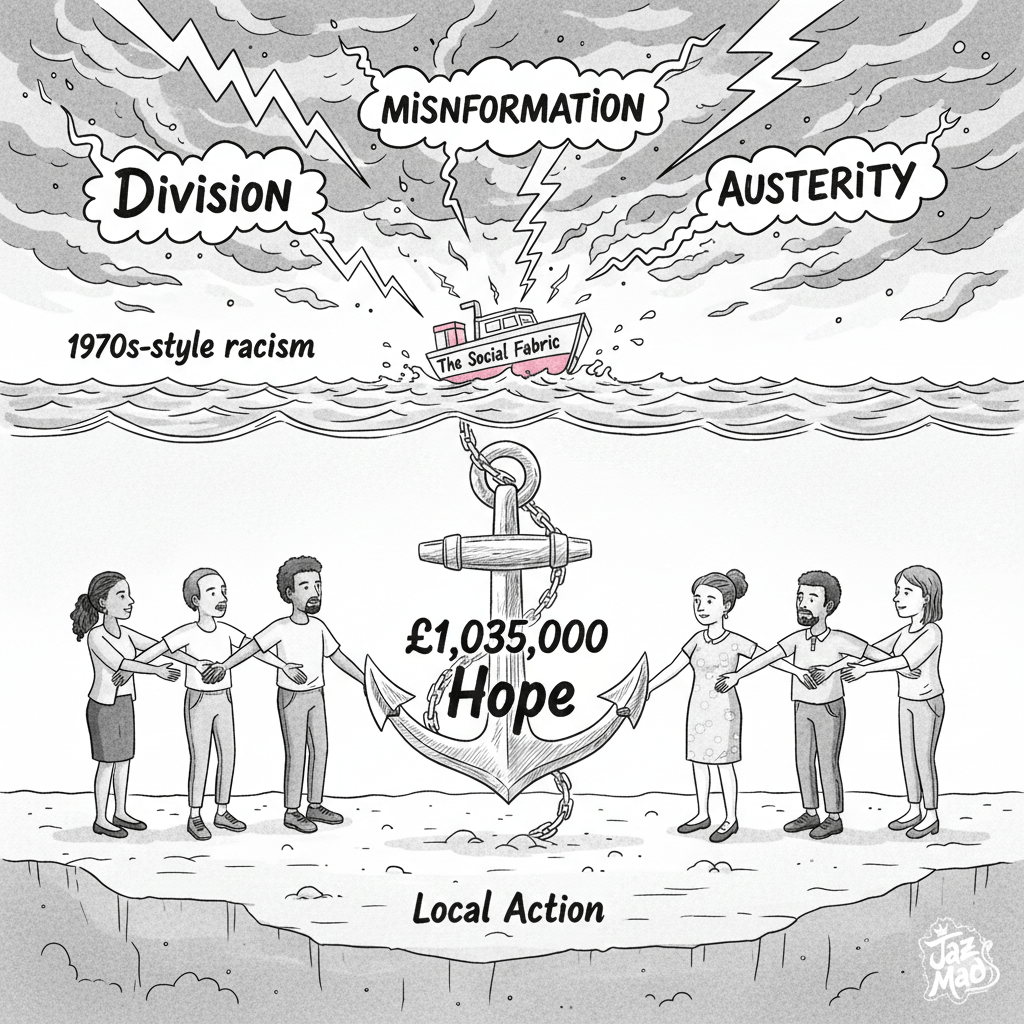
In the wake of a year scarred by extremist violence and the resurgence of what Guardian editor-in-chief Katharine Viner termed “1970s-style racism,” the UK voluntary sector has found itself at a crossroads. The 2025 ‘Hope’ appeal, however, has provided more than just a financial lifeline; it has delivered a potent strategic counter-narrative to the toxic rhetoric that has increasingly dominated the public square. By the time the appeal closed in January 2026, it had mobilised over 10,000 donors to raise £1,035,000—a milestone that signals a profound public appetite for grassroots resilience over state-level stagnation. This is not merely a fundraising success; it is an essential intervention in a climate where the demonisation of migrants and the erosion of civic infrastructure have threatened to tear the social fabric apart.
The Anatomy of a £1 Million Success: Journalism as Philanthropic Catalyst
The success of the ‘Hope’ appeal demonstrates the unique capacity of investigative journalism to convert passive concern into high-impact social capital. Throughout the campaign, the Guardian utilised its reporting as a strategic engine, with senior figures like Polly Toynbee, John Crace, and Patrick Wintour taking to the phones during a high-energy telethon to engage directly with the public. This wasn’t just about visibility; it was about leveraging journalistic weight to validate the work of the “frontline.”
The data reflects a sophisticated level of engagement from the British public. With nearly 11,000 donations and an average gift of approximately £80, the appeal showed that the commitment to community cohesion remains resilient despite a “broken economic model” and years of austerity. Crucially, 95% of these contributions were made online, suggesting that the voluntary sector can effectively bypass traditional gatekeepers to secure direct support. These funds now provide the operational capacity for five partner organisations—Citizens UK, The Linking Network, Locality, Hope Unlimited Charitable Trust, and Who Is Your Neighbour?—to scale interventions that treat empathy as a practical, logistical tool rather than a vague sentiment.
Strategic Analysis of the Five Pillars: A Frontline Defence
These five organisations represent a sophisticated defence against social erosion, each targeting a specific failure in the UK’s current civic infrastructure. By categorising their work, we see a multifaceted approach to rebuilding what years of political alienation have damaged:
- Educational Integration: The Linking Network, led by co-director Linda Cowie, has expanded its reach into 26 local authorities. By pairing schools of different faiths and socioeconomic backgrounds, the project moves beyond the classroom to build what Cowie describes as “empathy and understanding that lasts a lifetime.” In a period of increasing segregation, this school-based model is a strategic investment in the long-term cognitive resilience of the next generation.
- Democratic Empowerment: Citizens UK is utilising its share of the million-pound milestone to launch a “Power-Building Fund.” Under chief executive Matthew Bolton, this represents a significant shift away from Westminster-centric politics. By training community organisers to negotiate directly for better mental health services or cheaper bus fares—as seen in the North Shields “walk of hope”—the charity is mmodellinga new form of agency for those who feel abandoned by central government. Shifting power to community centres and places of worship is the sector’s direct response to the fragility of trust in national institutions.
- Facilitated Dialogue: The methodology of the “difficult conversation” has been championed by Who Is Your Neighbour? in South Yorkshire and Locality’s member, the 174 Trust in Belfast. Through the “Circle of Change,” facilitated by Tim Magowan, strangers from disparate backgrounds are brought together to undo preconceptions. As participant Maureen Hamblin noted, the process “humanised us all.” These interventions provide a necessary outlet for grievances regarding the decline of traditional industries, moving dialogue away from the “shrill white noise” of social media.
- Hyper-Local Grant Making: Hope Unlimited Charitable Trust, chaired by Gurinder Josan Singh, acts as a vital bridge for small-scale initiatives that often fall through the gaps of institutional funding. A prime example is the Salaam Shalom Kitchen in Nottingham—a joint Muslim-Jewish venture that provides shared meals. By funding hyper-local priorities on their own terms, Hope Unlimited ensures that the “beating heart” of local resilience is not starved of the capital required to survive.
Impact and Implications: Beyond the Balance Sheet
For the voluntary sector, the “Hope” appeal has generated a secondary currency that is often more valuable than cash: visibility and legitimacy. Social policy editor Patrick Butler has noted that the appeal acted as a “multiplier,” triggering a surge in direct website donations and volunteer interest that far exceeded the initial campaign targets. Perhaps most significantly, the reporting led to increased engagement from Members of Parliament, effectively forcing grassroots concerns onto the legislative radar.
The ethos of this mobilisation is grounded in the belief that civil society must lead where the state has retreated. As Father Chris Hughes of Tyne & Wear Citizens reflected, the appeal proved that “you can give people a sense of hope” through practical action. This sentiment was echoed by Pete Brierley, Citizens UK Director, who argued that the sector must now “roll up its sleeves” to model a politics based on listening and the common good.
The Antidote to a Toxic Climate: Context and Background
The necessity of this £1 million intervention is underscored by the historical context of the 2024 riots. In places like Sunderland and Liverpool, the erosion of communal spaces and the spread of social media misinformation created a vacuum filled by far-right rhetoric. Investigative reporting by Josh Halliday and films by Taj Ali have highlighted how these “toxic narratives” were countered not by rhetoric, but by physical presence—such as faith groups gathering to protect a refugee support centre in Liverpool.
By addressing the systemic issues cited by Katharine Viner—deep-rooted poverty, a broken economic model, and the resurgence of extremist marches—the appeal serves as a reminder that community pride and tolerance are the only sustainable defences against hatred. Whether it is revitalising a neighbourhood in Sunderland via Locality’s “Back on the Map” or children learning together in Bradford, these projects provide the “antidote to despair” that top-down policy has failed to deliver.
The Future of Hope: A Strategic Blueprint
The 2025 appeal serves as a blueprint for future sector solidarity, demonstrating that the voluntary sector can challenge national narratives through hyper-local action. As we move into 2026, the sector must monitor the scaling of these training and dialogue models. The transition from fundraising to implementation will see thousands of new community leaders trained and hundreds of facilitated dialogues taking place in areas once defined by silence or anger.
Ultimately, the ‘Hope’ appeal reinforces a fundamental truth for UK policy-makers and trustees alike: community is the beating heart of a fairer society. In an era of political instability, investing in these grassroots anchors is no longer a philanthropic luxury—it is a strategic necessity for the survival of a unified, resilient Britain.