Sector Calls for Better Development and Removal of Barriers for Trustees
The Governance Gap
The strategic leadership of trustees has never been more vital for the UK charity sector. As organisations grapple with rising demand and persistent financial strain, it is their boards that are tasked with navigating the complex path to sustainability and impact. Yet, a widespread and deepening crisis in trustee recruitment and development is leaving this critical function dangerously exposed. Recent studies reveal a stark reality: surveys from the NCVO and Pro Bono Economics show that nearly four-in-five (79%) and 63% of charities, respectively, report at least one board vacancy, indicating that governance structures are becoming incomplete and vulnerable. The recent closure of the specialist trustee recruitment charity ‘Getting on Board’ underscores the challenging environment. A growing chorus of voices from across the sector is now calling for a fundamental rethink of how trustees are recruited, trained, and supported to avert a more profound governance crisis.
The Scale of the Vacancy Crisis
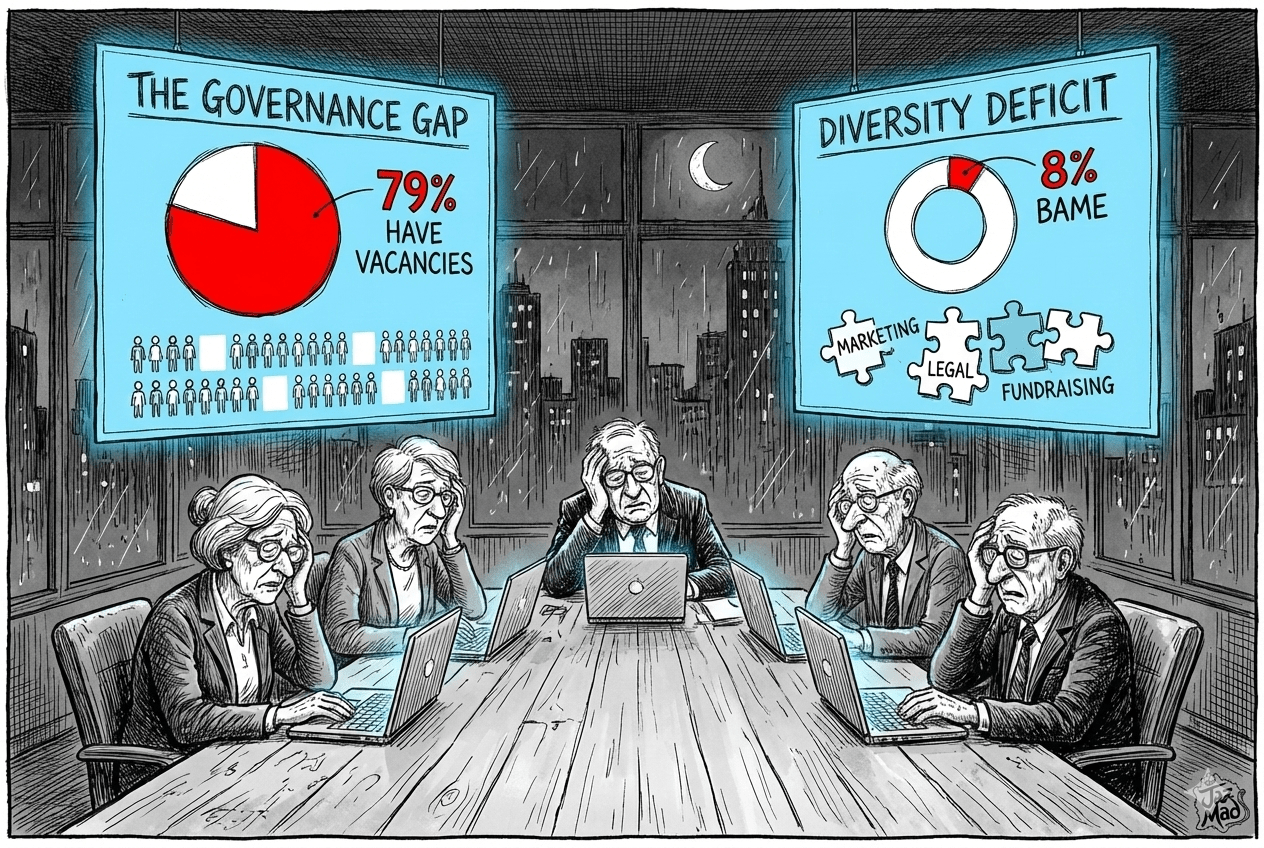
The shortage of trustees is not a temporary fluctuation but a chronic, structural problem. A landmark survey by the National Council for Voluntary Organisations (NCVO) found that a staggering 79% of charities have at least one board vacancy, with over half (62%) reporting two or more. The persistence of these gaps is equally concerning, as more than a third of these vacancies (35%) have been open for over a year. This crisis disproportionately affects smaller organisations, with the NCVO report highlighting that micro and small charities are more likely to have long-term vacancies and feel the negative impacts more acutely.
These are not just empty chairs; they represent critical gaps in expertise. Across multiple reports, boards consistently lack the high-demand skills essential to modern charities. Marketing and communications is the most common deficit, cited by 49% in one survey and 39% in another, followed closely by a lack of fundraising and income generation (44%), legal (41%), and technology skills (41%). These gaps in personnel and expertise have a tangible and damaging effect on both a charity’s day-to-day operations and the well-being of those left to manage an unsustainable workload. Critically, these skills gaps are not random; they are a direct and predictable consequence of the outdated recruitment practices that dominate the sector, a problem that demands urgent diagnosis.
The Human and Operational Cost of Ineffective Governance
The impact of these vacancies and the resulting governance failures extends far beyond statistics, inflicting real harm on organisations and their people. An anonymous post from a staff member at a small UK charity on the network CharityConnect provides a harrowing case study of what happens when governance completely breaks down. The staff member described a board that consistently overstepped into operational matters, fostered a culture of micromanagement and mistrust, blocked crucial structural improvements, and fundamentally failed in its safeguarding duties. The post details the severe emotional toll on staff, culminating in one manager breaking down and confiding suicidal thoughts—an incident that triggered no safeguarding action or policy review from the board.
“It’s created a culture of surveillance and mistrust. One former manager broke down due to this pressure and confided suicidal thoughts to me. I was left untrained and unsupported, and the trustees took no safeguarding action. No debrief, no policy review, no acknowledgement.”
— Anonymous Post, CharityConnect
This is not an isolated incident but an extreme example of systemic pressures. The NCVO survey quantifies the widespread stress caused by board vacancies, with 45% of charities reporting that they cause stress and anxiety—a figure that rises to 58% for small charities. Furthermore, these gaps directly impede organisational effectiveness, with 43% of charities stating that vacancies limit their ability to follow good governance practices and 60% saying they prevent them from developing as an organisation. What, then, are the root causes of these catastrophic failures in recruitment and governance?
Diagnosing the Cause 1: Outdated Recruitment and the Diversity Deficit
A primary driver of the crisis is the sector’s long-standing reliance on outdated and informal recruitment methods. Research from the Charity Commission is damning, revealing that only 6% of trustees applied for their role via an advertisement. More than half were recruited from the personal contacts of the chair or existing board members.
This inward-looking approach actively stifles diversity and perpetuates homogenous boards. As Malcolm John, founder of Board Racial Diversity UK, asserts, informal recruitment “inevitably perpetuates the status quo.” The result is a significant diversity deficit. Statistics show that only 8% of trustees are from Black and Asian backgrounds, well below the 17% required for proportional representation of the UK population.
In response, the Charity Commission has refreshed its core guidance on recruiting trustees (CC30). The regulator is now actively encouraging charities to conduct skills audits, improve their role descriptions, and advertise positions widely to break down barriers. As Mazeda Alam, the Commission’s Head of Trustee Guidance, explained, the goal is to help boards “widen the net and land you a valuable, new addition.” But while fixing recruitment is a critical first step, the problems for many trustees are only just beginning once they join a board.
Diagnosing the Cause 2: The Trustee Development Deficit
Coupled with poor recruitment is a systemic failure in trustee development, creating a cycle of underperformance and low retention. Governance consultant Penny Wilson describes the all-too-common experience:
“This is the typical journey of a trustee: we’re asked to join a board with no process… We then get little to no induction. We have no expectation that we will access any learning and development.”
This lack of professional support is directly linked to critical governance failures. Boards frequently make fundamental errors, such as failing to understand fiduciary duties and neglecting their safeguarding responsibilities. It is hardly surprising, given that a 2024 BMG report found two-thirds (66%) of trustees had never even heard of the Charity Commission’s essential 5-minute guides—the very resources designed to explain these core concepts. Perhaps more worryingly, of those who don’t use official guidance, 58% said they didn’t think they needed it, revealing a dangerous gap in both the provision of training and the perceived need for it.
Holly Riley, a strategic policy lead at the Charity Commission, has noted that this lack of development opportunity contributes to high turnover, with many trustees leaving after just one year. This is compounded by the fact that ‘time requirements’ were cited by 51% of charities as the single most significant barrier to retention, making it even harder for dedicated but overstretched volunteers to undertake the very training they need to be effective.
Conclusion: A Call for a New Approach to Trusteeship
The UK charity sector is confronting a systemic governance challenge, rooted deeply in outdated recruitment practices and a severe deficit in trustee development. The evidence is clear: informal, network-based hiring has created boards that lack essential skills and fail to reflect the communities they serve. This is compounded by a near-total absence of structured induction and ongoing training, leaving well-meaning volunteers unsupported and charities exposed to unacceptable risks. To build a more resilient and effective sector, a fundamental shift is required. This must begin with a sector-wide commitment to formal, open, and targeted recruitment, alongside urgent investment in robust induction processes and continuous professional development. Addressing these deep-seated issues is not merely an administrative task; it is a strategic imperative for building charities capable of meeting future challenges and earning the public’s trust that they exist to serve.