The Partnership Playbook: How a London NHS Trust is Building Resilience Through Strategic Alliances
The Partnership Imperative
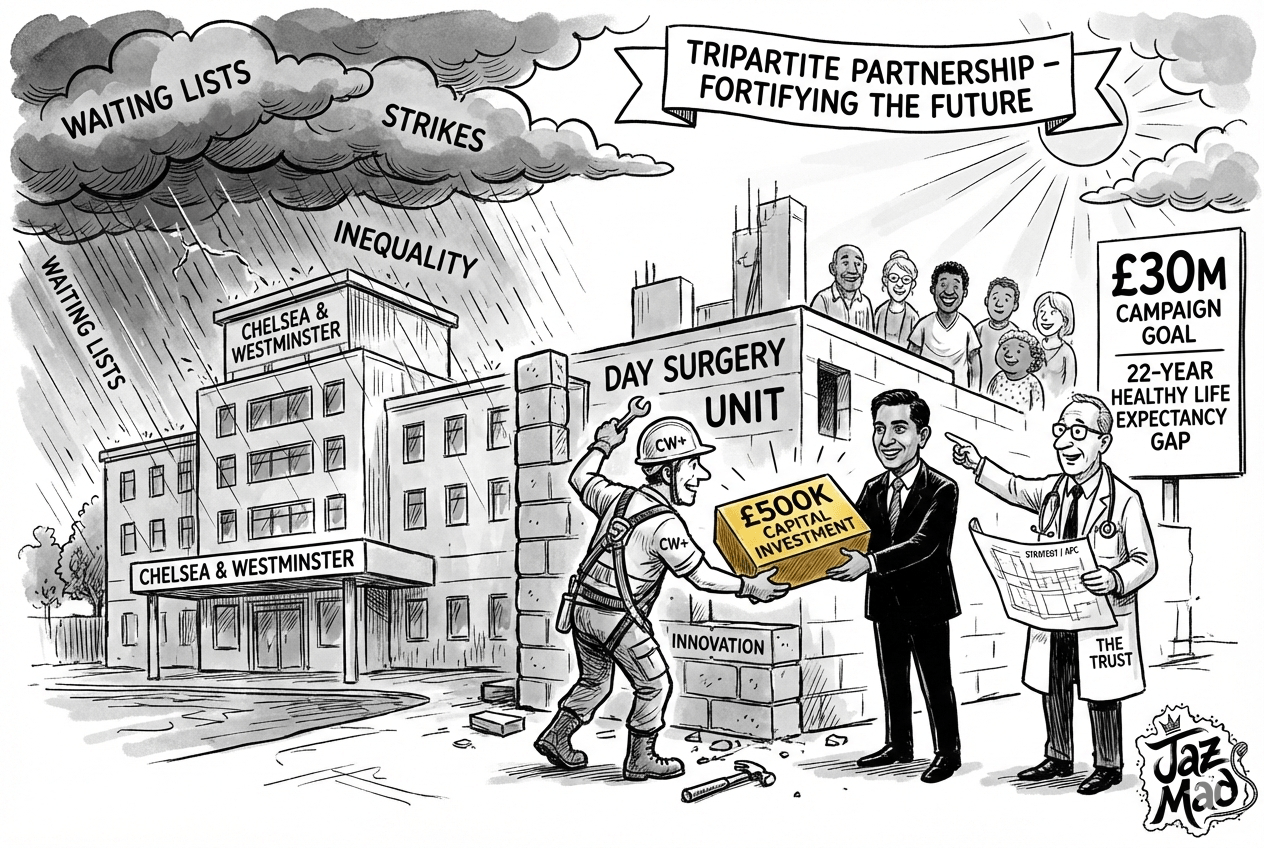
Faced with “incredibly busy” hospitals and the relentless impact of industrial action, it would be easy for an NHS Trust like Chelsea and Westminster Hospital NHS Foundation Trust (CWHFT) to be purely reactive. Instead, it is pioneering a powerful response that holds vital lessons for the entire charity sector. This tripartite partnership model—combining the strategic direction of the Trust, the innovative drive of its official charity CW+, and the catalytic investment of major philanthropic funders—is emerging as a strategic necessity for navigating modern healthcare challenges. A compelling example of this synergy is a recent £500,000 grant from Kusuma Trust UK to CW+ for a new Day Surgery Unit (Treatment Centre). This alliance showcases a sophisticated approach to tackling systemic pressures and provides a blueprint for how integrated partnerships can deliver profound public benefit.
Navigating the Storm: A Trust’s Response to Systemic Pressure
To fully appreciate the significance of this tripartite model, it is crucial to first understand the scale of the challenges CWHFT is navigating. Like many NHS organisations, the Trust faces a complex web of performance targets, deep-seated societal issues, and the need for greater system-wide efficiency.
A Perfect Storm of Pressure
The Trust’s performance on key metrics, such as the elective referral to treatment (RTT) 18-week wait and the A&E 4-hour performance, is described as “challenging”. These pressures are compounded by the significant impact of junior doctors’ industrial action, which has made reducing long waits increasingly difficult.
Beyond the hospital walls, CWHFT serves a highly diverse community where significant health inequalities persist. There are stark differences in healthy life expectancy between the most and least deprived areas; in the most deprived areas, men live 22 fewer years in good health, and women 21 fewer years, than in the most affluent areas. This context makes the Trust’s commitment to tackling inequities not just a strategic priority but a moral imperative.
The Response: Collaborating to Survive
But the Trust is not weathering this storm alone. Its primary strategic response has been to embrace deep collaboration. It is a key member of the North West London Acute Provider Collaborative (APC), working alongside three other acute NHS trusts to improve care and efficiency across the region. This is not just a theoretical alliance; it has delivered tangible, large-scale projects designed to address core challenges:
- The North West London Elective Orthopaedic Centre: A direct strategic response to challenging elective care waiting times, this new centre of excellence brings together routine orthopaedic procedures, allowing the collaborative to treat more patients efficiently and reduce the risk of cancellations due to emergency care pressures.
- Community Diagnostic Centres (CDCs): In a powerful example of the collaborative strategy directly addressing a core socio-economic problem, new CDCs have been opened in Willesden and Wembley. These have been specifically “located in areas that serve communities most at risk of health inequalities,” bringing vital services closer to those who need them most.
- A Single Electronic Patient Record (EPR): Now covering all 12 hospitals across the four trusts, the unified EPR system is improving continuity of care for patients and creating enormous potential for data-led research and service improvement.
This collaborative ecosystem provides the foundation for the Trust’s own charity to build on, acting as a pivotal partner to accelerate progress and drive innovation.
The In-House Engine: How CW+ Drives Innovation and Wellbeing
Integrated directly within the Trust’s structure, CW+ operates not merely as a fundraising arm but as an essential engine for innovation, patient experience, and staff wellbeing. It is a vital partner, embedded in the day-to-day life of the hospitals and actively shaping the future of care.
The charity’s ambition is demonstrated by its “Thirty at Thirty” campaign, launched to mark Chelsea and Westminster Hospital’s 30th birthday. With a goal of raising £30 million, the campaign aims to create world-class facilities, drive research, and enhance patient and staff wellbeing. It was kick-started with a sponsored abseil down the side of the hospital, where nearly 60 staff members raised an incredible £42,000—a powerful symbol of community and staff engagement.
As Chloe Roberts, Public Fundraising Manager at CW+, notes, the charity’s work is about much more than money:
“Our challenge events are about bringing people together to support their local hospital… as you raise funds that make a real difference to patients and staff.”
This commitment to making a tangible difference is evident in the diverse range of projects CW+ funds, translating philanthropic income directly into service improvements that solve specific problems:
- Digital Inclusion: Supporting an award-winning project to tackle health inequalities by improving patients’ access to digital healthcare services and information.
- Youth Mental Health: Co-delivering “Best For You,” a partnership with other Trusts that has opened ‘Arc, a pioneering community service for young people with eating disorders, which aims to “reduce hospital admissions” and ease pressure on acute services.
- Clinical Innovation: Funding a pilot for using mobile devices for nursing on wards, a project that improves patient interaction as it “removes the need for large computers on wheels which can act as a barrier between nurses and patients.”
- Patient Experience: Awarding small “booster” grants for items like sensory toys for blood tests and white noise devices to help patients sleep, improving the small but crucial details of a hospital stay.
It is this proven ability to identify needs and deliver high-impact projects that makes CW+ such an attractive partner for major external funders.
The Philanthropic Catalyst: Securing High-Impact Investment
The final layer of this partnership model involves securing strategic investment from external philanthropic bodies to scale the impact of an in-house charity exponentially. The relationship between CW+ and Kusuma Trust UK serves as an exemplary case study in securing a major, transformative gift.
Details revealed in Kusuma Trust UK’s accounts for the year ending 31 December 2024 show a targeted £500,000 grant awarded to CW+ for a Day Surgery Unit (Treatment Centre), with the agreement noting a start date of 28 November 2024. This is not just a generous donation; it is a targeted investment that directly addresses one of the Trust’s most significant operational challenges: elective care waiting lists.
For the charity sector, the nature of the funder provides a crucial lesson for fundraisers. Kusuma Trust UK is a “family-led philanthropic trust” whose priority areas include “Health and Wellbeing.” Critically, its operational model offers a key insight into modern philanthropy: it does not accept unsolicited applications. Instead, its team identifies partners “through various networks, event participation, [and] recommendations from advisors.” This underscores the importance for charities like CW+ of building a strong reputation, demonstrating clear impact, and cultivating relationships within philanthropic circles.
The strategic significance of this specific grant is profound. By funding a new Day Surgery Unit, Kusuma Trust UK is providing the capital for infrastructure that will increase surgical capacity, improve efficiency, and ultimately help CWHFT treat more patients. This single grant exemplifies the powerful synergy between an NHS Trust with a clear need, a dedicated charity with the capability to deliver, and a strategically aligned foundation providing the catalytic funding.
A Blueprint for the Future? Impact and Long-Term Significance
The model being refined at Chelsea and Westminster Hospital NHS Foundation Trust offers a powerful response to the enduring pressures on the NHS. By combining internal collaboration (the APC), an embedded innovation engine (CW+), and targeted external philanthropy (Kusuma Trust UK), it elevates the hospital charity from a traditional fundraiser to a central, strategic partner. In her annual report statement, Chief Executive Lesley Watts explicitly acknowledges the “excellent support of our partners… in the voluntary sector,” highlighting the value placed on these relationships at the highest level.
In an era where the NHS cannot meet mounting pressures alone, this tripartite model is not just a blueprint for resilience; it is emerging as an essential strategy for survival and innovation. The question for other healthcare charities is no longer if they should adopt such a model, but how.