Big Give’s £57.4m Christmas Miracle: How Match Funding Defied the UK’s Charitable Giving Slump
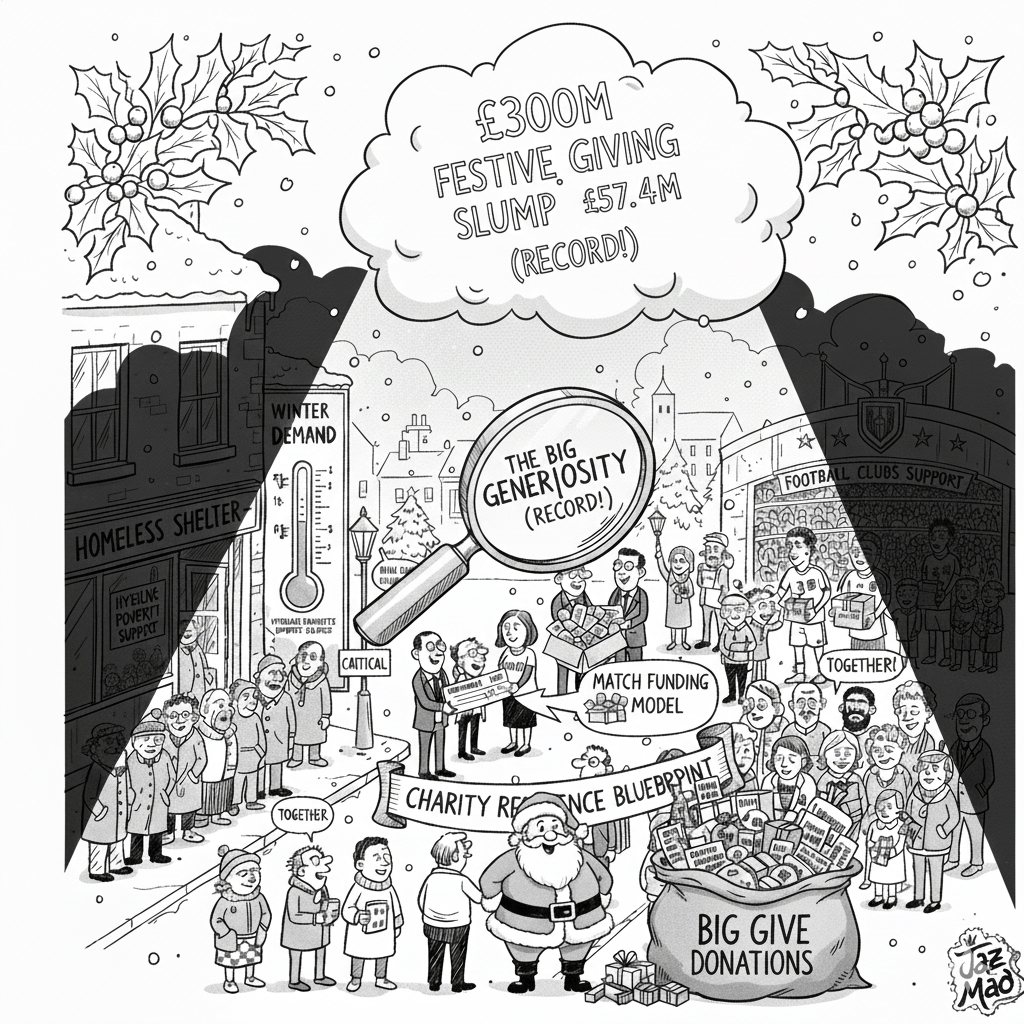
For charity leaders facing a projected £300 million drop in festive giving, Big Give’s £57.4 million haul can inspire confidence. Navigating a sector with rising operational costs and declining donations requires resilience and innovation. This story of success offers reassurance and hope, emphasising that strategic efforts can still deliver impactful results.
In a remarkable display of collective generosity, the campaign raised a record-breaking £57.4 million in just one week. This achievement is stunning on its own, but when juxtaposed with the latest research from the Charities Aid Foundation (CAF)—which predicts a staggering £300 million fall in festive donations for 2025—it becomes a powerful counter-narrative. At a time when the sector is bracing for a bleak midwinter, the Big Give’s result offers a vital story of hope. It signals that even in a challenging climate, the proper mechanism can unlock immense public goodwill and deliver transformative results.
This article will unpack the details of this extraordinary achievement, examining the figures, the context, and the powerful psychology of match funding to understand how this seven-day phenomenon was possible.
A Seven-Day Fundraising Phenomenon
To grasp the full significance of the Big Give’s 2025 Christmas Challenge, it is essential to first understand the sheer scale of the achievement. The seven-day campaign, which concluded at midday on Tuesday, 9th December, secured a total that cements its status as the UK’s biggest public fundraising campaign for the second consecutive year, surpassing established national telethons like Children in Need. The final £57.4 million tally, a formidable 28% increase on the previous year, was the result of a vast ecosystem firing on all cylinders. A record 1,591 charities were supported by over 152,000 donors, with the entire effort anchored by an unprecedented £25.8 million in match funding from Big Give’s Champion partners—a coalition of philanthropists, foundations, and companies.
The impressive numbers are the result of a carefully crafted fundraising model. Recognising why this model works can empower charity leaders and fundraisers to adopt similar strategies, fostering confidence in their ability to succeed despite sector challenges.
A Perfect Storm for the Third Sector
The Big Give’s record-breaking success was not achieved in a vacuum. It stands in stark contrast to the hostile economic and social environment currently confronting the UK’s third sector. Understanding this context is crucial to appreciating the magnitude of the campaign’s accomplishment and its potential lessons for other charities.
Data from across the sector describes a “perfect storm” of converging pressures. Research from the Charities Aid Foundation (CAF) forecasts a £300 million drop in festive donations for 2025. This is part of a wider, worrying trend: the proportion of people giving to charity has fallen from 65% in 2019 to just 50% in 2024, with a particularly sharp drop in the number of young donors. This decline in income is colliding with a crisis of capacity: 44% of charity leaders cite increased costs as a primary challenge, while an overwhelming eight in ten charities report an increase in demand for their services.
This confluence of falling income and rising need is pushing many organisations to the brink. As Nicholas Connolly, chief executive of the homelessness charity EveryYouth, powerfully articulated, charities are facing “a perfect storm” where “reserves are being decimated.”
Against this backdrop of systemic strain, the £57.4 million raised by the Christmas Challenge demonstrates that public generosity is still accessible. To replicate this success, charities should consider adopting strategies like effective match funding, engaging storytelling, and donor engagement tactics used by Big Give. This raises the critical question: how can your organisation implement similar approaches to unlock generosity?
Deconstructing the “Generosity Multiplier”
The success of the Big Give’s Christmas Challenge is rooted in the powerful psychological mechanism of match funding, which may raise questions about its scalability for smaller charities. Exploring how this ‘generosity multiplier’ can be adapted for organisations with fewer resources can help other charities understand its broader applicability and potential for impact.
Research commissioned by Big Give, detailed in the “A Great Match” report by Dr Catherine Walker, provides compelling evidence of the model’s power. An overwhelming 84% of donors said they were more likely to give because their donation would be matched. The model also increases gift size: the average matched donation on the Big Give platform stands at £333, a full 2.5 times the average unmatched gift of £132. Crucially, over a third of donors (36.5%) stated that they only gave because their donation would be doubled. Taken together, this data reveals a powerful triptych of donor motivation: matching removes hesitation, magnifies intent, and, for a critical mass of givers, creates an imperative to act where none existed before.
The benefits extend directly to the participating charities. A 2024 survey of organisations that took part found that 94% received donations from new supporters and 91% gained confidence in their online fundraising abilities, equipped with free resources from Big Give.
Expert analysis corroborates these findings. Dr Beth Breeze, Director of the Centre for Philanthropy at the University of Kent, notes that the model “chimes very much with the feeling people have at the moment of wanting their charitable donations to go as far as possible.” Meanwhile, David Warner, Director of London Funders, points to a broader strategic imperative: “funders need to collaborate more because there’s less money around,” a need that the Big Give’s collaborative model directly addresses.
The model’s success is therefore not just theoretical. It is a proven, data-backed strategy brought to life by the people, philanthropists, and charities it empowers.
Personal Stakes and Transformative Impact
Beyond the data and strategic analysis, the true power of the Christmas Challenge is found in the human stories behind the campaign. From the poignant dedication of its leadership to the tangible impact on beneficiaries, these voices illustrate the profound difference that collaborative fundraising can make.
This year’s campaign held a special poignancy for James Reed, Chair of Big Give. His father and the organisation’s founder, Sir Alec Reed, passed away on Giving Tuesday—the first day of the campaign. This personal loss galvanised the campaign’s purpose. James Reed noted that his father founded Big Give on the belief that “generosity is contagious,” and called the record result “a remarkable testament to his vision and his legacy.” This legacy is now enshrined in an ambitious new goal: for Big Give to raise £1 billion by 2030.
Those on the front lines best articulate the real-world effect of the campaign. Ambassador Michelle Collins described the model for theatre company Chickenshed, which raised its £42,000 target, as “transformational,” highlighting its power to give “every donor the chance to make twice the difference”—a proposition she labels “incredibly special.” Similarly, broadcaster and author Rob Rinder, president of the Orion Orchestra, described the funds raised as “genuinely transformative.” For the Orion Orchestra, this means the £10,045 raised translates directly into mentorship opportunities and first professional performance experiences for young musicians who might otherwise have been lost to the sector. The impact was felt across the sector, with charities like Young Minds smashing its £100,000 target to raise an incredible £114,258.
This success was made possible by a wide network of supporters. High-profile ambassadors, including Gary Lineker, Dame Judi Dench, and Dame Prue Leith, lent their voices to the campaign. Yet, at the core of the financial model are the philanthropic “Champion partners” such as The Reed Foundation and The Julia Rausing Trust, whose foundational contributions make the doubling of public donations possible. These voices collectively paint a picture of a campaign with deep personal stakes and a far-reaching impact that will resonate across the sector for years to come.
A Blueprint for Resilience?
The Big Give’s £57.4 million achievement is far more than just a successful fundraising campaign; it is a powerful counter-narrative to the prevailing story of decline. In a period marked by donor fatigue and economic anxiety, it proves that public generosity remains a deep well, provided charities have the right tools to tap into it. The collaborative match-funding model stands out as a proven and replicable blueprint for resilience. It demonstrates that by making giving feel more impactful, charities can inspire more people to give, and to give more. For charity leaders questioning how to navigate the perfect storm, this success offers a clear lesson: collaboration, strategic urgency, and a compelling, amplified value proposition can turn the tide. As Big Give pursues a £1 billion goal, the question for every other charity is no longer if resilience is possible in this climate, but whether they have the strategic courage to build it.