A Question of Burden: New Charity Accounting Rules Pit Transparency Against
Reality
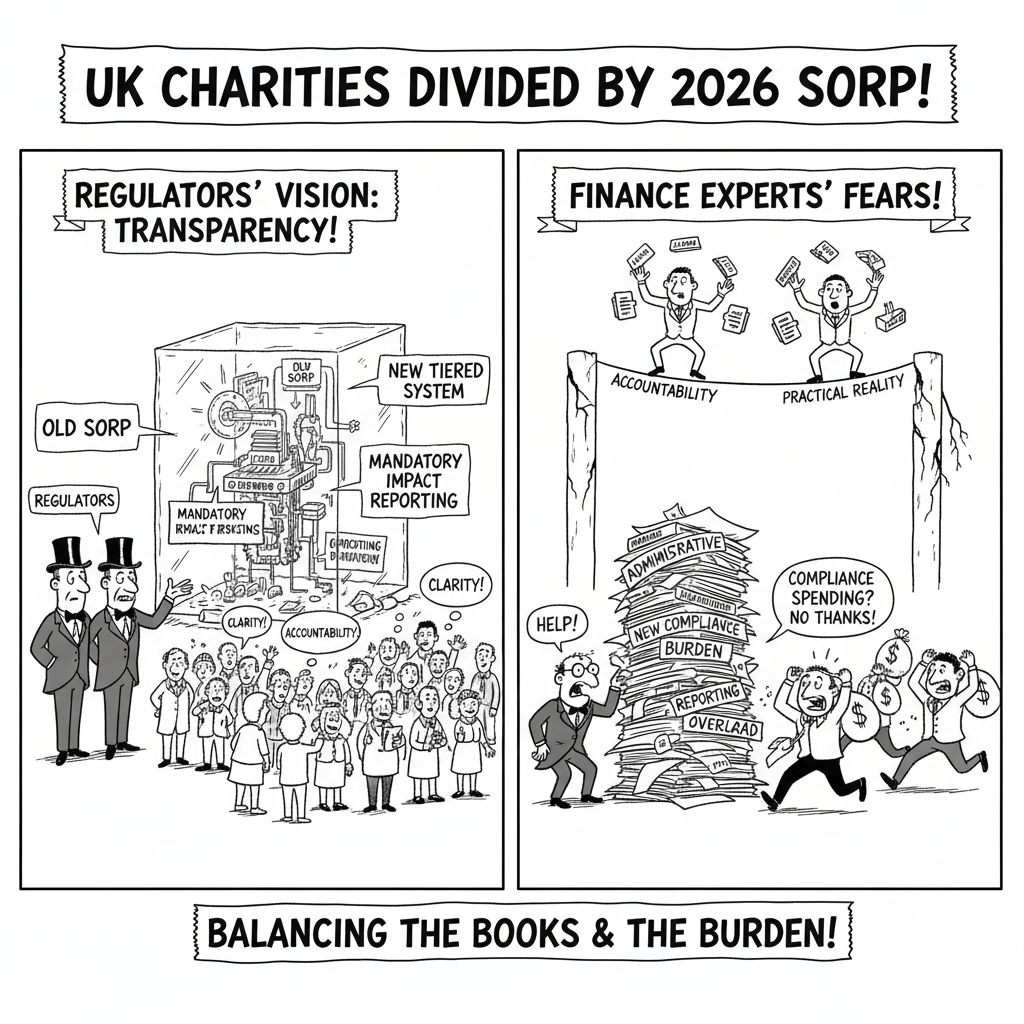
A Sector Divided Over New Accounting Rulebook
The finalisation of the new 2026 Statement of Recommended Practice (SORP) marks the most significant overhaul of charity accounting in years. Regulators have championed the changes as a crucial step towards greater transparency, proportionality, and public trust. However, far from being universally welcomed, the new rulebook has exposed a deep rift within the sector. Many of the UK charity’s most prominent leaders and finance experts are raising the alarm, warning of an escalating administrative burden, unworkable requirements, and potentially damaging unintended consequences. As the sector grapples with these sweeping reforms, the central conflict—between the laudable goal of accountability and the practical reality of compliance—has never been more critical for the UK’s charity professionals, trustees, and policymakers.
The New Financial Framework: What’s Changing?
To understand the controversy surrounding the 2026 SORP, it is first essential to grasp the fundamental changes it introduces. The new rules, effective for all accounting periods from 1 January 2026, were developed with the stated aim of creating a more proportionate, clear, and transparent reporting landscape that better serves the needs of donors and the public.
Core Changes
Synthesising the final framework and consultation feedback, the key updates include:
- A New Tiered System: A three-tier structure has been introduced based on annual income (Tier 1: up to £500,000; Tier 2: £ 500k- £ 15 m; Tier 3: above £15m). This is intended to make reporting requirements more proportionate to a charity’s size and complexity.
- Major Accounting Updates: The SORP now incorporates significant changes from FRS 102, introducing new requirements for lease accounting and a five-step revenue recognition model.
- Reporting Simplifications: The detailed statement of cash flows, previously a complex task for many, is now only mandatory for the largest charities in Tier 3, reducing the reporting burden on thousands of Tier 2 organisations.
- Trustees’ Annual Report: The report has been restructured with dedicated sections for impact reporting, and a new requirement for Tier 3 charities to report on sustainability (ESG issues), which is encouraged for Tiers 1 and 2 as well.
The Official View
From the regulators’ perspective, these changes are vital for the health and credibility of the sector. David Holdsworth, Chief Executive of the Charity Commission for England and Wales, stated that, “Clear and transparent reporting is essential to maintaining public trust in charities.” He added that the updated SORP is designed to help organisations “communicate both their financial position and the impact of their work more effectively.”
This official rationale, however, stands in stark contrast to the critical response from many of those tasked with implementing it.
A Rising Tide of Complexity and Concern
Despite the stated objective of simplicity, many charity finance experts’ initial reaction has focused on the growing complexity and sheer length of the new framework.
Analysis of the Burden
The new SORP has expanded significantly, ballooning from around 200 pages in the previous version to over 300. This increase has not gone unnoticed. Richard Bray, chair of the Charity Tax Group, voiced a common concern, noting that while there has been “a lot of tidying up,” the document has grown substantially and “some of the fundamental issues that face charity accounting at the moment haven’t been addressed.” These include, he specified, “the complexities that come from the new lease accounting and from having to follow the new requirements about income recognition.”
This sentiment was echoed by Fiona Condron, national head of charities at BDO, who highlighted the practical challenge for finance teams. She pointed out that charities must now navigate the 300-page SORP while also keeping the “similarly sized FRS 102 document” close at hand to understand the full scope of their obligations.
Specific criticisms have been levelled at the new tiered structure. In its formal consultation response, the Charity Finance Group (CFG) reported that while its members overwhelmingly support the idea of tiers, they believe the proposed income thresholds are flawed. The primary concern is the breadth of Tier 2, which covers organisations with incomes ranging from £500,000 to £15 million. The CFG argues that this imposes disproportionately onerous requirements on charities at the lower end of the spectrum, whose operations are vastly different from those at the top end. To reinforce the theme of administrative burden, the CFG noted that “many members thought it would be preferable to have separate SORP publications for each tier,” a move they believe “would drastically reduce the length of the overall SORP for each charity.”
Other specific concerns raised by the CFG include the impracticality of new volunteer disclosure rules and a call to raise the £60,000 remuneration disclosure threshold to ease the administrative burden, acknowledging the sector’s real operational challenges.
The new impact reporting rule, mandating all charities to report on their impact, has sparked intense debate about its practicality and usefulness for Stakeholders.
The new rule, stating impact reporting will be ‘a must’ for all charities, aims to build trust but may leave the sector feeling uncertain about its value and practicality, which is essential for fostering confidence among stakeholders.
The Case Against
Leading the criticism is Debra Allcock Tyler, chief executive of the Directory of Social Change (DSC), who has forcefully argued that the requirement is likely to “fail in its intent.” She predicts it will devolve into a “cut and pasted” statement, much like the generic declarations of public benefit that already populate thousands of annual reports.
Allcock Tyler illustrates her point with tangible examples of the difficulty, if not impossibility, of quantifying impact for many organisations. “How the hell do you do that as a church?” she asks. “Is it that the church officials have to stand around the collection box, nervously administering questionnaires that say: ‘On a scale of one to five, how much closer do you feel to God?’” Similarly, she argues that attempts to measure the impact of a youth club—whose value is often self-evident in its mere existence—could make young people feel “monitored and prodded.” Her memorable analogy captures the sector’s frustration: imposing such a rigid rule is like using “hobnail boots on a parquet floor.”
This practical critique is bolstered by a broader academic perspective. An article in the Stanford Social Innovation Review, “Ten Reasons Not to Measure Impact,” argues that true impact measurement requires proving causality by estimating what would have happened without the program—the “counterfactual.” This is an incredibly high bar that is often not the right tool for all organisations, especially if it distracts from essential operational monitoring and learning.
The Regulator’s Rebuttal
In response to this wave of criticism, regulators have acknowledged the risks but remain firm on the principle. The Charity Commission’s David Holdsworth conceded that the rule “can’t just be an annual tick-box” exercise. However, he urged the sector to engage deliberately and meaningfully with the challenge, framing the new mandate not as a bureaucratic hurdle but as “the exciting start of the conversation about impact reporting.”
This debate over the practicality of the new rules extends beyond the administrative effort, raising profound questions about the real-world financial consequences of these new compliance demands.
The Unintended Consequence: Could More Transparency Lead to Fewer Donations?
A critical, counterintuitive question is now emerging from the sector: could these well-intentioned regulations, designed to boost donor confidence, paradoxically lead to a drop in giving? The answer may lie in a phenomenon known as “compliance spending aversion.”
Exploration of “Compliance Spending Aversion”
Most fundraisers are familiar with “overhead aversion”—the tendency for donors to penalise charities for having high administrative or fundraising costs. However, a groundbreaking 2021 academic study published in the Journal of Behavioural Public Administration identified a near-identical bias: compliance spending aversion.
The study’s key finding is that donors penalise charities for costs associated with mandatory regulation, even when they understand these costs are outside the charity’s control. Regulators believe more granular reporting builds trust, but emerging behavioural science suggests donors may not distinguish between ‘good’ administrative spending (like mandatory compliance) and ‘bad’ administrative spending (inefficiency), penalising charities for both.
The implications for the new SORP are profound. The expanded, 300-page document, with its complex new requirements for lease accounting, impact reporting, and ESG disclosures, will inevitably increase the visible administrative and compliance burdens on charities. These costs must be reflected in their financial reports. The very act of complying with these new transparency rules could therefore make charities appear less efficient to potential donors, triggering this aversion and reducing overall donations. In a cruel twist of irony, a framework designed to strengthen public trust could undermine the sector’s financial resilience.
A Sector at a Crossroads
The 2026 SORP represents a pivotal moment for UK charities. While it aims for a more proportionate and transparent reporting regime, it has been met with significant and valid concerns regarding its escalating complexity, the practicality of its mandatory impact reporting, and the real-world risk of alienating donors through “compliance spending aversion.”
Looking ahead, the challenge of enforcement looms large. As Richard Bray of the Charity Tax Group warned, regulators “don’t necessarily have the resources to look at accounts in the way that ideally they should,” raising the prospect of widespread non-compliance. This concern was sharpened by BDO’s Fiona Condron, who contrasted “Companies House using AI to check the compliance of company accounts and the Charity Commission,” which she said were “worlds apart.” Such a gap in enforcement capability could undermine the sector’s credibility. While the new rules are now set, the fundamental debate about how to balance accountability with administrative reality is only just beginning. The sector will be watching closely to see whether regulators heed the growing calls for further reform and a more pragmatic approach to financial reporting.