A Drop in the Ocean? £100k Lifeline for Midlands Charities Highlights Systemic Underfunding of Women and Girls Sector
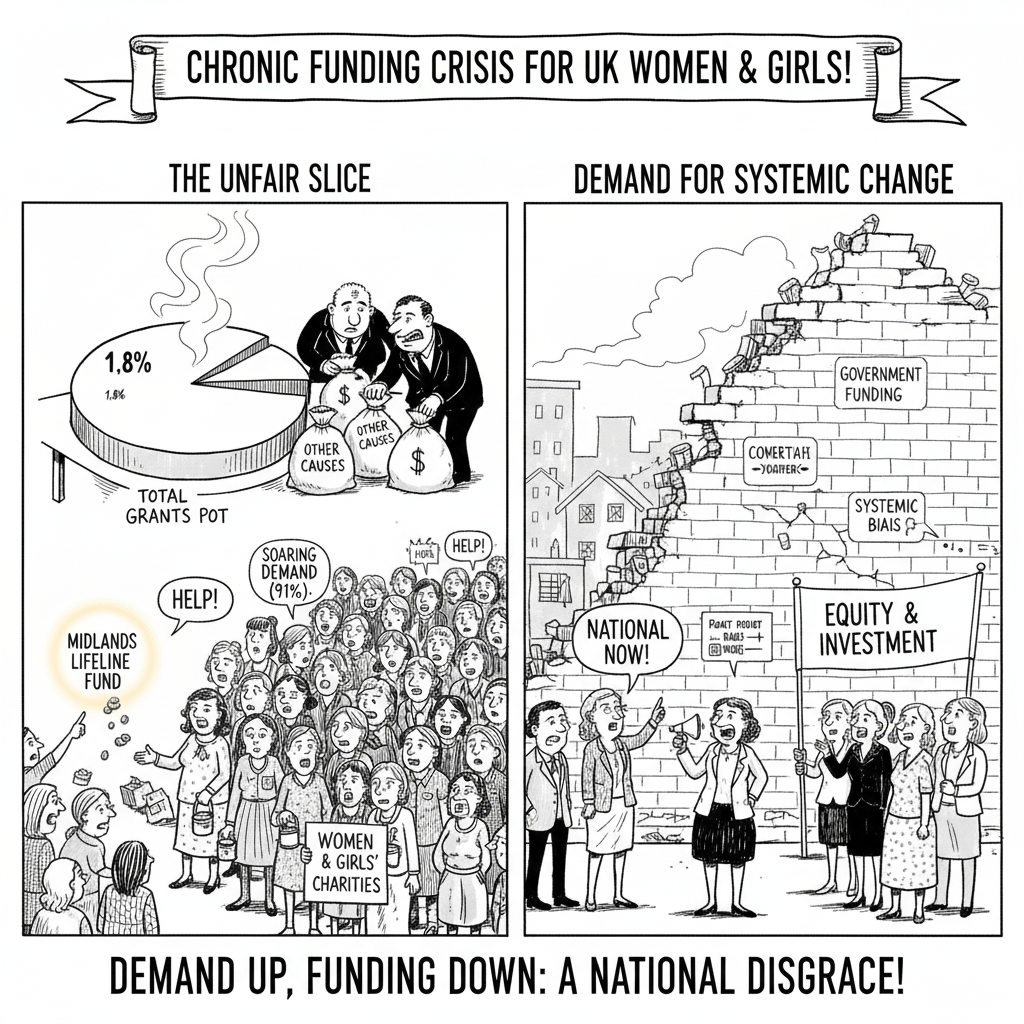
For the ten Midlands charities sharing a new £100,000 fund, the support is a vital lifeline. For the wider UK charity sector, it’s a stark reminder of a systemic crisis where women and girls’ organisations, making up 3.5% of charities but receiving only 1.8% of funding, face disproportionate challenges. The Heart of England Community Foundation’s recent grant distribution across the West Midlands and Warwickshire arrives against a bleak national backdrop. According to a landmark report from Women’s Funders Rosa, organisations dedicated to women and girls make up 3.5% of UK charities but receive a mere 1.8% of total grant funding. Simultaneously, research from Pro Bono Economics reveals that 91% of these organisations have reported a surge in demand. This local good news story, therefore, serves as a powerful case study, illustrating both the life-changing impact of targeted intervention and the profound, systemic crisis threatening the survival of essential services nationwide.
A Targeted Intervention: The Heart of England Fund
Community foundation-led initiatives are vital, but their local knowledge and agility alone cannot address the systemic funding crisis facing women and girls’ charities, calling for broader reform.
The fund was created after the Foundation identified a “significant decline in the funding available specifically for women and girls.” The details of the intervention highlight a proactive and community-driven approach:
- What: A £100,000 fund, distributed in grants of £10,000 to ten different charities.
- When: The announcement was timed for maximum impact, made on the International Day for the Elimination of Violence against Women.
- How: The Foundation demonstrated its own commitment by seeding the fund with £50,000 from its reserves, before impressively raising the remaining £50,000 from donors in just four months.
Crucially, the majority of the recipient charities will use the funds to cover the cost of core services and staffing. This type of unrestricted operational funding is the lifeblood of any organisation, but is notoriously difficult to secure in a funding landscape often geared towards new, project-based work. For these charities, £10,000 for core costs is not a ‘nice to have’; it is the financial bedrock that enables every other life-changing intervention.
The ten organisations receiving this vital support are:
- Anawim – Birmingham’s Centre for Women
- Birmingham and Solihull Women’s Aid
- Black Country Women’s Aid
- Coventry Haven Women’s Aid
- Coventry Rape and Sexual Abuse Centre
- Foleshill Women’s Training Limited
- RoSA
- Safeline
- The Esther Project
- WE: ARE Women’s Empowerment and Recovery Educators
But what does this relief look like on the ground? For frontline leaders, a £10,000 grant can mean the difference between a life-changing intervention and unmet needs, fostering hope and resilience.
Voices from the Frontline: The Impact of a £10,000 Grant
To truly understand the value of such funding, it is essential to listen to the voices of those who deliver the services. Their experiences translate financial figures into real-world impact, demonstrating how targeted grants can transform lives.
For a new organisation, securing foundational funding can be a monumental challenge. Lianne Kirkman, founding director of The Esther Project, a recipient of the Heart of England fund that supports women facing complex challenges like domestic abuse and homelessness, powerfully illustrates this point:
“We launched around 14 months ago, and it’s so difficult to get off the ground as a new charity, so this money is literally supporting our foundations… One of the causes of women becoming homeless is domestic abuse; however, we also know that homelessness for women is hidden. Because it’s a hidden problem, people often don’t realise it exists.”
Kirkman’s struggle for foundational support is the reality for new organisations. For those with a more established footing, impact reports like that from the Suffolk Community Foundation demonstrate precisely what such stability makes possible. A recent report highlights how a small grant to The Mix Stowmarket enabled them to support a young woman, Leonie, in escaping an abusive relationship and getting her life back. Similarly, a grant to Suffolk Rape Crisis provided a safe space for a survivor to disclose her experience of sexual abuse for the first time in 42 years, a critical step in her healing process.
These powerful, individual stories of change, enabled by relatively modest grants, underscore the immense value of specialist women’s organisations. They also form the human backdrop to the alarming national data that reveals the immense strain these services are under.
Contextualising the Crisis: A Sector Under Unprecedented Strain
While individual grants provide critical lifelines, comprehensive sector-wide reports reveal that these interventions occur within a system under severe, unsustainable pressure. Data from Pro Bono Economics and Rosa paints a clear picture of the systemic challenges facing women’s and girls’ organisations (WGOs).
The Double Bind: Soaring Demand, Stagnant Resources
The pressure on services is relentless. According to Pro Bono Economics, over 9 in 10 (91%) organisations reported an increase in demand over the past year, with 93% expecting that demand to grow even further. Yet this surge is being met with disproportionately low funding. Data from Rosa reveals that while WGOs make up 3.5% of all UK charities, they receive only 1.8% of total grant funding. This structural imbalance starves essential services of the resources they need to operate effectively.
An Unequal Ecosystem: Funding Diversion and Precarious Grants
The funding the sector does receive is often small-scale and insecure. Rosa’s research shows that over half of all grants awarded to WGOs are for £10,000 or less, making long-term planning almost impossible. It is no surprise that funding sources are the top concern for 52% of organisations, with financial pressure forcing over a quarter (26%) to reduce their services. To ensure sustainability, systemic reform must focus on increasing and stabilising core funding, enabling women and girls’ charities to plan confidently and expand their vital work.
This intense financial pressure has a direct human cost. The sector is heavily reliant on voluntary labour, with women’s and girls’ charities accounting for 6.6% of all charity volunteers, despite making up only 3.5% of charities. Furthermore, the strain on paid staff is acute, with 59% of organisations reporting they have insufficient staff to meet their objectives.
The Call for a Systemic Solution
In response to these deep-rooted pressures, sector leaders are increasingly arguing that piecemeal grants and individual fundraising efforts are no longer enough. The conversation is shifting towards the need for structural reform of the funding landscape.
This call to action is articulated clearly by Tina Costello OBE, Chief Executive of the Heart of England Community Foundation. Reflecting on her organisation’s local fund, she insists the problem requires a national response, urging the government to “recognise that we need a national fund to help organisations right across the UK.”
This call for a national statutory fund is part of a wider exploration of non-traditional funding models. These range from corporate philanthropy, such as beauty giant Avon’s international ‘Equal Futures Fund’, which targets gender bias as a precursor to violence, to devolved government initiatives, such as the Northern Ireland Executive’s statutory ‘Change Fund’, designed to resource community groups working to prevent violence against women and girls. These examples from corporate and statutory bodies show a growing recognition that tackling deep-seated inequality requires dedicated, strategic, and sustainable funding streams.
Beyond Lifelines to Sustainability
The £100,000 distributed by the Heart of England Community Foundation is an exemplary act of local philanthropy, providing an essential lifeline to ten organisations doing life-changing work. Yet, as the evidence clearly shows, these organisations operate within a national framework of systemic neglect. The women and girls’ sector, a cornerstone of our social fabric, is being asked to do more with less, squeezed between the immense pressure of soaring public demand and an inadequate, precarious, and unsustainable funding model. The growing chorus of voices, from community foundation leaders to frontline service providers, calling for systemic change must be heard. Lifelines are, by their nature, temporary measures for emergencies. To build a truly resilient and effective sector, the UK requires a national strategy that moves beyond patching holes and instead builds a foundation strong enough to secure the future for all women and girls.