Beyond the Donation Tin: UK Charities Forge Deeper, More Strategic Corporate Alliances
A New Era of Alliance
November 2025 has witnessed the unveiling of a remarkable array of corporate-charity partnerships, showcasing a significant shift in how the UK’s third sector engages with business. From luxury automotive marque Bentley committing to marine conservation, and home appliance giant Russell Hobbs launching a global anti-hunger campaign, to innovative finance firm EverGive pioneering Bitcoin-based philanthropy, the collaborations are as diverse as they are ambitious. This trend is not coincidental; it is a direct strategic response to the formidable headwinds facing charities. Against a backdrop of a persistent cost-of-living crisis and the added financial pressure of increased employer National Insurance contributions, these alliances represent a crucial evolution. They are moving far beyond simple corporate philanthropy, becoming deeply integrated, strategic necessities that demand greater sophistication, scrutiny, and responsibility from the entire sector. This evolution can inspire sector professionals to see new possibilities for impact and resilience.
The Spectrum of Collaboration: From Global Pledges to Grassroots Campaigns
The partnerships announced this month showcase a wide spectrum of engagement models, each tailored to different strategic goals for both the corporation and the charity. From multi-year brand alignments to innovative financial mechanisms, these collaborations reveal a growing sophistication in the pursuit of mutual value. Understanding this diversity is key to identifying and leveraging future opportunities in an increasingly competitive funding environment.
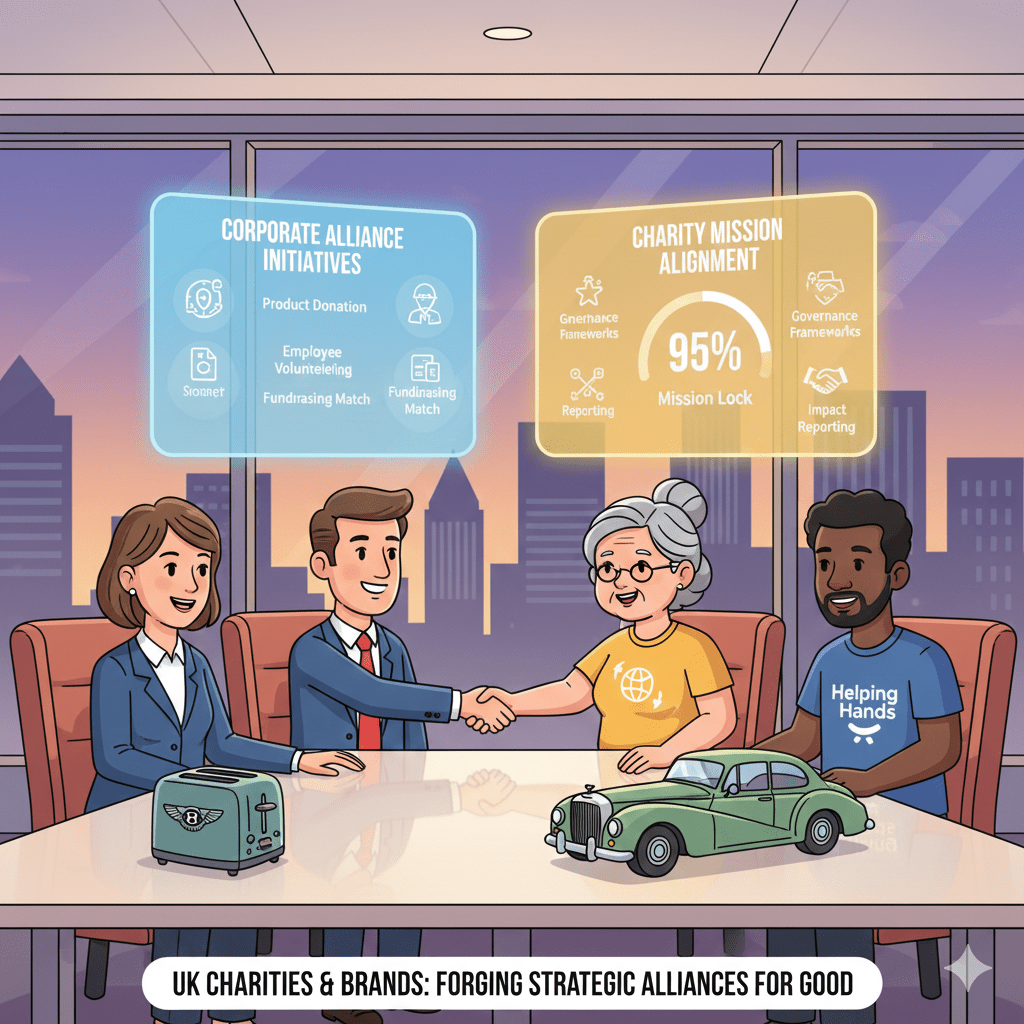
These new alliances demonstrate a clear move towards strategic brand alignments, where corporate and charitable missions are deeply intertwined. Russell Hobbs’s ‘Make a Meal Difference’ campaign with Action Against Hunger is a prime example, marked by a £270,000, three-year global pledge. The partnership aims to ‘redefine the kitchen as a force for good,’ equipping people with the tools and skills to provide nourishing food for their families, a mission that aligns perfectly with the brand’s place at the heart of the home. Similarly, the Bentley Environmental Foundation’s support for the Seatrees kelp restoration project off the Australian coast is not a standalone gesture but a core component of Bentley’s corporate ‘Beyond100+’ strategy. To ensure such partnerships are truly strategic, charities should evaluate how well these initiatives align with their mission and long-term impact goals, fostering responsible engagement and sustainable outcomes.
At the other end of the spectrum are campaigns designed for creative public engagement, capturing hearts and minds to drive donations. Proving that fundraising can have a sense of humour, BusinessWaste magazine launched a search for Britain’s “buffest binmen” to feature in a 2026 charity calendar for FareShare. Co-founder Mark Hall framed the initiative as a way of celebrating “unsung heroes” while raising money for a vital cause. This sits alongside more traditional but equally powerful public-facing campaigns, such as Sainsbury’s long-standing, multi-faceted support for the Royal British Legion Poppy Appeal, which seamlessly integrates donation opportunities at checkouts and through the Nectar points system, making giving easy and accessible for millions of shoppers. While one campaign uses novelty to gain media traction, the other leverages ubiquity and convenience, proving that successful public engagement requires tailoring the approach to the brand’s unique market position.
Other partnerships leverage media and community amplification to scale local initiatives into national movements. The Sunday Times has thrown its weight behind Bookbanks with its ‘Get Britain Reading’ campaign, aiming to dramatically expand the charity’s reach from six to 30 partner food banks. This model uses the media partner’s platform to galvanise public support and volunteerism for a grassroots organisation. On a more local level, TYS Retail’s milestone of donating over £100,000 to communities in Peterborough, Stamford, and St Neots through the Making a Difference Locally (MADL) initiative highlights the cumulative power of sustained, community-focused retail partnerships. These examples show two sides of the same coin: media partnerships provide the scale for explosive growth, while sustained retail initiatives demonstrate the profound cumulative impact of deep community integration.
Finally, we are seeing the emergence of a new frontier of giving through innovative financial models. EverGive’s initial $200,000 Bitcoin donation to the UN’s International Organisation for Migration (IOM) to combat modern slavery marks a significant breakthrough. Its unique “low-time-preference” giving model, where donations are held in a strategic Bitcoin reserve to grow over time, offers a new paradigm for sustainable endowments. Ismael Dainehine, EverGive’s CEO, underscored its importance, stating the goal is to “align financial tools with human values” to create lasting liberation. This represents a fundamental challenge to traditional fundraising, suggesting a future in which endowments are not just preserved but designed to grow in real terms, offering a new path to long-term financial independence for charities.
These examples illustrate the sheer breadth of modern collaborations, but they also raise the question of how charities can navigate this complex landscape effectively and responsibly.
Navigating the Partnership Imperative: Opportunity, Risk, and Responsibility
While the benefits of corporate partnerships are increasingly clear, their growing complexity necessitates a deeper understanding of the underlying risks and the robust governance required for success. As charities become more reliant on these alliances for survival and growth, ensuring they are managed with diligence and transparency is paramount to protecting both their reputation and their mission.
Contextual Pressures Driving Collaboration
The imperative for charities to seek out and secure corporate funding has never been stronger. The sector is still grappling with post-pandemic challenges and a protracted cost-of-living crisis that have strained traditional income streams. Furthermore, the FORVIS MAZARS 2025 State of the Nonprofit Sector Report highlights a critical operational challenge: senior leaders and fundraisers are among the most difficult staff to recruit. This skills shortage makes it harder for charities to deliver fundraising strategies in-house, rendering the expertise, capacity, and innovative approaches of corporate partners and professional agencies essential to both survival and growth.
Evaluating the Risks and Upholding Best Practice
As charities increasingly turn to external partners, the Chartered Institute of Fundraising’s authoritative guide provides a critical roadmap for navigating potential pitfalls. It stresses that a charity “cannot absolve itself of obligations and duties because it has outsourced fundraising activity.” This principle of ultimate responsibility underpins all best-practice recommendations. A foundational safeguard is the implementation of robust, written contracts that move beyond informal or ‘rolling contracts’ to include clear service level agreements (SLAs), data protection terms, and well-defined termination clauses. Furthermore, following the Fundraising Regulator’s 2024 Market Inquiry into sub-contracting, rigorous due diligence on both primary partners and any sub-contractors they use has become a critical focus. Charities must conduct thorough checks to mitigate risks such as “loss of control over donor interactions and potential misalignment with the charity’s mission.” Ultimately, this underscores the principle that charity trustees must have a “clear line of sight” regarding every organisation and individual raising funds on their behalf. This oversight is not a procedural formality but a fundamental governance duty to protect the charity’s reputation and ensure all activities align with its core values.
By embedding these practices, charities can confidently seize the opportunities offered by corporate partnerships while safeguarding their integrity and the trust of their supporters.
The Future of Purpose-Driven Alliances
The trend towards more deeply integrated, strategic, and creative corporate-charity partnerships is undeniable and set to accelerate. This evolution offers the UK charity sector immense opportunities to innovate, scale its impact, and build financial resilience in a challenging economic climate. However, these opportunities come with significant responsibilities. The future of successful fundraising lies in building transparent, mutually respectful alliances grounded in robust due diligence, clear contractual obligations, and a shared commitment to measurable, ethical impact. As outlined by sector bodies like the Chartered Institute of Fundraising, the path forward requires a sophisticated balancing act. Charities must embrace the innovation and creativity that modern partnerships offer while steadfastly upholding the rigorous governance and oversight necessary to protect public trust and confidence—the sector’s most valuable asset.