Under the Spotlight: Why Governance Failures in the Arts are Sounding Alarm Bells Across the UK Charity Sector
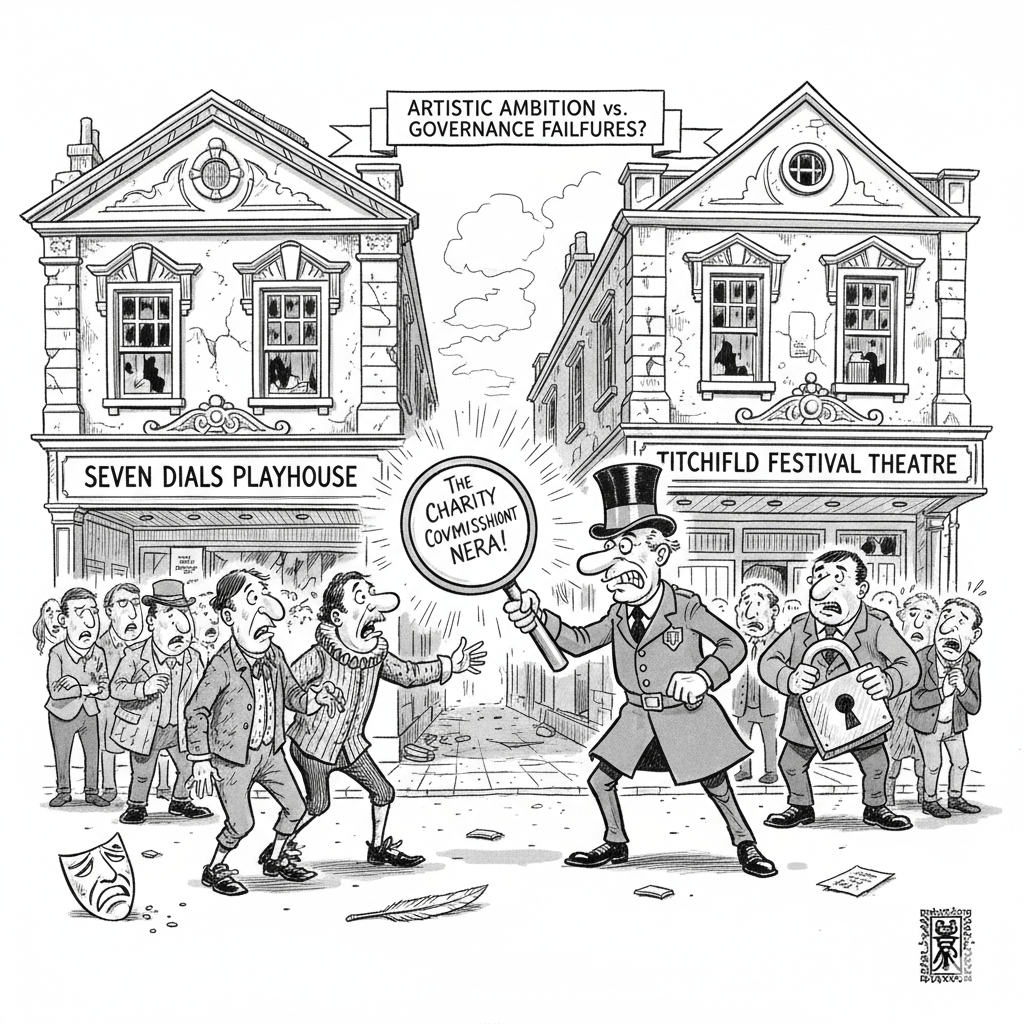
The UK arts sector is currently navigating a period of unprecedented scrutiny, with the footlights shifting from the stage to the cold, clinical glare of the boardroom. As the Charity Commission intensifies its investigations into Titchfield Festival Theatre and Seven Dials Playhouse, these cases serve as a sobering proxy for a wider governance crisis. In a post-pandemic economy besieged by high inflation, the “charity brand” is under threat. Public trust is not merely a moral asset; it is the sector’s lifeblood. When trustees treat the Charities Act 2011 as a set of loose suggestions rather than a statutory mandate, they jeopardise the very fiscal privileges—from VAT exemptions to Gift Aid eligibility—that keep the arts alive. These failures represent a profound systemic risk, suggesting that a dereliction of fiduciary duty is being masked by artistic ambition.
This escalating regulatory intervention is no accident. It is the result of a tightening oversight environment designed to curb a culture that mistakenly believes “artistic license” extends to financial and legal obligations.
Case Studies in Crisis: Seven Dials and Titchfield Festival Theatre
The statutory inquiries into Seven Dials Playhouse and Titchfield Festival Theatre illustrate a dangerous fracture in the stewardship model, where boards have played fast and loose with their regulatory obligations. These are not merely administrative lapses; they represent a fundamental disconnect between charitable objects and operational reality.
For Seven Dials Playhouse (formerly The Actors Centre), the crisis is one of unsustainable legacy. After thirty years in central London, the charity sold its eponymous property lease in late 2024 to clear “historic debt.” However, the regulator remains unconvinced of its long-term viability. An analysis of its previous model revealed a staggering engagement gap: of its 2,000-strong membership, only 8% were active before the pandemic. Since March 2020, the charity has haemorrhaged funds, recording a £1.29 million deficit (£3.76m spent against £2.47m income). Interim managers from Moore Kingston Smith & Partners have now been installed to determine if the board’s new business plan—which relies on renting back the space it once owned—is anything more than a stay of execution.
In Hampshire, Titchfield Festival Theatre represents a more defiant form of mismanagement. The charity is currently reeling from a lost High Court appeal regarding an unauthorised £1.7 million development built without planning permission. Beyond this architectural hubris, the Charity Commission is investigating serious “mismanagement” regarding accounts that are overdue by 623 and 258 days. Crucially, an investigative eye has been cast on “connected entities.” Three of the four trustees also govern a sister charity, Titchfield Festival Theatre Productions, which shares the same website, email address, and charitable objects—and, unsurprisingly, the same overdue account status.
These cases illustrate that the regulator is no longer content to issue gentle reminders while charity assets are treated as private fiefdoms.
The Regulatory Climate: From Compliance to Statutory Inquiry
The Charity Commission’s strategic “Regulatory and Risk Framework” has undergone a sharp evolution. We have moved past the era of “regulatory compliance investigations”—actions that often lacked a firm statutory basis—to a regime of robust statutory inquiries under Section 46 of the Charities Act 2011. The scale is immense: in 2022-23, the Commission concluded 5,726 regulatory action cases, including 68 full statutory inquiries.
Trustees must now contend with the newly enforced Charity Governance Code. While technically voluntary, the Commission uses its eight principles as a yardstick for mismanagement:
- Foundational Principle: Understanding legal duties and responsibilities.
- Organisational Purpose: Clarity on public benefit.
- Leadership: Effective strategic oversight.
- Ethics and Culture: Standards that influence behaviour.
- Decision Making: Serving the charity’s purpose above all.
- Managing Resources & Risk: Efficient stewardship and risk assessment.
- Equity, Diversity & Inclusion: Evident throughout the organisation.
- Board Effectiveness: Regular, honest reviews of performance.
The landscape is further complicated by SORP 2026, which introduces three tiers of income reporting to ensure proportionality. However, sector analysts should note a looming “cliff-edge” of confusion: while the new SORP applies to accounting years starting 1 January 2026, the DCMS changes to audit and independent examination thresholds do not take effect until 30 September 2026. This gap creates a significant burden of proof for trustees who must navigate two different sets of rules for reporting and external scrutiny.
Impact and Implications: The High Cost of Mismanagement
Internal governance failures inevitably bleed into public perception, causing irreparable reputational harm. The “period of investment” cited by Seven Dials, along with the planning disputes at Titchfield, threaten their long-term viability in a fiercely competitive funding market.
Contrast these failures with the Blue Teapot Theatre Company’s Donors Charter, which sets a benchmark for transparency that was ignored in the inquiries above. To protect the sector’s integrity, boards must adopt these specific transparency commitments:
- Audited Financial Statements: Providing immediate website access to the most recent, fully audited accounts.
- Mission Clarity: Clearly defining how every pound furthered the organisation’s charitable objects.
- Board Transparency: Maintaining a public list of trustees to ensure visible stewardship.
- Complaint Procedures: Establishing and publicising clear, agreed-upon procedures for public grievances.
Without these safeguards, the stewardship model—a concept dating back to the Statute of Charitable Uses 1601—is rendered meaningless.
Perspectives and Voices: Defiance vs. Regulation
There is a palpable tension between the regulator’s duty to protect the public and the trustees’ desire for “artistic freedom.” Seven Dials Playhouse expressed “disappointment” at the inquiry, dismissively framing “misconduct” as a mere disagreement over “strategic direction.” Similarly, Titchfield spokespeople remain defiant, insisting “shows continue” despite a “difficult financial climate.”
However, we must apply the lessons from the Charity Commission’s warnings to the Dioceses of Liverpool and Chelmsford. The regulator noted that “spiritual leadership” can create an abuse of power where allegations are ignored, and oversight fails. In theatre, “artistic leadership” poses an identical risk. Strong-willed creative leaders often convince boards to overlook “related party transactions” or “unauthorised private benefits” in the name of the “mission.” This charismatic leadership model is a governance trap; the regulator’s sensitivity to these transactions is a necessary barrier against the erosion of charitable assets.
Conclusion: The Road to 2026 and Beyond
As we approach 2026, the margin for error has evaporated. The sector must prepare for the transition of the Listed Places of Worship Grant Scheme to the new Places of Worship Renewal Fund, which brings £92 million in funding but demands rigorous compliance. Trustees must also be wary of the 31 March 2026 deadline for the predecessor scheme to avoid a funding shortfall.
The future of oversight will be increasingly data-driven, yet the “Trusting AI” caution from ACAT reminds us that “hallucinations” in automated summaries can misrepresent a charity’s standing. Ultimately, technology is no substitute for human accountability. The sector must watch carefully: as we move toward the 2026 SORP and the new audit thresholds, the statutory inquiry is no longer an outlier—it is becoming the standard response for any board failing to perform an honest, periodic review of its own effectiveness. In the modern regulatory climate, the most critical performance an arts charity gives is its annual return.