MND Association Report: Terminally Ill Trapped by ‘Broken’ Housing System
A System in Crisis
A ‘broken’ system is trapping people with motor neurone disease (MND) in unsafe and unsuitable homes, forcing them to spend their final months battling bureaucracy instead of living with dignity, a damning new report from the MND Association has revealed. The charity’s report, titled A Lifeline Not a Luxury, exposes a critical failure of statutory support that is placing an intolerable burden on individuals, their families, and the third sector organisations that step in to help. For the charity sector, this raises urgent questions about its role when state provision fails. The core of the crisis lies in a devastating mismatch: the slow, complex process of securing essential home adaptations is entirely out of step with the rapid, relentless progression of a terminal disease that gives people no time to wait.
The Evidence: A Lifeline Out of Reach
To understand the scale of this systemic failure, it is essential to examine the data underpinning the MND Association’s campaign. The charity’s investigation, which combined Freedom of Information requests with a survey of affected individuals, paints a stark picture of unacceptable delays and a system struggling to meet the most basic needs of terminally ill people.
The statistics are damning. Half of all people diagnosed with motor neurone disease die within two years of their diagnosis. In stark contrast, the average time taken for a Disabled Facilities Grant (DFG) application to be processed-375 days in England, 357 days in Northern Ireland, and 289 days in Wales- illustrates how current policies and bureaucratic practices delay essential support. This year-long delay is not merely a bureaucratic inconvenience; for a person with MND, it represents a fundamental failure of the system to comprehend the very nature of the disease it is supposed to support, underscoring the urgent need for reform.
These grants, administered by local councils, are designed to fund essential adaptations that allow people to remain in their own homes as their mobility declines. They cover vital modifications such as ‘stairlifts, door widening and ramps’—modifications that are not luxuries, but fundamental necessities for accessing bathrooms, living spaces, and gardens. The chasm between the urgent need for these adaptations and the year-long wait to receive them reveals the human reality behind the statistics.
The Human Cost: Dignity Denied
Statistics only tell part of the story. The true cost is seen in the daily loss of independence and dignity, inspiring the audience to empathise with those affected.
Diagnosed with MND just six months after giving birth, the disease has robbed Charlotte of the use of her arms, and she is now wheelchair-bound. To live safely, she requires a single-storey extension with a wet room and an adjoining bedroom. Her family’s struggle to secure this highlights the profound personal toll of the current system. Her father, Bob Parker, articulates the family’s distress and the fundamental nature of their request.
“They’re not luxury items, they’re things Charlotte needs to make her life easier. Planning applications for someone with a terminal condition shouldn’t be treated the same as a family simply extending their kitchen.”
As her mobility declines daily, the indignity of her situation becomes more acute. Mr Parker describes the potential reality of their living situation without the adaptations:
“The thought of having a bedroom down here in the front room, being strip-washed in front of your children, is so undignified. It must be really upsetting.”
The family’s distress is compounded by a financial deadlock. While they are hopeful of receiving the maximum £30,000 DFG, the total cost of the work leaves a shortfall of £45,000. An application for a further discretionary grant was refused due to council budget constraints, leaving the family in an impossible position. Bob and his wife are now considering remortgaging their own home to fund the adaptations their daughter desperately needs.
“Housing shouldn’t be just about putting a roof over someone’s head. It should consider the long-term outlook and the real needs of people living with a progressive, terminal disease. We’re not talking millions of pounds here; it is giving people the dignity they need to live their lives in a world which is always going to be challenging for them.”
The Response: A Campaign for Change
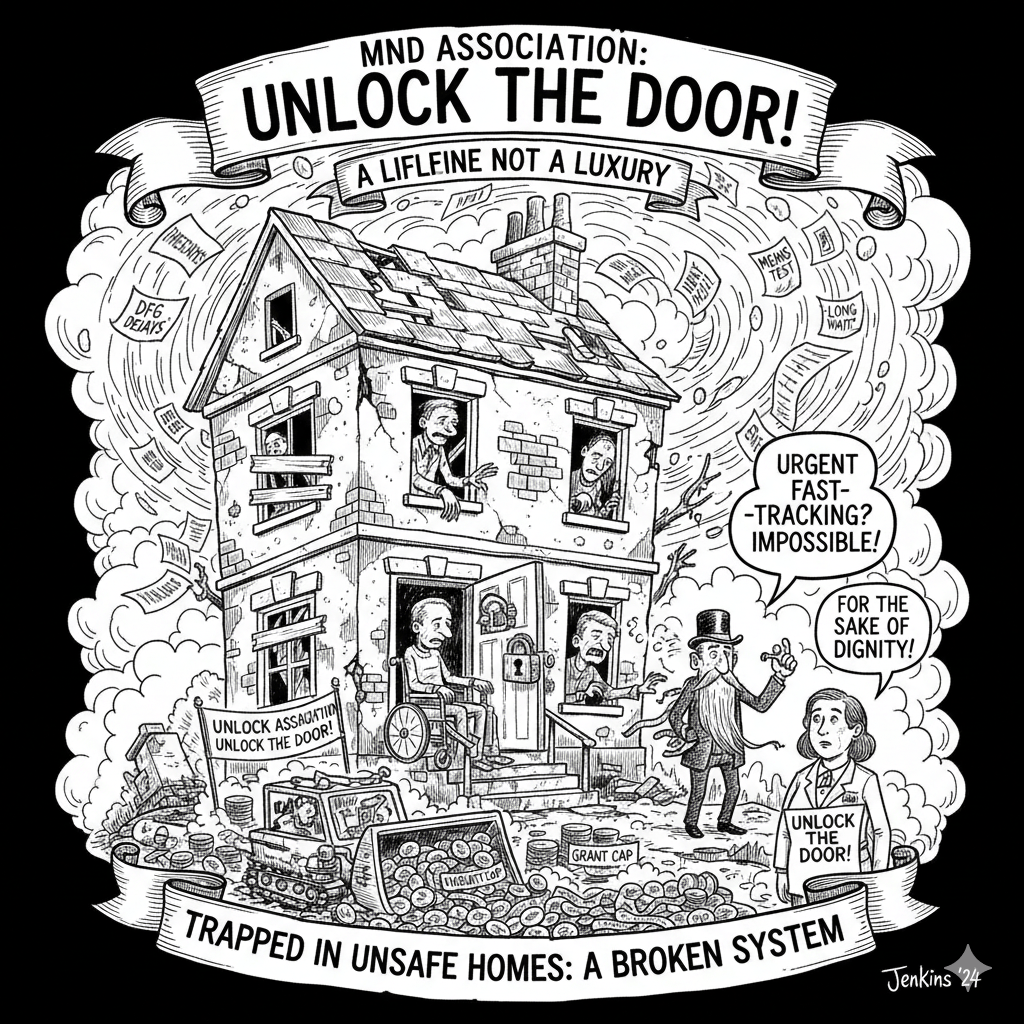
In response to its investigation, the MND Association is channelling its findings into a targeted advocacy effort to drive meaningful reform. The charity has launched the Unlock The Door campaign, calling on local authorities and the Northern Ireland Housing Executive to urgently overhaul the Disabled Facilities Grant process for people with terminal illnesses.
The campaign’s demands are clear, practical, and designed to address the system’s most critical failings. They are calling for authorities to:
- Implement a formal fast-track process for people with MND to apply for a DFG, recognising the urgency of their condition.
- Waive the means test for adaptations for individuals with progressive, life-limiting conditions such as MND.
- Increase the mandatory DFG cap, which has not been updated since 2008, to align it with current inflation and the real cost of construction.
The urgency of these reforms is underscored by Tanya Curry, Chief Executive of the MND Association, who provides a powerful voice for those let down by the current system.
“There are hundreds of people with MND whose housing robs them of both their dignity and the chance to make the most of the time they have. For someone whose condition may progress dramatically in a matter of months, waiting a year or more for vital adaptations is equivalent to being denied them altogether. MND won’t wait for a broken system to catch up – people living with MND shouldn’t have to either.”
The proposed solutions provide a pathway for systemic change, empowering the audience to advocate for accountability and improved support systems.
A Challenge for the Sector
The MND Association’s report is more than an exposé of a flawed grant system; it is a powerful indictment of a state provision that is failing the terminally ill at their most vulnerable. It demonstrates with painful clarity the unacceptable human cost of bureaucratic delay, where people are stripped of their dignity while waiting for essential support that may never arrive. The Unlock The Door campaign has presented a clear and achievable pathway for reform, putting the onus on local authorities to act with the urgency these situations demand.
For the wider charity sector, this crisis poses a fundamental question. When statutory services prove too slow, too underfunded, or too inflexible to meet the acute needs of the people they exist to serve, how must we respond? This failure in housing adaptation points to a broader challenge: advocating for systemic change while simultaneously plugging gaps in provision. The challenge, therefore, is not merely to plug the gaps left by a failing state, but to force a systemic recognition that for the terminally ill, dignity delayed is dignity denied.