Fundraising Regulator Strengthens Leadership at a Pivotal Moment
Setting the Stage
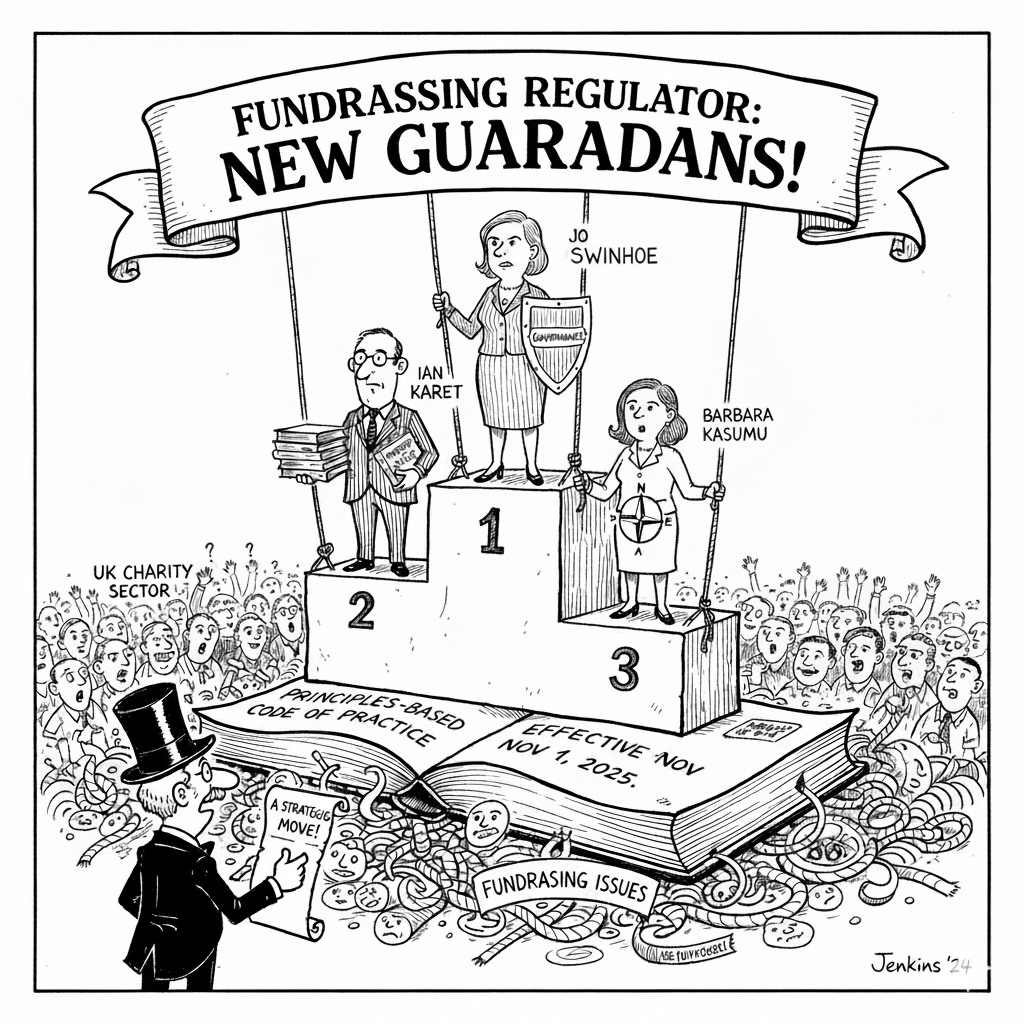
The Fundraising Regulator has announced the strategic appointment of three new board members—Jo Swinhoe, Ian Karet, and Barbara Kasumu—signalling a significant reinforcement of its governance at a critical time for the UK charity sector. This move anticipates the implementation of the regulator’s new, principles-based Code of Fundraising Practice, which becomes effective on 1 November 2025. Lord Toby Harris, chair of the Fundraising Regulator, underscored the importance of these appointments, stating that the new members bring “considerable experience across charitable fundraising, governance, regulation and law.” Their collective expertise is seen as a deliberate step to strengthen the board, uphold high standards, and ensure public trust can prosper during a period of profound change for fundraising regulation.
A Strategic Blend of Expertise
The trio of appointments represents a formidable trifecta of expertise, purpose-built to navigate the sector’s current and future challenges. Rather than simply adding impressive CVs, the regulator has assembled a board where the whole is greater than the sum of its parts. Jo Swinhoe, the first female Executive Director of Income Generation at the NSPCC and a Fellow of the Chartered Institute of Fundraising, provides deep, practical insight into the operational realities of high-level fundraising. Complementing this is Barbara Kasumu, whose leadership at major hospital charities, such as Guy’s & St Thomas’ Foundation, adds significant experience in complex organisational governance. The crucial third element is Ian Karet, whose tenure as interim chair of the Charity Commission brings unparalleled insight into the workings of the other key regulator in the English and Welsh charity landscape. This signals a move towards more cohesive and sophisticated sector-wide oversight, equipping the board with a perfect blend of frontline fundraising mastery, operational governance, and high-level regulatory acumen.
A New Code for a New Era
These appointments are not routine; they arrive at a critical juncture defined by the launch of the overhauled Code of Fundraising Practice, effective 1 November 2025. This new code marks a fundamental shift away from a prescriptive list of rules towards a more flexible, principles-based framework built on four core values: fundraising must be Legal, Open, Honest, and Respectful. This less prescriptive approach demands far more subjective judgment and nuanced interpretation than a rules-based system. Consequently, the board’s role as the ultimate arbiter of what constitutes compliant and ethical practice becomes more critical than ever. The expertise of the new members is therefore directly aligned with this new era. As Lord Harris noted, their insights will be “invaluable” to the governance and implementation of the new code, ensuring it is applied with both rigour and an appreciation for practical realities.
Navigating a Sector Under Pressure
The strengthening of the regulator’s board is not only a response to internal policy changes but also to the immense external pressures confronting the UK charity sector. Robust governance is essential at a time when charities are navigating a landscape fraught with financial, operational, and reputational challenges. A comprehensive analysis of the current environment reveals several key pressure points:
- Persistent Fundraising Issues: According to the Fundraising Regulator’s ‘Annual Complaints Report’, misleading information remains a top public concern, especially in digital fundraising. Furthermore, door-to-door fundraising continues to generate a high volume of complaints, highlighting an ongoing friction point that requires careful management.
- Governance Deficits: The Grant Thornton ‘Charity sector development report’ identifies significant difficulties for charities in recruiting trustees with the right mix of skills, experience, and diversity. This skills gap at the board level can create vulnerabilities and contribute to governance failures, making the example set by the regulator’s own high-calibre appointments all the more important.
- Financial and Regulatory Complexity: Charities are operating in an unpredictable economic environment where they are “asked to do more with less.” The Grant Thornton report emphasises the critical need for organisations to diversify revenue streams and navigate an increasingly complex legal and regulatory environment, including new requirements under the Economic Crime and Corporate Transparency Act.
The board is now uniquely equipped to address these issues head-on: Swinhoe’s practical fundraising mastery directly targets the sector’s ‘Persistent Fundraising Issues’; Kasumu’s background in complex governance provides a model for overcoming ‘Governance Deficits’; and Karet’s high-level legal expertise is essential for navigating the rising ‘Financial and Regulatory Complexity’.
A Look to the Future
The appointment of Jo Swinhoe, Ian Karet, and Barbara Kasumu is a clear and strategic move by the Fundraising Regulator. It is a direct and robust response to the dual demands of a new regulatory era, ushered in by its principles-based Code, and a sector grappling with significant external pressures. Their collective expertise in fundraising practice, charity law, and organisational governance is precisely the toolkit required to oversee the successful implementation of the new Code and guide the sector towards higher standards.
This is more than a moment to take note; it is a signal for action. Charity leaders and trustees must now audit their own fundraising cultures against the spirit, not just the letter, of the new Code. The regulator has equipped itself for a more nuanced future; the sector is now expected to prove it can do the same, demonstrating that public trust remains the non-negotiable bedrock of all charitable giving.