Pylons and Pounds: Grid Upgrade Unlocks Millions for Charities, But Sparks Fierce Debate on Fairness
A Charged Landscape for the Third Sector
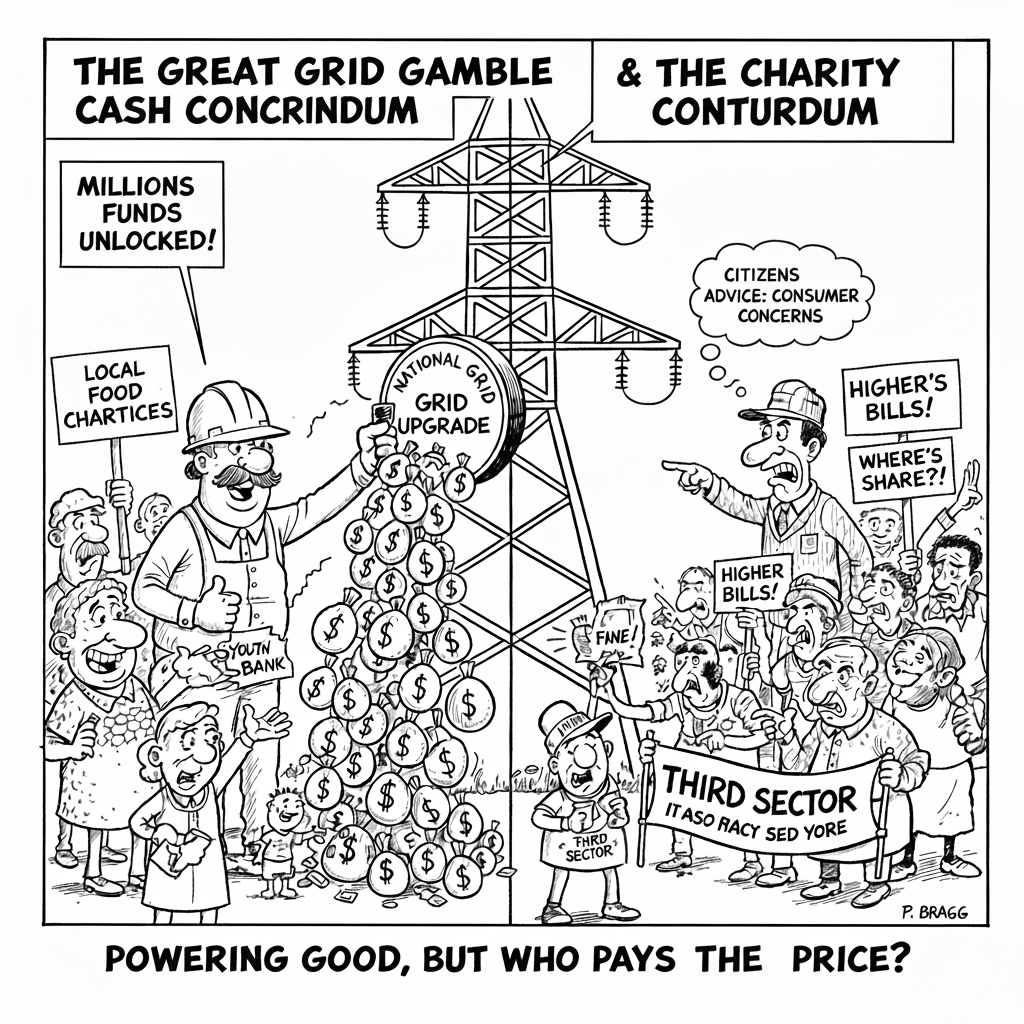
The United Kingdom is embarking on the largest overhaul of its electricity grid in generations, a monumental effort to build the infrastructure required to meet ambitious net-zero targets. Amidst the hum of transformers and the steel skeletons of new pylons, a significant new policy has been formalised: energy companies must now provide multi-million-pound community benefit funds in areas hosting this new hardware. National Grid has already launched the first of these schemes in the North of England, opening a vital new funding stream for local organisations. While this presents a welcome opportunity for charities operating on the front lines, it is important for sector professionals to understand the ongoing debate about fairness and effectiveness. Recognising your role in this transition can help you navigate these changes effectively.
The New Funding Reality: What Charities Need to Know
With the government’s new guidance now in effect, the abstract concept of community benefits has become a tangible reality for the third sector. The first funds are now open for applications, and for charities in affected areas, understanding the mechanics of this new opportunity is of strategic importance. National Grid has launched community funds for its major projects in Yorkshire and County Durham, offering a clear blueprint of what organisations can expect.
- The Projects: The initial funds are tied to three specific National Grid projects: Yorkshire GREEN, Eastern Green Link 1 (EGL1), and Eastern Green Link 2 (EGL2).
- The Offer: Grants of up to £20,000 are available for local projects and initiatives.
- Eligible Organisations: Applications are open to a broad range of community-focused bodies, including registered charities, non-profit companies, community benefit organisations, parish and town councils, and other locally based non-profit groups.
- Fundable Activities: The funding is designed to be flexible, supporting projects across several key areas that reflect community priorities, such as:
- Education and Science, Technology, Engineering & Maths (STEM) opportunities
- Environmental protection and access to green spaces
- Improving community spaces and promoting energy saving
- Cost of living help and employability support
- Supporting local health and wellbeing initiatives
- The Application Process: To administer the funds, National Grid has partnered with the charity Localgiving. Eligibility is determined by an organisation’s proximity to the construction activity, which can be verified through a postcode checker on the Localgiving website before an application is started.
Emma Bennett, Head of Socioeconomic and Community Benefits at National Grid, framed the initiative as a core part of the developer’s commitment to the regions affected by the grid upgrade:
We want to support communities in creating a lasting, positive impact for people living and working near our projects. Working together with communities in Yorkshire and County Durham, we can ensure these funds support what local people care about most.
These first funds provide a practical example of a much broader policy framework designed to bring communities onside for the net-zero transition.
The Policy Blueprint: Bringing Communities Onside for Net Zero
The government’s new formal guidance represents a strategic attempt to move away from the ad-hoc nature of previous schemes. It aims to create a consistent, ambitious, and transparent national framework to ensure communities hosting vital new infrastructure share directly in the benefits. This is viewed as a critical step in building public support and accelerating the rollout of clean power infrastructure needed to meet the UK’s 2030 targets.
The policy is built on a clear set of principles and a defined funding structure:
- Guiding Principles: The government expects all funds to be developed with five core principles in mind:
- They must be community-led and reflect local priorities.
- They should create a lasting legacy, improving social, economic, or environmental wellbeing.
- They must be delivered with fairness and transparency.
- Communities should be supported to build their capacity to participate.
- The framework should be flexible to adapt to local needs.
- National Funding Levels: The guidance sets clear expectations for the total sums that developers should provide for new onshore infrastructure:
- £200,000 per kilometre for overhead lines.
- £530,000 per substation or converter station.
- Crucial Distinction from Planning: The government explicitly states that these community funds are separate from, and are not a material consideration for, planning authorities. This is a critical distinction, intended to allow local communities to raise legitimate concerns about a project’s impact through the formal planning process without the fear that doing so will cause them to lose out on the associated benefit funds.
While the government’s blueprint aims for a smoother path to net zero, it also presents an opportunity for the sector to engage with challenging questions about fairness and the economic model. Understanding these debates can empower charities and community groups to advocate for fairer policies and better outcomes for their communities.
A Question of Fairness: Who Really Pays for Community Benefits?
While the multi-million-pound funds offer a welcome new resource, influential voices, led by consumer champion Citizens Advice, are questioning the model’s fairness and effectiveness. As sector professionals, your understanding of these ethical debates is crucial in ensuring that community benefits truly serve local needs and uphold sector integrity.
In its recent discussion paper, “Growing pains,” Citizens Advice evaluates the central arguments underpinning the new policy and finds them wanting.
First, it highlights that the community benefit funds provided by transmission operators are not paid for out of developers’ profits or general taxation. Instead, they are funded by all GB electricity bill payers through network costs, which make up a significant portion of every household and business energy bill.
Second, the paper challenges the core assumption that these funds will prevent costly project delays by reducing local opposition and legal challenges. Citizens Advice points to government research showing that even substantial payments fail to win over a significant minority of opponents. The paper concludes that it is not a “safe assumption” that community benefits will have a material impact on the likelihood of legal challenges that cause delays.
Third, this leads to what the paper calls significant “distributional implications.” If the funds don’t deliver a net benefit to all bill payers by reducing project costs, they represent a simple transfer of value from every electricity consumer to the specific communities hosting the infrastructure. Citing analysis from the Resolution Foundation, the paper notes that these are often rural areas that, on average, are wealthier than the national average, raising serious questions of equity.
Based on this analysis, Citizens Advice makes a clear recommendation:
Community benefits for transmission infrastructure should be funded through general taxation, not regressive electricity bills, to ensure fairness and place the risk of project delays on the government rather than consumers.
This high-level policy debate is not just theoretical; its tensions are already becoming visible in the real-world planning and consultation processes for major infrastructure projects across the country.
Reality on the Ground: Funds, Frustration, and a Path Forward
To understand the true impact of this new policy, it is essential to look at how it intersects with the often-contentious reality of local planning. The response of Chelmsford City Council to National Grid’s proposed Norwich to Tilbury powerline project provides a telling case study of the policy’s real-world limitations.
The council’s formal response to the project explicitly references the new government guidance and states its expectation that National Grid will provide community funding accordingly. This shows that, far from being a tool to secure consent, the provision of these funds is already treated as a baseline expectation—a standard part of any negotiation with a developer.
Crucially, despite this expectation, the council maintains its “objection in principle” to the onshore pylons, citing “unnecessary harm to heritage, landscape, ecology and residential amenity”. This local-level response perfectly illustrates the central flaw identified by Citizens Advice: the availability of funds, while now an established expectation, is not proving effective at overriding fundamental local opposition or preventing project challenges.
Furthermore, the funds are not silencing debate but are instead becoming just one part of a much more complex and demanding negotiation. The council goes on to propose its own, more expensive mitigation strategies, demanding that National Grid consider alternatives such as underground cabling for sensitive sections or the use of different, less intrusive ‘T-pylons’. This case study demonstrates that community funds are not a “silver bullet” for winning local support, but rather the new entry point for a more sophisticated and challenging engagement landscape for developers.
A Complex Opportunity for the Sector
The Great Grid Upgrade has unlocked a tangible and significant new funding opportunity for charities in specific regions, directly linking their work to the UK’s vital net-zero transition. For many, these funds will provide a welcome resource to support local services, from protecting green spaces to tackling fuel poverty. However, profound questions hang over the entire policy. The debate, powerfully articulated by Citizens Advice, challenges the fairness of funding these benefits through every consumer’s energy bill and casts doubt on their ultimate effectiveness in accelerating infrastructure delivery. As more pylons are planned and more projects roll out across the country, the debate over who benefits and who pays is only set to intensify. The UK’s third sector will find itself at the very centre of this charged landscape, navigating both the practical opportunities and the complex ethics of this new world of pylons and pounds.