Still Speaking Up: A Legacy Charity’s Enduring Voice in Modern Cancer Care
The Voice of Experience
A laryngectomy, the surgical removal of the voice box, is a profoundly life-altering procedure. It permanently changes how a person breathes, communicates, and engages with the world. For nearly 50 years, the National Association of Laryngectomee Clubs (NALC) has stood as a pillar of peer-led support for this community, offering a lifeline rooted in shared experience. But in an era of significant change—marked by the sharp rise of HPV-related throat cancers, new evidence on patient outcomes, and a diverse and digitally-savvy support sector—what is the enduring role of an organisation founded in the 1970s? This article explores how NALC’s foundational principles and strategic influence ensure its relevance remains more critical than ever in the UK’s evolving healthcare landscape.
The Foundations of a Lifeline
To appreciate the present-day impact of any long-standing charity, it is essential to understand its origins and the unwavering principles upon which it was built. NALC’s story is one of a patient-led initiative, created by the very community it was designed to serve.
The organisation was established in 1975 by several laryngectomee groups to promote patient rehabilitation and foster public understanding of their needs. It became a registered charity in 1976 and, for many years,s was associated with Macmillan Cancer Support. However, reflecting the changing healthcare landscape, the number of local clubs has fallen in recent years, as has the number of hospitals performing laryngectomies, and NALC is no longer connected to Macmillan. Despite this consolidation, its core purpose has remained steadfast: to provide the kind of non-medical help and information that can only come from lived experience.
This ethos is embodied by its leadership. The President, Malcolm Babb, underwent his own laryngectomy in 2002, after which he returned to work as a teacher. His leadership reflects a deep commitment to patient involvement in high-level research, such as the ground-breaking PETNECK2 study, and his service on national bodies, including NICE guideline committees. For him, the first priority is ensuring that patients and their carers receive the essential information and support needed to navigate their journey. It was created not merely to serve patients, but to be their collective voice, addressing the profound challenges that follow surgery.
Anatomy of a Life-Changing Journey
Grasping the actual value of NALC’s services requires a clear understanding of the patient journey itself. The physical, psychological, and social challenges entailed in a laryngectomy are immense, shaping the very nature of the support required for recovery and adjustment.
As detailed in NALC’s Handbook for Laryngectomy Patients, the operation permanently disconnects the mouth, nose, and lungs. Breathing is rerouted through a new opening in the neck called a stoma. This permanently severs the pathway from the lungs to the mouth, meaning the ability to speak, laugh, or cry audibly using the vocal cords is lost forever. The aftermath of surgery presents formidable hurdles. Initially, patients cannot eat or drink normally and require feeding tubes. They must learn the meticulous process of stoma care to ensure their airway remains clear. Most fundamentally, they face the challenge of learning to communicate again.
Beyond the physical recovery, the psychological and social adjustments are significant. The handbook acknowledges the familiar feelings of anger, grief, and frustration that patients may experience as they mourn the loss of their voice and adapt to a new way of life. The support of family is noted as essential, but this implicitly highlights the unparalleled value of peer-to-peer connection. These immense personal challenges form the backdrop against which the evolving landscape of UK cancer care must be understood.
Navigating a New Era: Data, Demographics, and Digital Support
Long-standing charities do not operate in a vacuum. To remain effective, they must navigate a dynamic environment shaped by new medical research, shifting disease patterns, and a modernised third sector. NALC’s work today is informed by a complex and evolving contemporary context.
A significant demographic shift is underway. According to data highlighted by the support group Life After Lary, HPV-related oropharyngeal cancer is now the fastest-growing head and neck cancer in the UK. Cases have doubled over the past 20 years, with diagnoses in England increasing by 47% between 2013 and 2020. This trend affects people with no traditional risk factors, such as smoking or alcohol use, and disproportionately affects men.
This changing patient profile is complemented by new, evidence-based insights. A 2024 study in The Journal of Laryngology & Otology, analysing data from a 2020 UK-wide survey of 1,216 patients, found that while surgical voice restoration (SVR) is common, females were less likely to use it than males (63% vs 73%). Crucially, the research also identified a significant challenge for laryngectomees in care facilities, noting a recognised lack of knowledge about altered airways in community settings. This evidence provides a direct line of sight into the strategic importance of specialist charities capable of bridging this knowledge gap—a challenge that NALC has specifically tailored its services to address.
This modern landscape also includes a diverse ecosystem of support. Newer groups like The Swallows and Life After Lary provide vital services, including 24/7 support lines and regular online meetings. This is not a sign of competition, but rather evidence of a vibrant and necessary support network meeting a clear and growing need. It is within this complex environment that NALC continues to deliver its unique and strategic services.
From Local Clubs to National Influence
An effective modern charity must deliver on two fronts: providing direct, grassroots support to its community while also engaging in strategic, high-level advocacy to shape the system in which that community lives. NALC’s operating model demonstrates a clear commitment to delivering on both.
The organisation’s direct support begins at the hospital bedside, distributing vital information packs and leaflets to trusts across the country. This is backed by a national telephone advice line for patients, families, and professionals, which connects to a community through its quarterly newsletter, ‘CLAN’, and a modernised programme of online Zoom meetings featuring clinical guest speakers. Crucially, its national telephone advice line is not merely a passive resource; it is a strategic intervention for professionals, particularly care home staff, directly addressing the critical safety gap in community-based airway knowledge identified by the latest UK-wide research.
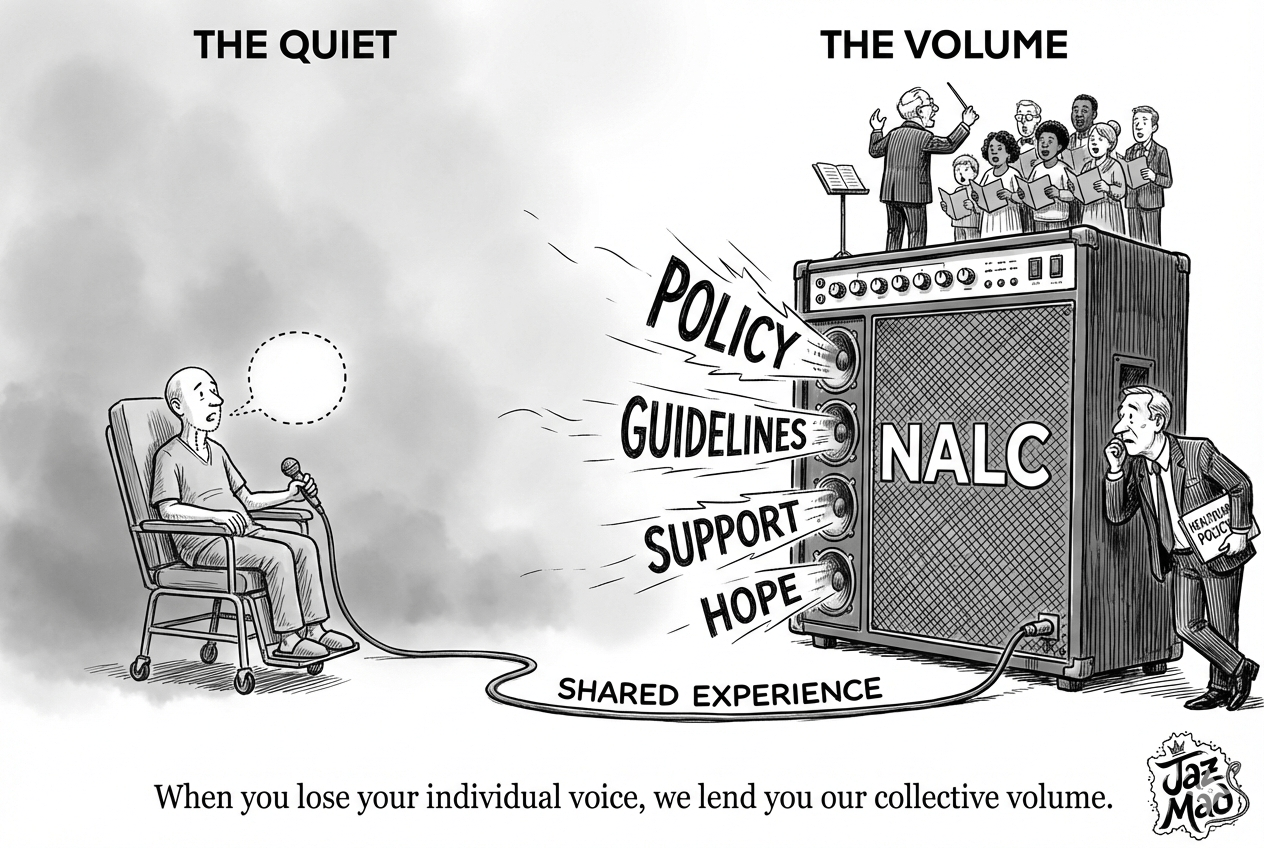
However, NALC’s impact extends far beyond direct service delivery. Its unique strategic value lies in its ability to provide a “patient voice on relevant national groups and committees.” By participating in NICE guideline committees and the UK Head and Neck Cancer Coalition, NALC actively influences national policy, clinical standards, and patient safety. This high-level advocacy ensures that patients’ lived experiences are embedded in the decision-making processes that shape UK healthcare. This dual role—providing both individual support and systemic influence—defines its enduring strength.
The Enduring Value of a Patient Voice
For almost half a century, the National Association of Laryngectomee Clubs has provided an indispensable service, born from the simple yet powerful principle of peer support. Its deep-rooted history, combined with a clear-eyed adaptation to a modern healthcare landscape, underscores its continued importance. In an era defined by new cancer trends, a growing body of evidence on patient needs, and an increasingly complex support sector, NALC’s dual mission has never been more relevant. Simultaneously offering a compassionate ear to the individual and a powerful, evidence-informed voice at the national policy table, it addresses the entire spectrum of patient needs. In a sector striving for truly patient-centred care, the NALC model of sustained, expert advocacy rooted in lived experience offers a powerful lesson in enduring impact.