The Architecture of Solidarity: Dr Halima Begum’s Biography
The Convergence of Lived Experience and Global Leadership
The appointment of Dr Halima Begum as the Chief Executive of Oxfam GB in 2024 marked not merely a succession in leadership but a paradigmatic shift in the ontology of British humanitarianism. As the first British-Bangladeshi woman to ascend to the helm of this confederation, Dr Begum’s tenure signified the dismantling of the traditional “white saviour” industrial complex that has historically plagued the development sector. Her trajectory—from a child of the Bangladeshi squatter movement in London’s East End to a leader in the highest corridors of international diplomacy—embodies the very systemic disruptions she advocates: the decentralisation of colonial power structures, the prioritisation of marginalised voices, and the transition from the vertical imposition of “charity” to the horizontal embrace of “solidarity”.
Dr Begum’s life story is a testament to the entanglement of the personal and the political. Unlike many of her predecessors in the aid sector, whose pathways were often paved by elite public schooling and frictionless entry into the civil service, Dr Begum’s expertise is forged in the crucible of resistance. Her professional resume, spanning the Department for International Development (DFID), the British Council, the LEGO Foundation, and the Runnymede Trust, is impressive not only for its breadth but also for its grounding in the harsh realities of her formative years in Tower Hamlets. Her intellectual contributions, particularly her doctoral research on the commodification of multiculturalism, provide a sophisticated theoretical framework for understanding her critique of the aid sector, while her intersectional identity as a disabled Muslim woman informs a governance style where inclusivity is a mechanism for survival rather than a corporate metric.
This biographical report reconstructs Dr Begum’s life through a sociological and historical lens, emphasising how the socio-political currents of late 20th-century Britain-such as anti-fascist activism and diplomatic shifts-shaped her leadership. Her career, from anti-fascist street battles to diplomatic negotiations, offers insights into the evolving relationship between the Global North and South, illustrating her influence within these dynamics.
Origins in Resistance – The East End Crucible (1970s–1980s)
The Aftermath of Liberation and the Migrant Journey
To understand Dr Halima Begum, one must first understand the geopolitical soil from which she sprang. She was born in the Sylhet region of Bangladesh, a landscape that, at the time of her birth, was still reeling from the visceral trauma of the 1971 Liberation War. This conflict, which birthed the nation of Bangladesh from East Pakistan, was defined by a brutal struggle for linguistic and cultural autonomy—a struggle in which her father was an active participant. A veteran of the Bangladeshi resistance, he instilled in the Begum household an ethos of resilience and anti-imperialist fortitude. This familial legacy of fighting for self-determination would later become the bedrock of Dr Begum’s professional worldview, informing her stance on sovereignty and local empowerment in the development sector, which can inspire respect and admiration in the audience.
The family migrated to the United Kingdom when Begum was just two years old, arriving in a Britain that was grappling with its own post-imperial identity crisis. The socio-economic climate of the 1970s was volatile; the country was beset by industrial unrest, economic stagnation, and a rising tide of nativist sentiment that viewed Commonwealth migrants not as citizens, but as encroachers. For the Begum family, the ‘Mother Country’ offered not a warm embrace, but an immediate lesson in systemic exclusion, which helps the audience feel the resilience and challenges her family faced during migration.
The Politics of Housing: The Squatter Movement
Upon arrival in London, the Begum family faced an acute crisis of shelter. The allocation policies of the time, often institutionally racist, systematically marginalised Bangladeshi migrants, leaving many families in a state of destitution. Excluded from decent public housing and unable to access the private market, the family was forced into homelessness. It was here, in the face of systemic failure, that the Begum family engaged in their first act of British civic resistance: they joined the British-Bangladeshi squatter movement.
This was not merely a chaotic scramble for shelter; it was a deliberate act of community activism that showed the power of collective action. In the 1970s, the Bengali community in East London mobilised to occupy derelict council properties—buildings often condemned for demolition due to lingering World War II bomb damage. The Begum family took up residence in one such squat, reclaiming a space that the state had left to rot. This experience of ‘squatting’ became a symbol of the community’s resilience and collective strength, inspiring others to stand against systemic neglect.
However, it also taught her a profound lesson in agency and hope. She witnessed her parents and their peers organising to secure fundamental rights that the state had denied them. She has often reflected on this period as the genesis of her political consciousness, noting that the discrimination she faced from the state—particularly in health and housing services—was as damaging as the overt racism of the streets. The squat was not just a home; it was a classroom where she learned that rights are rarely given; they must be seized, inspiring her to believe in the possibility of change.
Living on the Frontline: The National Front
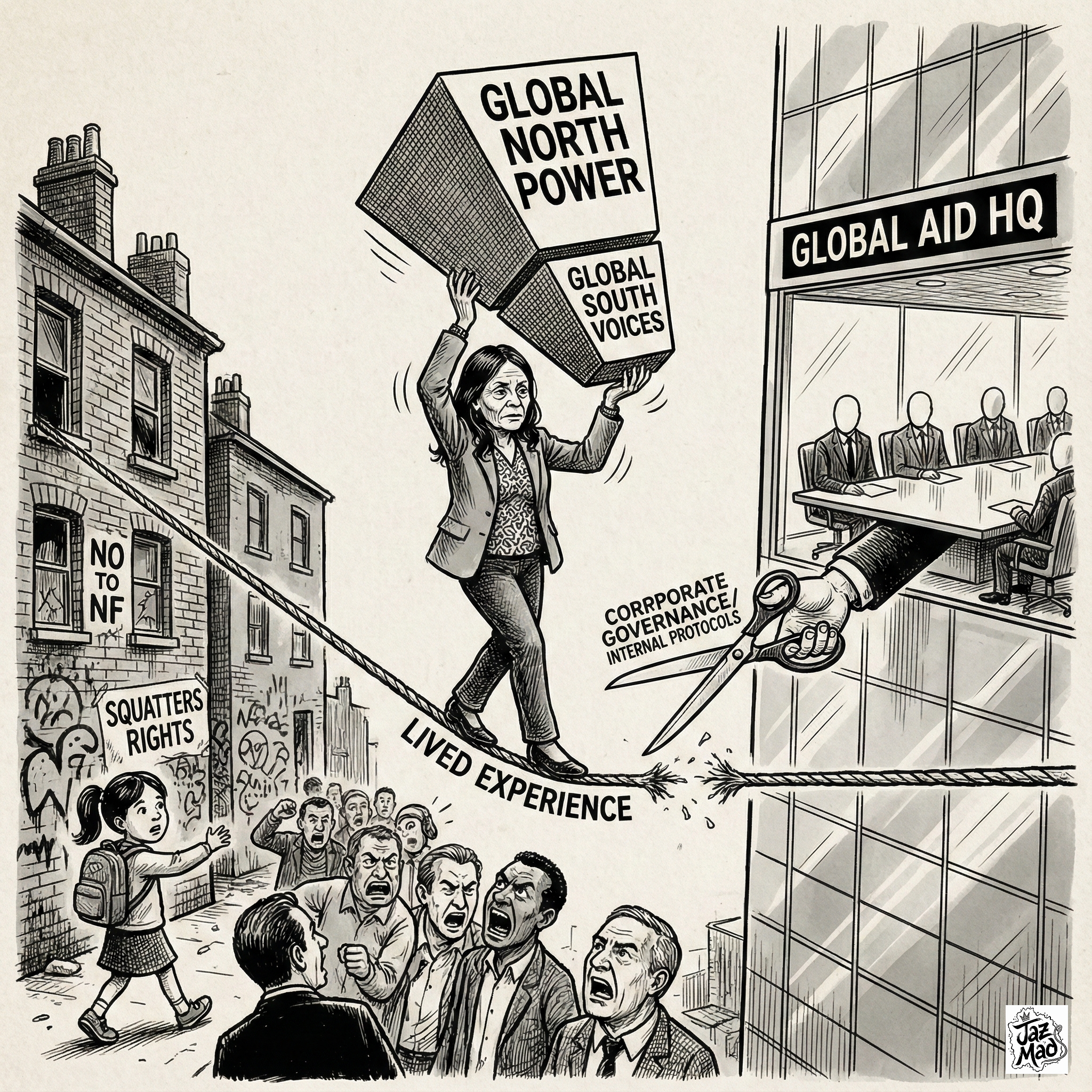
The East End of the 1970s and 80s was a physical battleground. The National Front (NF), a far-right fascist organisation, had established a significant presence in the area, capitalising on white working-class economic anxieties to stoke racial hatred. For the Begum family, the threat of fascism was not abstract or theoretical; it was literal and immediate. Their squat was located directly opposite a National Front bookstand, meaning the ideology of hate was a permanent fixture of their domestic landscape, highlighting the intense racial tensions of the time.
The daily act of leaving the house became a high-stakes political negotiation. Begum has recounted the harrowing experience of walking to Thomas Buxton Primary School with her mother and siblings. Dressed in traditional sarees, they would have to push through lines of neo-Nazi extremists who gathered outside their home. She described this journey as “a daily act of resistance by four little British-Bangladeshi children”. This environment of constant siege fostered a deep, protective solidarity within the Bangladeshi community, with vigilance patrols and defence committees organised to shield residents from “Paki-bashing” violence, demonstrating their resilience and mutual support.
The culmination of this racial tension was the murder of Altab Ali in 1978, a pivotal moment that galvanised the Bengali community into mass political action. While Begum was a child during the height of the 1978 mobilisation, the legacy of that summer—the shift from passivity to active self-defence—became the cultural atmosphere in which she was raised. It instilled in her a “courage and certainty” that standing up for dignity was a moral imperative, a belief that would later underpin her human rights work, illustrating how community resilience shaped individual activism.
The Young Activist – Organising Against Hate (1990s)
The Rise of the BNP and “Women Unite Against Racism”
As Begum transitioned into her teenage years in the early 1990s, the face of fascism in East London morphed. The street-level thuggery of the National Front evolved into the electoral strategy of the British National Party (BNP). This period saw a terrifying mainstreaming of racist politics in Tower Hamlets, culminating in the election of Derek Beackon as the BNP’s first councillor on the Isle of Dogs in 1993. This victory for the far-right sent shockwaves through the community, signalling that racism had moved from the streets into the council chambers.
In response, Begum did not retreat; she organised. As a teenager, she co-founded Women Unite Against Racism (also referenced as Women Against Racism), a grassroots collective designed to combat the rising incidence of racial discrimination and Islamophobia in the borough. This organisation was significant because it centred the voices of women in the anti-fascist struggle, a space often dominated by male community leaders. Begum and her peers understood that women, often visible in their traditional dress, were on the frontlines of abuse and needed a specific platform for resistance.
The group’s work was dangerous and direct. Begum campaigned in hostile territories like Millwall and the Isle of Dogs, areas where the BNP had its strongest support. They distributed leaflets, organised counter-demonstrations, and challenged the BNP’s narrative that blamed migrants for the shortage of housing and jobs. During this period, Begum was physically assaulted several times, attacks that targeted her intersectional identity as a Muslim woman of colour. These assaults, rather than deterring her, solidified her resolve. She later noted that the targeting of her “race, faith, and disability” gave her the clarity that equality was non-negotiable. Her activism played a crucial role in the eventual unseating of Derek Beackon, proving that grassroots mobilisation could defeat electoral fascism.
Personal Tragedy: The Murder of Abdul Samad
The violence of the era touched Begum’s life in the most devastating way possible. In 1997, when Begum was 23 years old, her brother, Abdul Samad, was murdered. The circumstances of his death—he was pressured to become involved in a dispute between rival curry house proprietors—highlighted the complex internal pressures within the community as well as the external failures of protection.
This tragedy was a profound interruption in her early adulthood, occurring just as she was navigating her higher education. It reinforced her understanding of the precarity of life for young ethnic minority men in inner cities. The loss of her brother likely fueled her later focus on youth justice and civil rights, grounding her policy work in the painful reality of loss. It underscored that for families like hers, the stakes of social policy were life and death.
Intellectual Formations – The Academic Lens
The LSE Years: Government and International Relations
While deeply embedded in local activism, Begum pursued a rigorous academic path that broadened her perspective and connected her local experiences to global issues. She attended the London School of Economics (LSE), a bastion of social science research, where she earned her undergraduate degree in Government and History, followed by a Master’s degree in International Relations. The LSE environment in the late 1990s provided her with the tools to analyse the systemic inequalities she had experienced in East London. It allowed her to connect the local struggles of Tower Hamlets to broader currents of global governance, post-colonial theory, and international political economy.
Doctoral Research: Commodifying Multicultures
In 2000, Begum obtained funding from the Economic and Social Research Council (ESRC) to undertake a PhD at the School of Geography, Queen Mary University of London (QMUL). Her research centred on urban regeneration and multiculturalism, with her thesis, titled “Commodifying Multicultures: Urban Regeneration and the Politics of Space in Spitalfields,” completed in 2004, serving as a critical foundation for her intellectual framework.
Under the supervision of Professors David Pinder and Alison Blunt, Begum returned to her childhood streets, but instead of merely viewing them as arenas of racial resistance, she delved into their transformation through gentrification. Her thesis powerfully critiques how “multiculturalism” has been strategically packaged and marketed by developers and urban planners to rebrand Spitalfields and Brick Lane. She asserts that the rich, diverse culture of the Bengali community has been commodified—reduced to a consumable aesthetic of “curry capital”—designed to allure wealthy professionals and tourists, all while the authentic community endures exclusion and displacement, which invites respect for her critical perspective.
This revelation—that inclusion can be a mere façade, manipulated by capital—profoundly informs her later critiques of the aid sector. Just as developers exploit the superficial aesthetics of diversity without genuinely empowering local residents, international aid frequently appropriates the stories of the marginalised without transferring any real power to them. Begum’s academic work reflects a nuanced understanding of the “politics of space,” a concept she adeptly applies to the complex geopolitical landscapes of international development, which enhances her credibility among professionals in the field.
The Commission for a Multi-Ethnic Britain
Parallel to her academic work, Begum began her professional career as a policy analyst on the Commission on the Future of Multi-Ethnic Britain (often called the Parekh Report), published in 2000. This landmark inquiry challenged the British self-conception of race and national identity, famously arguing that Britain needed to reimagine itself as a “community of communities.” Working as a young researcher on this commission placed her at the centre of the national debate on multiculturalism, connecting her with leading race equality thinkers and cementing her reputation as a formidable policy analyst. It was here that she learned the mechanics of high-level policy advocacy, bridging the gap between grassroots activism and national governance.
The Architect of Development – DFID and the Global Stage (2000s–2012)
Joining the Department for International Development (DFID)
Following the completion of her PhD, Begum transitioned from domestic civil rights to international development, joining the UK’s Department for International Development (DFID). This move occurred during the New Labour era, a period characterised by a massive expansion of the UK’s aid budget and a focus on the Millennium Development Goals. For Begum, this was an opportunity to apply her understanding of inequality on a global scale.
Begum spent nearly a decade at DFID, a tenure that included postings to some of the most geopolitically complex regions of Asia, including Nepal, China, Pakistan, and Bangladesh. Her work during this period was not merely administrative; it was deeply strategic, involving high-level diplomacy and the management of complex bilateral relationships.
The Sino-British Action Plan on Food Security
One of her most significant achievements during this period was leading the Sino-British Action Plan on food insecurity. This role required navigating the delicate diplomatic relationship between the UK and China. The project focused on the intersection of climate change and food systems, recognising that environmental degradation in China—the world’s most populous nation—would have global ripple effects on food prices and availability.
Begum’s leadership here demonstrated her foresight in linking climate justice with basic human needs. She understood early on that food security was not just an agricultural issue, but a geopolitical one. Her ability to facilitate cooperation between the UK and Chinese governments on such a sensitive issue highlighted her skill as a diplomat and technical expert.
Girls’ Education in Pakistan and Reconstruction in Nepal
In Pakistan, Begum demonstrated strong negotiation skills by working with provincial governments to secure access to and funding for female education, inspiring confidence in her leadership amid the region’s cultural, political, and security challenges. Her work involved negotiating with provincial governments to secure access and funding for female schooling, directly addressing the gender disparities that perpetuate poverty. She viewed education not just as a service, but as a tool for emancipation, echoing the resistance of her own childhood.
In Nepal, she was involved in post-conflict reconstruction following the Maoist insurgency. This work extended beyond infrastructure rebuilding to strengthening fragile state institutions and reintegrating former combatants, aligning with international development goals of peacebuilding and state capacity. Her experience highlights her ability to operate effectively in complex, conflict-affected environments, emphasising her strategic expertise.
Soft Power and Cultural Strategy – The British Council & LEGO (2012–2020)
Director of Education, East Asia (British Council)
In 2012, Begum was appointed Director of Education for East Asia at the British Council, based in Indonesia. In this capacity, she shifted from DFID’s hard policy to the “soft power” of cultural diplomacy. She was responsible for shaping education strategies across a vast region that included China, Indonesia, and Myanmar.
Begum’s tenure coincided with the strategic “pivot to Asia” or the “Asian Century.” She championed the Global Education Dialogue (GED) series, which brought together policymakers and universities to debate the future of higher education in the Asia-Pacific region. She argued that for the UK to maintain relevance, it had to engage with Asian institutions as equals, not just as markets for international students. She co-authored and launched reports such as “Grand Challenges in Asia-Pacific Education,” emphasising that innovation in the 21st century would be driven by the East.
Her work in this period was characterised by a forward-looking analysis of global knowledge economies. She recognised that the flow of knowledge was no longer unidirectional (West to East) and that the UK had much to learn from Asia’s rapid educational expansion.
The LEGO Foundation and Play-Based Learning
In 2017, Begum made a surprising yet strategic shift into the philanthropic sector, moving to Denmark to become the Vice President of the LEGO Foundation. In this role, she managed the foundation’s global education portfolio. Although this might seem like a departure from traditional development work, it aligned with her growing focus on early childhood development and the psychology of learning.
She advocated for “learning through play,” emphasising that it should not be viewed as a luxury for the privileged, but rather as a critical component of cognitive development for children in crisis zones. Begum argued that play served as a vital mechanism for refugee children to process trauma and rebuild resilience. This experience provided her with insights into corporate philanthropy and demonstrated the potential for private-sector funding to drive social change, thereby broadening her understanding of the funding ecosystem for global development.
The Crisis Manager – The Runnymede Trust (2020–2023)
Returning to the UK in a Storm
In August 2020, amidst the height of the COVID-19 pandemic and the global resurgence of the Black Lives Matter (BLM) movement following the murder of George Floyd, Begum was appointed CEO of the Runnymede Trust, the UK’s leading race equality think tank. She described her return to the organisation where she started her career as driven by a “deep sense of responsibility” to address the structural inequalities laid bare by the pandemic and the racial reckoning of the moment.
COVID-19 and the Windrush Scandal
Begum’s leadership at Runnymede was defined by her forensic dismantling of the racial disparities in COVID-19 outcomes. She utilised her background in public health and data to show that the high death rates among Black and Asian communities were not genetic, but structural—linked to overcrowded housing, frontline occupations, and unequal access to healthcare. She became a ubiquitous presence in the media, translating complex data into a clear moral indictment of the government’s pandemic response.
Simultaneously, she continued the Trust’s pivotal work on the Windrush Scandal, ensuring that the victims of the Home Office’s “hostile environment” remained in the public eye. Under her guidance, the Runnymede Trust launched a successful legal challenge against the government regarding the lack of diversity in public appointments during the pandemic. The High Court ruled that the government had failed in its Public Sector Equality Duty, a significant legal victory that Begum spearheaded.
Navigating the “Culture Wars”
Begum led Runnymede during a period of intense “culture wars” in the UK. The Trust came under fire from conservative MPs and commentators who accused it of pushing a “woke agenda.” Begum stood firm, defending the organisation’s research on structural racism. When the government-commissioned Sewell Report (Commission on Race and Ethnic Disparities) was published in 2021, denying the existence of institutional racism, Begum was a leading voice of critique. She argued that the report ignored the lived realities of millions of Britons and cherry-picked data to suit a political narrative.
Her tenure at Runnymede solidified her status as one of the most influential public intellectuals in Britain. She was recognised not just as a researcher, but as a campaigner who could translate data into moral arguments, steering the Trust through one of the most polarised periods in British racial history.
Decolonising the Sector – ActionAid and Oxfam (2023–2025)
The Brief ActionAid Interlude
In July 2023, Begum stepped down from Runnymede to become the CEO of ActionAid UK. Although her tenure was short—lasting only four months before she was headhunted by Oxfam—it was impactful. She oversaw the organisation’s initial response to the humanitarian crisis in Gaza in late 2023. Her stance was unequivocal: she used her platform to demand a ceasefire and to highlight the disproportionate impact of the conflict on women and girls, framing the crisis as a failure of international humanitarian law. This willingness to take a strong political stance on a contentious issue signalled the kind of leadership she would bring to the wider sector.
Taking the Helm at Oxfam GB
In early 2024, Dr Begum assumed the role of Chief Executive of Oxfam GB, becoming the first British-Bangladeshi woman to lead the confederation’s British arm. This appointment was viewed as a radical step for Oxfam, an organisation that was still rebuilding trust following the Haiti safeguarding scandal of 2018. The appointment of a leader with Begum’s background—a Muslim woman of colour with a history of anti-racist activism—sent a powerful message about the organisation’s direction.
The Philosophy of “Solidarity, Not Charity”
Begum’s vision for Oxfam was rooted in the concept of decolonisation. In interviews, she explicitly stated that the traditional aid model—wealthy white nations dispensing charity to the poor Global South—is obsolete and morally bankrupt. Instead, she advocates for a “systems change” approach.
This involves three key pillars:
Shifting Power: Moving decision-making power and funds directly to local civil society groups in the Global South, rather than filtering them through UK headquarters. She advocates for an approach where fundraising continues in wealthy nations, but the allocation is decided by those on the ground.
Political Accountability: Using Oxfam’s voice to hold Western governments to account for their role in creating poverty, whether through climate inaction, unfair trade, or arms sales. She argues that aid is not a gift, but a form of reparative justice: “We’ve created so much wealth and probably polluted so much of the world. It’s paying our just dues… That’s decolonisation”.
Intersectionality: Ensuring that all programs analyse poverty through the lens of gender, race, and disability. She posits that you cannot solve poverty without addressing the prejudices that fuel it.
In her speeches, she often references the women she meets in the field—ironically, some named Halima Begum themselves, such as the rickshaw puller’s wife in Bangladesh who received support with cattle fodder. Dr Begum uses these coincidences of naming to highlight the lottery of birth: but for migration, she implies, she could have been the beneficiary, not the CEO. This deep identification with the “subject” of aid drives her transformative agenda.
Identity and Intersectionality – The Personal is Political
The “Most Influential Disabled Person”
Dr Begum is a high-profile disabled leader, a facet of her identity that she has brought to the forefront of her public persona. She has a health condition that requires her to shield and wear masks, a visibility she has maintained even as pandemic restrictions eased. In 2021, she was named one of the most influential disabled people in the UK by the Shaw Trust Disability Power 100 list, a recognition that places her alongside figures like Rose Ayling-Ellis and Ellie Simmonds.
She has spoken candidly about the “double burden” of being a disabled woman of colour. In a report on COVID-19, she noted that people often questioned her mask-wearing because they did not understand the invisible nature of her condition, an experience she shares with many in the South Asian community who face health inequalities. Her leadership challenges the ableism inherent in the high-pressure world of CEO roles, demonstrating that disability is not a deficit but a perspective that enriches strategic decision-making. She argues that her experience of navigating an inaccessible world has equipped her with unique problem-solving skills and a heightened sensitivity to exclusion.
Faith and Heritage
Begum identifies proudly as a Muslim woman. Her faith has been a target of abuse, particularly during her early activism, but also a source of strength. She has served on the board of the Labour Campaign for Human Rights and has been involved in initiatives at the intersection of faith and civil liberties. Her success challenges the stereotype of Muslim women in Britain as passive or oppressed, presenting a model of fierce, articulate leadership. She carries the legacy of her father’s resistance and her mother’s resilience, embodying the story of the Bangladeshi diaspora in the UK—a story of rising from the squatters’ movement to the highest echelons of public life.
Institutional Crisis and Departure (2025)
An Untenable Position
In December 2025, Dr Begum’s tenure as Chief Executive of Oxfam GB ended abruptly following an independent review into her conduct. The charity’s Board of Trustees deemed her position “untenable” after the investigation identified “serious issues” regarding her leadership behaviour and decision-making.
The review, which gathered testimony from 32 current and former colleagues, revealed breaches of organisational processes and values. Specifically, the findings cited “inappropriate interference” by Dr Begum in safeguarding and integrity investigations, leading the board to conclude there had been an irretrievable breakdown in trust.
Financial Context and Aftermath
This leadership crisis unfolded against a backdrop of significant financial challenges for the organisation. During this period, Oxfam GB faced staff redundancies and a notable drop in profits from its network of charity shops, adding a layer of fiscal strain to the governance issues.
Following Dr Begum’s forced departure, Jan Oldfield was appointed as acting Chief Executive. In official statements, the organisation emphasised its commitment to restoring stability and confidence among staff and supporters in the wake of the incident.
A Complex Legacy
Dr Halima Begum’s journey from a squatted tenement in Brick Lane to the CEO’s office at Oxfam House remains a narrative of extraordinary ambition and impact, though its conclusion at Oxfam introduces a complex chapter to her legacy. Every stage of her life—from fighting neo-Nazis in the 1990s to negotiating education reform in Indonesia—was built on a foundational belief that inequality is man-made and can be unmade.
Her biography serves as both a testament to the power of lived experience in shaping policy and a case study in the challenges of institutional leadership. While her tenure at Oxfam ended in controversy, her broader contributions to civil rights, racial justice, and the decolonisation of aid continue to influence the sectors in which she worked. Her life story stands as a reminder of the volatile intersection between personal advocacy and corporate governance in the modern humanitarian landscape.
Key Career Milestones & Data