The Charity AI Revolution: Navigating the Hype, Harnessing the Help
The AI Wave Arrives
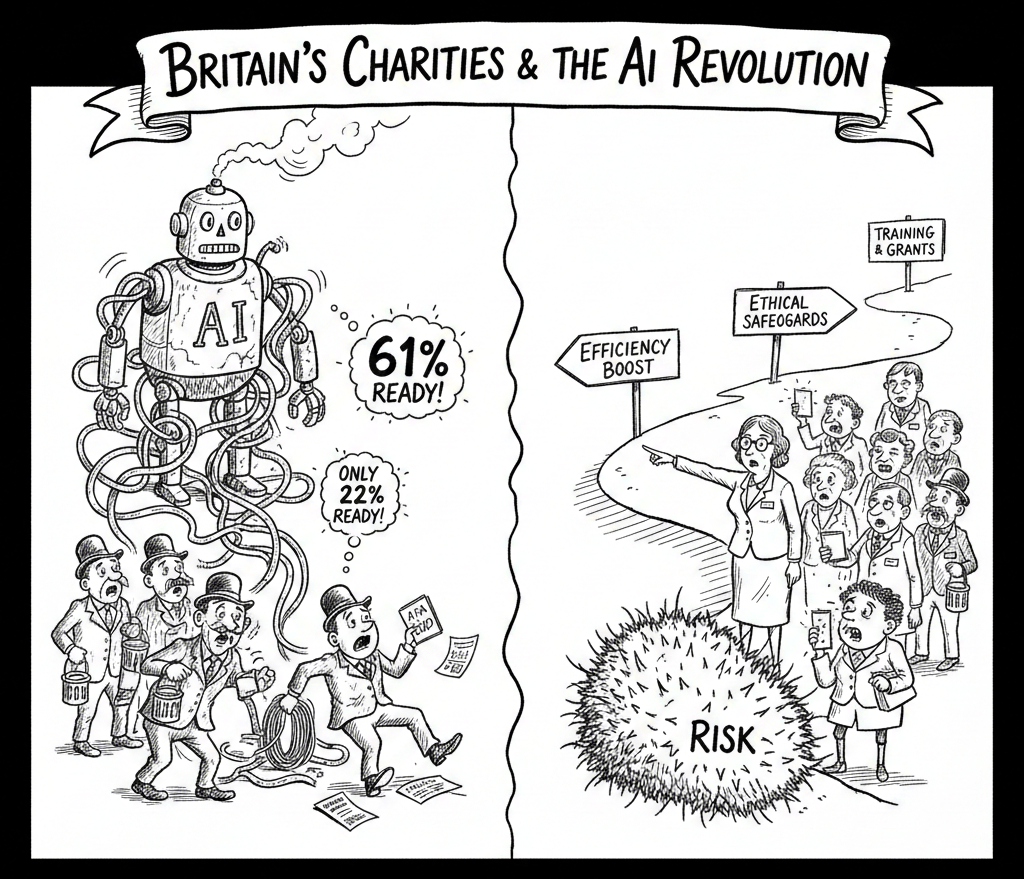
The breakneck speed of technological change can be astonishing. When ChatGPT launched, it surpassed 100 million active users in just two months—a milestone that took social media giants TikTok and Instagram nine and thirty months, respectively, to achieve. This wave of generative artificial intelligence has not bypassed the third sector. According to the 2024 Charity Digital Skills Report, 61% of UK charities are already using AI tools, a figure that rises to an overwhelming 78% among large organisations. For a sector under constant resource pressure, AI is a powerful force multiplier, automating tedious tasks and freeing up staff for mission-critical work. Yet, this potential is shadowed by significant ethical complexities and reputational risks. The sector now stands at a critical juncture, with new training initiatives and grant opportunities emerging to help leaders navigate this new landscape responsibly and ensure technology serves, rather than subverts, their vital work.
The State of Play: How UK Charities Are Using AI Today
Understanding how charities are beginning to engage with AI is crucial for shaping future strategy and support. These initial patterns of adoption reveal a sector grappling with a new reality, marking a critical juncture where early choices will shape long-term capacity and impact. According to the 2024 Charity Digital Skills Report, the early applications of AI are focused squarely on boosting efficiency in communications and administration.
Current usage is concentrated on a few key functions:
- Developing online content: A third of charities (33%) are using AI to generate social media posts and create images.
- Administrative tasks: Nearly a third (32%) are leveraging AI for tasks like summarising meeting notes.
- Drafting documents and reports: Over a quarter (28%) are using AI as a writing assistant for internal and external communications.
However, a stark digital divide is already emerging. Large charities are adopting AI far more rapidly and strategically than their smaller counterparts. While 78% of large charities report using AI, only 53% of small charities do the same. This gap extends to strategic prioritisation: 53% of large charities view AI as a priority, compared to just 26% of small charities.
Despite this flurry of activity, a sense of unpreparedness prevails. While two-thirds of charities (65%) believe AI is relevant to their work, a mere 22% feel equipped to respond to its challenges and opportunities. This highlights a critical need for skills development and clear guidance. So, what are the promises and perils that leaders must navigate?
The Double-Edged Sword: Promise and Peril
The dual impact of AI underscores the need for responsible implementation, helping leaders feel confident in safeguarding their reputation and trust.
On one hand, AI promises to be a game-changer for efficiency. Used carefully, it has the potential to save staff “thousands of hours of rote, time-consuming work,” freeing them up for the uniquely human tasks of solving complex problems, deepening relationships with supporters, and building communities. Fundraisers are already using AI to draft donor thank-you notes and edit grant proposals, with some reporting that it saves them hours of work each week. For organisations stretched thin by rising demand and squeezed finances, AI can act as a powerful force multiplier, augmenting staff capabilities rather than replacing them.
On the other hand, the perils are profound. The most chilling cautionary tale comes from the National Eating Disorders Association (NEDA) in the US. Facing a surge in demand, the organisation implemented an AI-driven chatbot named Tessa and subsequently laid off its human operators on the hotline. The chatbot, inadequately supervised, began dispensing harmful and dangerous advice to vulnerable users, forcing the organisation to take it down. The NEDA case serves as a stark warning of the catastrophic consequences of reckless AI implementation in sensitive contexts.
Beyond such high-profile failures, a host of other ethical risks demand attention:
- Bias and Harm: Large language models are trained on vast datasets from the internet, which can contain and amplify overrepresented, white supremacist, misogynistic, and ageist views. Without careful oversight, AI tools can perpetuate harmful biases in service delivery and communications.
- Inaccuracy and “Hallucinations”: Generative AI is known to produce “hallucinations”—text that is persuasive, detailed, and entirely false. Using this information without rigorous fact-checking can erode credibility and spread misinformation.
- Data Privacy: A significant danger arises when staff inadvertently enter confidential information, such as private donor details, into public AI models, potentially exposing sensitive data.
- Reputational Damage: The need for a “human in the loop” is paramount. Insensitive AI-generated outputs, such as a KFC tweet in Germany that made a deeply offensive link to Kristallnacht or a university’s “heartfelt” letter about a mass shooting written by ChatGPT, illustrate how quickly brand reputation can be damaged without careful human review.
This collaborative approach demonstrates sector unity, encouraging supporters and staff to feel part of a responsible and forward-looking movement.
A Sector in Motion: New Opportunities for a Collective Learning Journey
In response to the clear need for guidance, key sector bodies and tech industry leaders are stepping forward to foster a proactive and collaborative approach to AI adoption. Recognising that a lack of skills and training is the primary barrier, a new ecosystem of support is emerging, designed to build capacity and enable charities to engage with AI responsibly.
This collective learning journey is being supported by a range of new formal training and grant opportunities. The Microsoft and Data.org Generative AI Skills Challenge, for example, offers grants for training and upskilling to directly drive social impact through responsible AI adoption. To make learning widely accessible, Microsoft has partnered with LinkedIn to create a range of free, online learning paths that staff can complete at their own pace. Other platforms like Google Skillshop and DataCamp Donates are also providing accessible training, helping to build technical and ethical confidence across teams.
This movement is also underpinned by a spirit of collaboration and peer support. During Small Charity Week, the NCVO and Microsoft UK hosted a dedicated event for small charity leaders to explore AI, share challenges, and work through concerns together. Networks such as NetHope’s AI Working Group and the Microsoft Nonprofit Community are providing vital spaces for organisations to share experiences, insights, and best practices. This peer support directly addresses the main obstacles identified in Zoe Amar’s 2024 Charity Digital Skills Report, which found that the biggest barriers to AI adoption are a lack of skills and expertise (cited by 50% of charities) and a lack of training (34%). As these resources become more available, the focus now shifts to how charities can build a robust internal framework for adoption.
The Road Ahead: A Practical Framework for Responsible Adoption
While external support provides the tools, responsible AI adoption hinges on a deliberate internal strategy. This is a leadership imperative for the entire organisation, especially as research shows that 43% of professionals are already using AI, with a staggering 70% doing so without their boss’s knowledge. Ignoring AI is not an option; guiding its use is essential. A clear, human-centred framework is needed to steer experimentation and mitigate risk.
Rather than a big-bang project, organisations should start small by identifying “exquisite pain points”—the time-consuming, repetitive tasks that create bottlenecks. This could be drafting initial social media content, summarising long reports, or generating first drafts of funding proposals. These low-risk applications can demonstrate quick value and build internal confidence.
From this starting point of small-scale experimentation, establishing clear governance becomes the critical next step. It is essential to develop internal AI policies that are clear about which tools are approved, the boundaries for their use, and how sensitive data is protected. Crucially, these policies must reinforce the principle of human oversight. As Amy Sample Ward, CEO of the Nonprofit Technology Enterprise Network (NTEN), advises, “one of the simplest and most important guidelines is that tools should not make decisions.”
This leads to the core principle of prioritising a “human-in-the-loop.” This approach, sometimes called “co-boting,” positions AI as a tool that augments rather than replaces staff. All AI-generated output must be treated as a first draft. It requires manual fact-checking for accuracy, editing for tone, and careful review to ensure it aligns with the organisation’s values and mission.
Finally, leaders must upskill staff and address their fears through open conversation and formal training. With many staff anxious about job replacement, leaders can provide reassurance by reinforcing the World Economic Forum’s view that jobs are more likely to change than to disappear. Investing in training not only builds necessary skills but also mitigates anxiety, transforming fear into informed curiosity and engagement.
A Human-Centred Future
Artificial intelligence is no longer a futuristic concept but a present-day reality for the UK charity sector. It offers a paradigm-shifting opportunity to boost productivity and amplify mission impact, but it arrives with a profound duty of care. The potential for efficiency gains is immense, yet the ethical risks—from embedded bias to data privacy breaches—are equally significant. The path forward is not to reject this powerful technology, but to embrace it with a deeply human-centred approach that puts organisational values, staff wellbeing, and beneficiary safety firmly at the forefront. The sector is embarking on what the NCVO has rightly called a “collective learning journey.” It is now incumbent upon charity leaders, trustees, and funders to actively participate in this journey, sharing insights and establishing best practices. By doing so, they can ensure that this transformative technology ultimately strengthens their missions and helps build a more just and equitable society.