Authenticity vs. AI: Charity Christmas Ads Face a Reckoning
The Season of Goodwill and Growing Pains
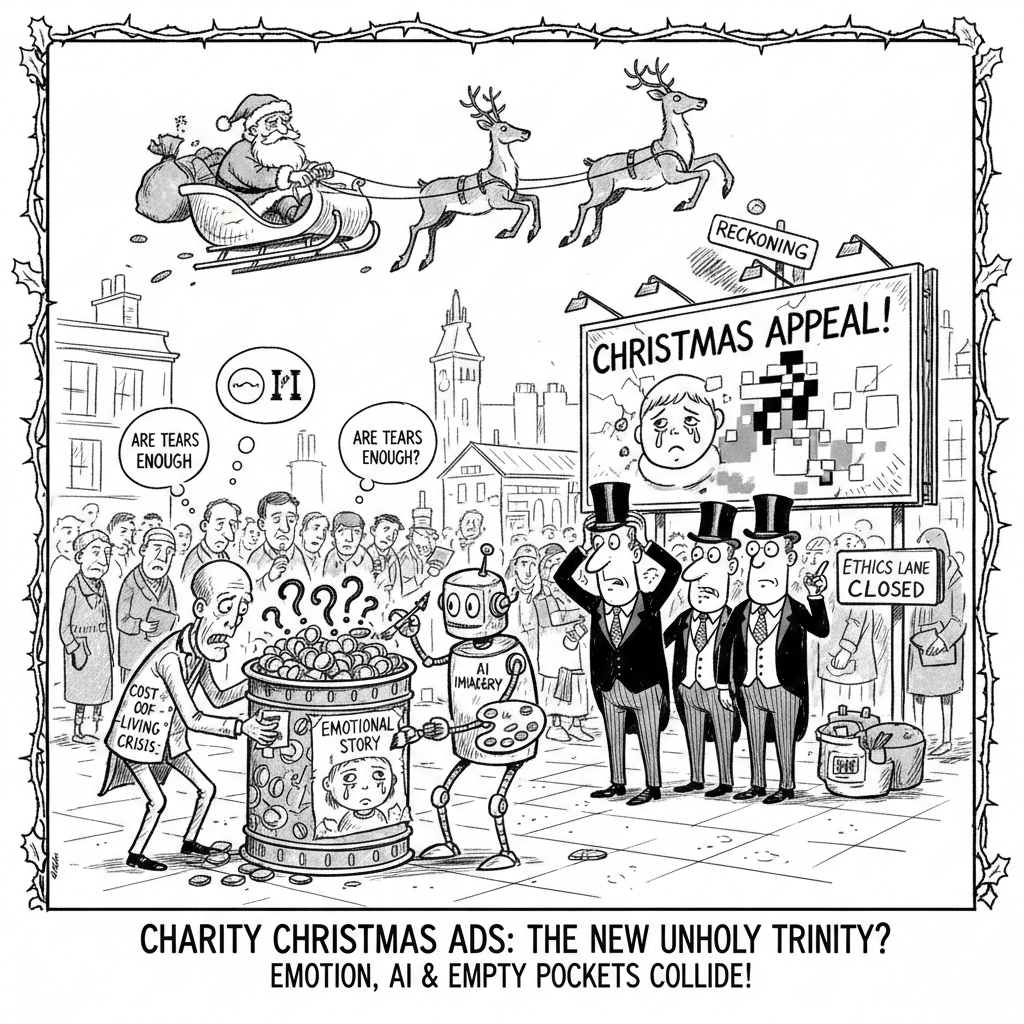
The first wave of 2025’s major charity Christmas campaigns has arrived, with films from Dogs Trust, the Stroke Association, and Francis House Children’s Hospice signalling the start of the sector’s most crucial fundraising period. But this year, the familiar festive appeals land in a profoundly different landscape. As a severe cost-of-living crisis continues to squeeze household budgets, and an explosive ethical debate erupts around the use of Artificial Intelligence in fundraising, a critical question emerges for the sector: are traditional, heartwarming stories still the most effective strategy? The campaigns of 2025 reveal a sector at a crossroads, grappling with fundamental questions of authenticity, effectiveness, and the complex ethics of new technology in its pursuit of public support.
The Class of 2025: A Doubling Down on Authentic, Human-Centred Narratives
In a direct response to an increasingly cynical media environment, many of this year’s leading charities have eschewed celebrity gimmicks and high-concept productions. Instead, they have doubled down on deeply personal and authentic storytelling, aiming to forge genuine emotional connections by grounding their appeals in lived experience. This creative trend sees charities placing the real stories of their beneficiaries and supporters at the very heart of their campaigns.
The approaches, while varied, share a common DNA of raw, unfiltered narrative. While Dogs Trust’s ‘Thank you for my Happy Place’ tugs at the heartstrings from a dog’s-eye view, celebrating the “simple, everyday gestures” of love, Francis House grounds its appeal in the human reality of family life, positioning the hospice as a vibrant “second home” not just for 11-year-old Florence but for her entire support system. The Stroke Association takes a different path to the same goal, using real home videos and photos from stroke survivors, voiced by high-profile supporters like Brian Cox and Alison Steadman, to powerfully juxtapose happy memories with the challenging reality of recovery.
This strategic shift towards authenticity aligns with growing calls within the sector for more ethical, empowering filmmaking practices. As creative agency The Saltways argues, it is vital that beneficiaries are treated as “partners rather than subjects” in the storytelling process. This co-creation not only builds trust but also results in films that feel more credible. Yet, for all their emotional resonance, these human-centric appeals now face a critical test: can heartfelt brand-building truly cut through in a stark economic reality that demands a far more direct conversation about need?
The Cost-of-Living Crisis Shapes the Uncomfortable Reality
While emotional, brand-building films dominate the headlines, other charities are tackling the UK’s economic climate head-on. Recognising the financial pressures on potential donors, these organisations have grounded their appeals in urgent, practical need, making a direct and unambiguous case for support.
The Salvation Army’s Christmas appeals serve as a prime example of this strategy. The “Be a Star” fundraising campaign directly connects to the struggles of families facing “heartbreaking” choices between heating their homes and feeding their children. The approach is relentlessly practical, tying specific donation amounts to tangible outcomes, reassuring donors that £20 could provide a Christmas dinner for five lonely people, while £85 could cover a week of shopping for a family. This message is powerfully illustrated through the story of Emma, a former fundraiser who, after fleeing an abusive marriage, found herself needing support. “The stress of wanting to make Christmas special for the kids was making everything worse,” she recalls. “It was a massive burden off my shoulders.”
This focus on practical value in a time of hardship mirrors strategies seen in the commercial sector. As detailed in a ClickZ analysis, supermarket giant Asda’s “A Very Merry Grinchmas” campaign uses a popular character not merely for entertainment, but to land a clear message about “stretchable budgets” and “value” for “squeezed households.” The shared insight is clear: whether selling groceries or soliciting donations, acknowledging the financial strain on the audience and offering tangible ‘value’—be it a lower price point or a specific, costed outcome—is a critical strategy in a recession.
The Digital Ghost in the Machine: AI and the Spectre of ‘Poverty Porn 2.0’
As charities navigate the economic landscape, an even more complex ethical challenge has emerged. While many organisations champion authentic human stories, an unsettling trend of using AI-generated imagery in fundraising campaigns is raising profound questions about representation and consent, threatening to undermine the sector’s hard-won public trust.
Exclusive reporting from The Guardian has brought this controversy into sharp focus. Researchers have identified a rising number of NGOs using AI-generated images depicting extreme poverty and vulnerable children in their social media campaigns. Driven by lower costs and the ability to sidestep complex consent procedures, these images often replicate what researcher Arsenii Alenichev labels “poverty porn 2.0″—perpetuating harmful, “racialised,” and stereotypical visuals of suffering.
The debate has implicated major international organisations, revealing conflicting and rapidly evolving approaches. Plan International, for instance, initially justified its use of AI in a 2023 campaign as a way to “safeguard the privacy and dignity of real girls,” though the organisation has since adopted guidance advising against using AI to depict individual children. Conversely, the United Nations was forced to remove a video that used AI “re-enactments” of sexual violence after it was deemed an “improper use of AI” that risked blending real footage with artificial content.
This issue is not confined to the charity sector. Coca-Cola’s 2025 AI-driven Christmas ad sparked a “mass debate” online, with some critics calling it “creative bankruptcy.” According to the Charity Digital “Marketing trends for charities in 2025” report, while many charities are considering AI for content creation, consumer sentiment remains wary, with two-fifths stating that AI-generated ads bother them. This growing controversy forces a difficult conversation not just about how stories are told, but whether the methods used are fundamentally undermining the very act of telling them.
The Enduring Question of Effectiveness
Beyond the creative and ethical debates, the sector faces a perennial challenge: proving the tangible impact of expensive, high-profile Christmas campaigns. In an environment of heightened scrutiny, generating festive goodwill is no longer enough. There is growing pressure on charities to demonstrate a clear and measurable return on their significant marketing investment.
In a critical analysis for UK Fundraising, consultant Mark Phillips points to the danger of the “John Lewisification of charity advertising.” This critique lands squarely on campaigns like those from Dogs Trust and Francis House, questioning whether their “exquisite, expensive films whose primary job is to make audiences feel moved, while the secondary job – the actual behavioural objective – is left to fend for itself.” This focus on emotional engagement over a direct call to action, he suggests, often fails to translate into a tangible increase in donations.
This view is bolstered by academic research. A systematic literature review published by IDEAS/RePEc, which analysed 79 articles on charity advertising, found that the extensive body of research on using emotions to encourage donations presents “conflicting evidence.” There is no clear consensus that making an audience feel sad, hopeful, or inspired directly leads to prosocial behaviour. This mirrors the intense pressure for accountability in the commercial world. The ClickZ analysis of seasonal advertising stresses the need to measure “full-funnel impact” and prove that a campaign “genuinely move[d] the… business forward,” rather than just making marketers “feel busy.”
A Sector at a Strategic Crossroads
The 2025 Christmas season finds the UK charity sector navigating a complex web of competing pressures. The drive for raw authenticity clashes with the seductive efficiency of AI; the timeless power of emotional connection is weighed against the urgent demand for demonstrable impact; and the need to tell hopeful stories is set against a backdrop of deep economic hardship. The decisions charities make today—particularly regarding the ethical adoption of new technologies and a commitment to authentic representation—will be critical in maintaining public trust for years to come.
As the Charity Digital report highlights, trust in a charity’s own website (73%) is nearly double the trust placed in social media (38%). This underscores the vital importance of charities controlling their own narratives on trusted platforms, free from the misinformation and ethical ambiguities of the wider digital world. Ultimately, the most successful campaigns of the future will be those that masterfully blend heartfelt, human-led storytelling with undeniable proof of their impact, reassuring donors that their compassion is not just felt but channelled into meaningful, measurable, real-world change.