Charity Commission’s Balancing Act: New Strategy Meets Record Demand
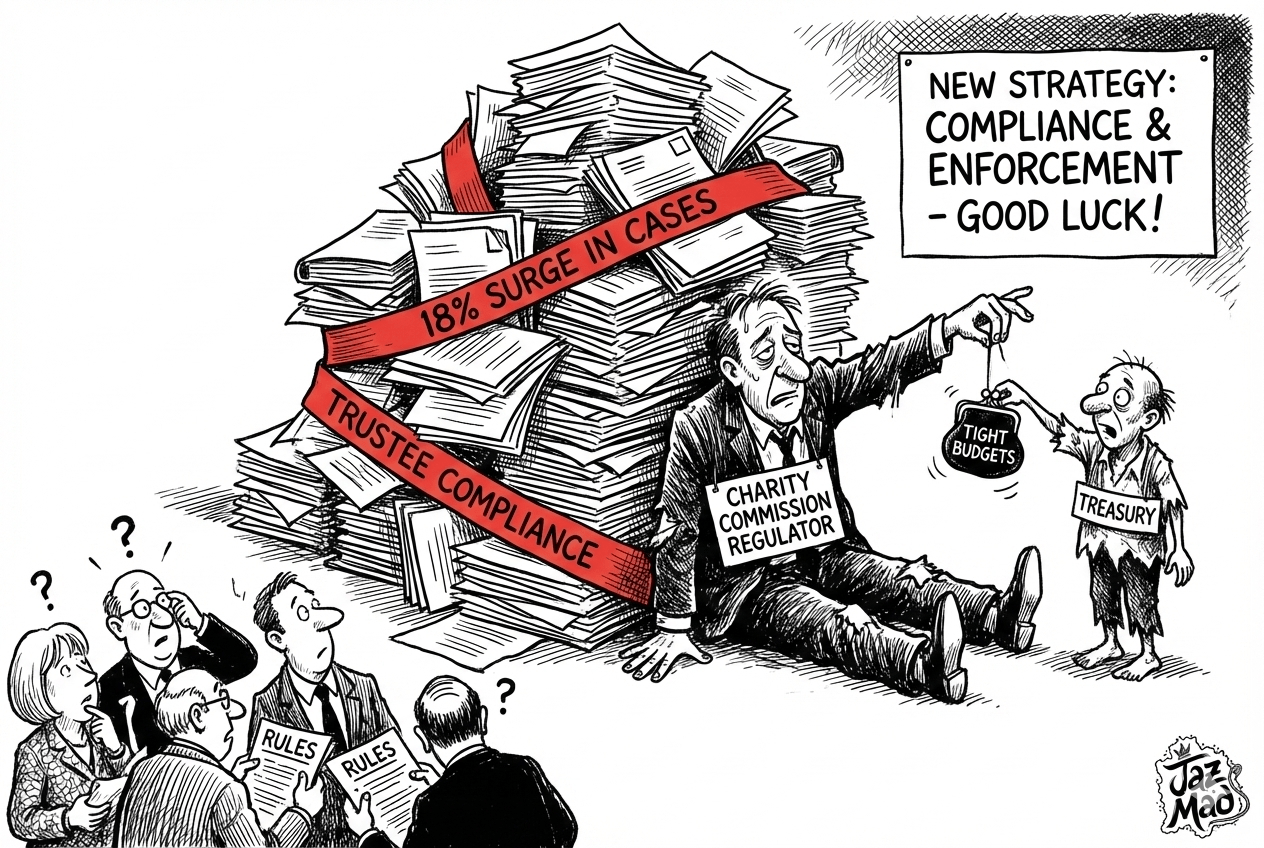
The Charity Commission for England and Wales has painted a picture of a year defined by “continued change and challenge” in its 2024-25 Annual Report. The regulator is grappling with a record-breaking and increasingly complex workload, all while operating under a tightly constrained budget. This pressure is starkly illustrated by a 9% year-on-year increase in charity registration applications and a significant 18% rise in concluded regulatory concern cases. In response, the Commission has launched a new five-year strategy and has seen a near-complete turnover in its most senior leadership roles. For the thousands of charities across England and Wales, this report offers the first critical insight into how the regulator plans to balance vital support with robust enforcement in an increasingly volatile environment, with direct implications for every trustee and organisation.
A Strategy Tested by Rising Tides
The Commission’s new five-year strategy, which aims to be a “fair, balanced, and independent” regulator, is crucial for sector stakeholders as it directly influences how the regulator addresses unprecedented operational pressures and shapes future sector support and enforcement efforts.
The key statistics defining this challenge are stark:
- A record 9,836 applications to register a new charity were received.
- 4,375 regulatory concern cases were concluded, representing an 18% increase from the previous year.
- 112 new statutory inquiries—the Commission’s most serious form of engagement—were opened.
These figures directly substantiate the report’s narrative of intensifying “volume and complexity” in casework. This surging demand must be managed within a tight financial reality, with the Commission’s revenue budget for the year standing at £32.149m. This tension between a surging workload and a static budget forces a critical question: can the Commission effectively deliver on both halves of its dual mandate—support and enforcement—or will one inevitably be compromised?
The Dual Mandate: Support and Enforcement in Action
Balancing robust enforcement against wrongdoing with proactive support for trustees is fundamental to maintaining public trust and enabling the sector to thrive—a core priority of the Commission’s new strategy. The annual report provides a detailed account of the regulator’s performance against this dual mandate, using specific examples to illustrate its impact on the ground.
- Enabling and Supporting the Sector: The report highlights the Commission’s role as an enabler, citing the 3,320 instances in which it used its “permissive action powers” to authorise charity actions. High-profile examples demonstrate the significant economic and social impact of this work. Permissions granted to the Wellcome Trust will facilitate a major expansion of its Genome Campus in Cambridgeshire, securing its status as a world-leading scientific hub. Similarly, the Commission authorised the flotation of the Raspberry Pi Foundation’s trading subsidiary, a move described in the press as a ” real shot in the arm for sentiment for the London Stock Exchange”. This supportive role also extends to individual trustees, with the Commission publishing the “most extensive research ever undertaken in England and Wales into trusteeship” and reworking its guidance on financial resilience.
- Robust Enforcement and Intervention: On the enforcement side, the Commission’s activity has been equally pronounced, with 37 trustees disqualified and 1,858 uses of “regulatory action powers” The regulatory compliance case into Penny Appeal serves as a clear case study. Following an Official Warning from the Commission concerning failures in governance and conflicts of interest, the charity implemented key improvements. These included appointing a minute taker for trustee meetings, recording conflicts of interest, and terminating a contract that was the source of a perceived conflict. This intervention demonstrates the regulator’s focus on securing tangible improvements to protect charitable assets and public confidence.
This complex balancing act is being managed by a leadership team undergoing its own significant transformation.
A Changing of the Guard and the Hunt for Expertise
For a regulator’s credibility to be maintained, a stable and expert leadership team is vital. The past year at the Charity Commission has been one of significant transition at the highest levels, reshaping the team responsible for delivering its new strategy amid mounting challenges.
The departure of Director of Legal and Accountancy Services Aarti Thakor in May 2024 left a critical vacuum at a time of mounting legal complexity. The subsequent high-profile recruitment drive is therefore not merely about filling a role; it is a direct strategic move to arm the Commission with the ‘expert’ leadership required to navigate the very legal minefields detailed in its own report. This is a direct manifestation of the strategy’s fifth priority: to be the “expert Commission”. In his welcome letter within the candidate brief, new Chief Executive David Holdsworth, who took over from Dame Helen Stephenson in July 2024, underscores this, stating the search is for an “experienced, enthusiastic, and inspirational leader” capable of handling “high profile, and complex legal cases” and engaging at the most senior levels, including with the Attorney General.
The leadership transition also saw Mark Simms OBE appointed Interim Chair in April 2025—a significant change that took place just after the end of the reporting period—following the end of Orlando Fraser KC’s term.
Navigating a Complex Legal and Political Landscape
The Commission’s regulatory work does not exist in a vacuum; it is increasingly scrutinised and shaped by legal challenges and the wider political climate. The annual report highlights several key cases and regulatory actions that set important precedents for the charity sector and vividly illustrate the legal complexity its new director will face.
- Trustee Conduct in the Digital Age: The Mond v The Charity Commission case marked the first successful appeal against a trustee disqualification and the first related to social media activity. The Tribunal made a nuanced distinction between social media ‘posts’ and ‘likes’ in its judgment. Crucially, it cautioned that the case is not intended to provide “broader principles, reinforcing the complex, case-by-case nature of the Commission’s regulatory decisions in this evolving area.
- Charitable Purpose and Global Conflict: The decision to refuse registration for the Ukraine Development Charity (UDC) provides a critical lesson for charities operating in conflict zones. The registration was refused due to the UDC’s lack of independence from non-charitable entities and its potential political purpose arising from military affiliations. This case illustrates the vital importance of demonstrating clear independence and exclusively charitable aims.
- Political Campaigning: The Commission’s proactive engagement ahead of the 2024 General Election was a notable success. By hosting webinars and issuing clear guidance, the regulator saw a “marked improvement in charities’ compliance” with the law. This resulted in a 60% decline in high-risk cases related to political campaigning compared to the 2019 election, demonstrating the effectiveness of a preventative and educational approach.
These high-stakes legal challenges are not isolated incidents; they are the tangible expression of the “intensifying volume and complexity” the Commission cites as its core operational pressure, directly fuelling the demand for expert leadership and robust regulatory frameworks.
A Sector Watching Closely
The Charity Commission’s latest annual report reveals a regulator facing unprecedented demand with finite resources. Its response is a new, ambitious strategy delivered by a new leadership team. The report candidly details the central tension the Commission must manage: its dual role as both a supportive enabler and a robust enforcer. The sector will be watching closely to see how the new executive team translates this strategic ambition into regulatory reality. The ultimate test will be whether the Commission’s drive for “excellence in regulation” can be maintained against persistent pressures. Moreover, the rise in novel cases like Mond, which explores trustee conduct in the digital age, suggests the Commission must now develop a more sophisticated regulatory framework for the social media era—a formidable task that will undoubtedly fall to the new legal director. How the regulator continues to hold charities to account while enabling them to thrive will be the defining measure of its success.