‘We Will Not Comply’: UK Charities in Open Revolt Over Migrant Volunteering Plan
A Sector in Defiance
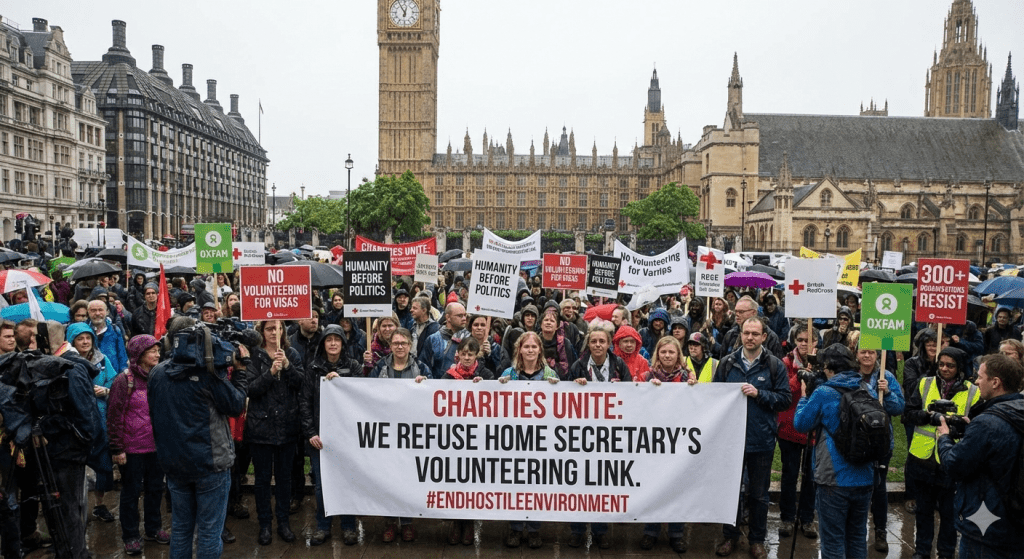
The UK’s charity sector is in open revolt. In an unprecedented show of unity and defiance, more than 300 organisations have declared they will refuse to comply with the Home Secretary’s plan to link volunteering to migrants’ settlement applications. This is not merely a policy disagreement; sector leaders have branded the proposal “immoral and impractical,” framing it as a fundamental battle over the very principle of volunteering. By vowing mass non-compliance, charities are drawing a clear line in the sand, setting the stage for a dramatic standoff with the government. At stake is the relationship between the state and its vast voluntary sector, and the core tenet that giving one’s time should be an act of free will, not a condition of belonging.
The Heart of the Controversy is the Government’s ‘Contribution-Based’ Settlement Plan
This contentious policy did not emerge in a vacuum. It is a key component of a broader, tougher government stance on immigration, designed to redefine the path to permanent settlement in the UK. The proposal seeks to frame the right to remain not as a function of time served, but as a “privilege” to be earned through tangible societal contributions.
The specifics were unveiled by Home Secretary Shabana Mahmood in a speech at the Labour Party conference in September 2025. She announced that the government would consult on a new “contribution-based model” for settlement, outlining a series of stringent new tests. An applicant would need to demonstrate they were:
“…in work; making national insurance contributions; not taking a penny in benefits; learning English to a high standard; having no criminal record; and finally, that you have truly given back to your community, such as by volunteering your time to a local cause.”
This “volunteering test” is intrinsically linked to a major overhaul of immigration rules. Under the new plans, the standard period for a migrant to qualify for Indefinite Leave to Remain (ILR) is set to double, rising from five to ten years. However, the Home Office has clarified that making “contributions to our economy and society”—such as volunteering—could allow individuals to shorten this extended timeframe. This reframes settlement as something that must be actively earned, moving away from what a spokesperson called a “right” towards a “privilege.”
While presented as a uniquely British solution, this approach is part of a wider, ongoing European debate over the role of volunteering in migrant integration. Tensions between viewing such schemes as tools for integration and as forms of exploitation have been debated for years. In Italy, for example, similar initiatives offering community service work to asylum seekers have been both praised for providing productive activity and panned for potentially taking jobs from locals and exploiting migrant labour.
By viewing volunteering as a transactional tool for immigration control, the government has fundamentally misread the very organisations it would need as partners. This has provoked a unified, non-negotiable sector-wide rebellion, the consequences of which could be severe for both the government and the charity sector.
The Sector’s Principled and Practical Objections
The scale of the charity sector’s response has been remarkable, signalling a near-universal rejection of the policy. An open letter sent to the Home Secretary has been co-signed by over 300organisationss, ranging from the influential National Council for Voluntary Organisations (NCVO) to the Charity Retail Association, local Citizens Advice branches, and grassroots refugee support networks. This united front, a testament to the sector’s strength and unity, demonstrates a sector-wide belief that the proposal is ethically indefensible and operationally unworkable.
The sector’s primary charge against the plan is ethical, arguing it represents a fundamental perversion of the act of volunteering. Leigh Brimicombe of the NCVO stated that the plan “fundamentally undermines the idea of volunteering,” because its value lies in being an act of “your own free will.” This view was echoed by Janet Thorne, CEO of Reach Volunteering, who argued, “Volunteering is about compassion and connection, not compliance.” Sarah Wilson of the Penrith and Eden Refugee Network put it even more starkly, stating that volunteering “should not be weaponised to prove ‘contribution’ to the UK.” The open letter itself condemns the proposal as “an exploitation of volunteering” that would “create a population of people forced to work for free.” Critically, it also serves as a statement of solidarity, with signatories vowing: “We will not allow our volunteers’ valuable work to be used against other migrants and racialised people who aren’t able to volunteer.” This commitment to the ethical principles of volunteering is a testament to the sector’s values and integrity.
Beyond the moral objections, charities have raised serious concerns about the immense practical strain the policy would create. Any system of mandatory volunteering would require a “huge amount of reporting work,” a burden that would fall squarely on organisations already “stretched near breaking point.” This challenge is particularly acute for the smaller, grassroots charities that make up the sector’s backbone. As analysis from the Institute of Chartered Accountants in England and Wales (ICAEW) highlights, many charities already struggle with complex compliance and legal frameworks and often lack the specialist skills to manage them. For these organisations, the prospect of diverting scarce resources to become an arm of Home Office reporting is not just onerous, but operationally impossible. This emphasis on the practical challenges underscores the sector’s operational realities and the potential impact on its ability to deliver its core services.
Ultimately, the sector’s opposition is rooted in the policy’s damaging and discriminatory impact on individuals. Gee Manoharan of the Association of Visitors to Immigration Detainees (AVID), who came to the UK seeking asylum, offered a powerful personal testimony: “Volunteering wasn’t a condition of my belonging—it was how I discovered I already belonged.” Louise Calvey of Asylum Matters notes that the plan “ignores and undermines the immense contribution already made to the voluntary sector by migrants,” especially people seeking asylum who are banned from paid employment. The open letter also points to the inherent unfairness for those unable to volunteer due to “caring responsibilities, disabilities, health needs or work schedules.” Most chillingly, it highlights the profound risk for one particularly vulnerable group, stating: “We also share the concern of organisations supporting survivors of modern slavery and human trafficking, who fear these proposals may pressure survivors into unpaid work that could be deeply damaging for their journey of recovery.”
A Collision Course Over the Meaning of Community.
Despite the challenges and threats posed by the government’s plan, the charity sector remains committed to its values and mission, ready to defend the very principle of volunteering that it stands for.
The government is determined to pursue a tougher, more conditional immigration policy. Still, in doing so, it has provoked a unified and principled backlash from the very organisations it would need to enact its vision. The result is an impasse. The charity sector has made its position unequivocally clear with the powerful declaration: “We will not work with coerced volunteers.” While the Home Office intends to launch a public consultation, the sector’s red lines have already been firmly drawn. The sector’s refusal to become an arm of immigration enforcement has drawn a new, indelible line in the sand. The outcome will not only determine the fate of this policy but may redefine the boundaries of state-charity partnership for a generation, testing whether the sector’s core principles can withstand direct political pressure.