More Than a Festive Fixture: How West Ham’s Christmas Campaign Offers a Blueprint for Social Value
More Than Just a Match
In an era defined by a persistent cost-of-living crisis and community needs more acute than ever, the role of corporate social responsibility is under intense scrutiny. Against this backdrop, West Ham United’s ‘United at Christmas’ campaign emerges not merely as a seasonal act of goodwill, but as a compelling case study for the UK charity sector. It demonstrates how a major commercial brand can strategically deploy its influence, resources, and star power to create deep, multi-faceted community impact. This is not just about footballers handing out gifts; it is a calculated, year-round operation reaching its most visible peak during the festive season.
The campaign’s scope is extensive, encompassing traditional hospital visits by first-team players, surprise appearances at events for the elderly, bespoke hamper donations for NHS staff, and youth-led fundraising for toy appeals. While the immediate impact is a boost in morale for thousands across East London, for charity professionals, the critical question lies deeper: what strategic framework, leadership, and long-term commitment enable such a high-profile, wide-ranging community programme to succeed? This investigation into West Ham’s festive outreach reveals an organisational model built for sustained social change, powered by a sophisticated charitable foundation.
Spreading Festive Spirit Across East London
For any community-focused organisation, a key strategic challenge is ensuring that outreach is both broad and deep. West Ham’s festive activities exemplify a comprehensive approach, consciously targeting a diverse range of demographics—from young hospital patients and their families to isolated elderly fans and vulnerable children. This multi-pronged strategy ensures the club’s presence is felt across the entire community ecosystem, reinforcing its identity as an institution embedded in the fabric of East London.
The campaign’s heartwarming centrepiece involved traditional visits by Men’s and Women’s First Team players to local hospitals. Stars including Jarrod Bowen, Alphonse Areola, Tomáš Souček, Anna Csiki, Eva Nyström, and Seraina Piubel brought gifts and festive cheer to patients and staff at Newham Hospital, Queen’s Hospital in Romford, King George Hospital in Ilford, and St Francis Hospice in Romford. This was complemented by a highly personal gesture at The Royal London Hospital, where Chairman David Sullivan personally funded the delivery of 70 bespoke “West Ham-pers”. The initiative was a partnership with the Secret Hampers ‘ThankYouNHS’ campaign, founded by lifelong West Ham fan Nigel Richardson in memory of his late father. The delivery was also a specific thank-you for the care given to player Michail Antonio following a road traffic accident.
The club’s engagement extended beyond medical facilities. Men’s Head Coach Nuno Espirito Santo made a surprise visit to the Any Old Irons Christmas party, a group for supporters aged over 65, at the iconic Boleyn Tavern. Meanwhile, the club’s future stars demonstrated their own commitment, with Academy scholars raising over £800 to purchase toys for the Ambition Aspire Achieve (AAA) Newham Christmas Toy Appeal.
The impact of this presence was articulated by those on the front line. Simon Ashton, Chief Executive at Newham Hospital, noted the visits gave staff “a much-needed morale boost during this busy festive period,” a sentiment echoed by Anna Page, Deputy Chief Nurse at King George Hospital, who said the players’ visit “really helps lift everyone’s spirits.”
The players themselves understand this responsibility. Men’s Captain Jarrod Bowen emphasised the club’s ethos:
“It’s really important as a Club, being a family-oriented Club, it is what we pride ourselves on, looking out for everyone in our community. It’s a difficult time for people being in hospital at Christmas, but if we can come here and lift their spirits, it’s a great thing.”
Women’s midfielder Anna Csiki added a crucial perspective on the reciprocal nature of this work:
“It puts everything into perspective for us as players as well. It’s important that we give back and support our local community, and I’m pleased we could do that today.”
These coordinated activities are far from spontaneous; they are the public manifestation of a powerful and independent engine working behind the scenes.
The Engine Room: The West Ham United Foundation
For charity sector professionals, the most significant lesson from West Ham’s community work is that these initiatives are not ad-hoc gestures. They are the visible output of a sophisticated charity: the West Ham United Foundation. Crucially for governance, the Foundation is an independent entity; as its Annual Report clarifies, “it operates independently of the football club and…the articles of association confer no ability by the club to exercise control over the company.” It is the strategic engine that translates brand power into tangible, year-round social programmes, operating with a clear mission:
“To provide an innovative approach to understanding and meeting the needs of our community; building partnerships and utilising insight and technology to create an environment where all can thrive – from the heart of East London.”
The scale of this operation is substantial. According to its 2022/23 Annual Report, the Foundation runs over 30 distinct initiatives that reach thousands of people each week, supported by a total income of over £3.61 million. It is a significant charitable entity in its own right, delivering programmes that span health, education, employability, and social inclusion.
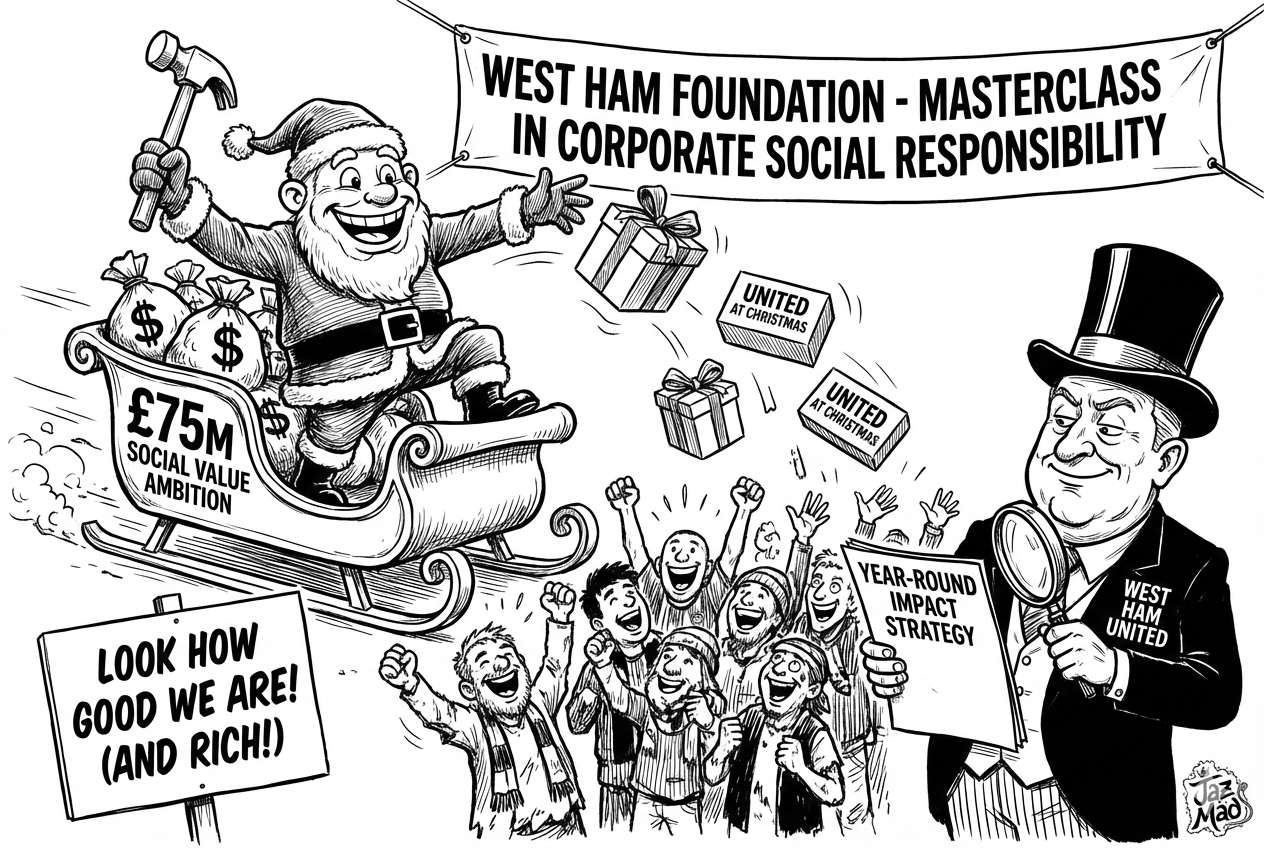
A cornerstone of its expanding ambition is “The Foundry,” the Foundation’s new state-of-the-art community hub in Beckton. Celebrated at a recent Gala Dinner at Mansion House, this facility is designed to dramatically increase the club’s community footprint. The ambition is for The Foundry to reach over 60,000 people annually and deliver an estimated £75 million in social value within its first five years.
Crucially, the Foundation’s work addresses complex social issues far beyond the festive season. Its portfolio details targeted interventions including mental health mentoring, employability support, and knife crime prevention programmes. This provides the strategic depth behind the high-profile Christmas work; while hospital visits provide immediate comfort to those suffering from illness or injury, the year-round programmes are designed to tackle the root causes of poor health and youth violence. A prime example of this deep-rooted commitment is the West Ham United Night Shelter. Operating from The Foundry, the shelter provides a hot meal and a safe place to sleep every Saturday night, a service that was extended to a nightly offering during the Christmas period. This demonstrates that while the Christmas campaign provides visibility, the Foundation’s core work is a year-round lifeline for the most vulnerable.
A Case Study in Community Cohesion
The true measure of a community programme’s success lies in its authenticity. West Ham’s approach demonstrates the strategic value of being a deeply embedded local partner rather than a distant corporate donor. The presence of players, coaches, and staff across the community creates a powerful sense of shared identity and mutual appreciation.
This impact is best understood through the voices of those who experience it directly. From the frontline of the NHS to the heart of the fanbase, the sentiment is one of genuine connection.
- The Frontline View: Zane Perkins, the Trauma Surgeon who treated Michail Antonio, highlighted the unique power of this local bond. “Smaller towns and cities have a much bigger community feel, and in London that can be lost because of its size,” he reflected. “So it’s nice to see when it does happen.”
- The Leadership Vision: At the Foundation’s Gala Dinner, CEO Joseph Lyons framed the work as essential, particularly in difficult times. He spoke of the event providing “recognition and validation for our Foundation” and the vital need to “respond to urgent needs during what is already proving to be a harsh winter.”
- The Beneficiary Perspective: The gestures of appreciation resonated deeply with staff and fans. Gary, a Porter Manager and lifelong West Ham supporter, said of the hamper delivery, “I feel appreciated, feel proud that whatever you do is making an impact on people and that gratitude is shown.” Similarly, after the Head Coach’s surprise visit, Any Old Irons member John Gregory captured the simple joy of the moment: “It was an absolute delight to see him, what a lovely man he is and it’s made the day feel complete.”
These individual stories, woven together, paint a picture of an organisation that has successfully integrated into its community, building social capital that extends far beyond the 90 minutes on the pitch.
A Model for the Future?
West Ham United’s ‘United at Christmas’ campaign is more than a seasonal highlight; it is a powerful and replicable example of how a high-profile commercial brand can deliver authentic and strategic social value. By channelling its outreach through a dedicated, professional, and independently constituted foundation, the club has created a sustainable model for community engagement that is both highly visible and deeply impactful. The campaign successfully leverages the emotional power of football to open doors, build trust, and deliver vital support where it is needed most.
Looking ahead, the West Ham United Foundation is already focused on the next set of challenges. Its formal “Plans for future periods” explicitly state an intention to sharpen its focus on tackling the most entrenched issues facing its community. With the cost-of-living crisis, food insecurity, and youth violence all cited as priority areas, the Foundation is positioning itself not just as a service provider but as “an anchor in the community.”
For the wider charity sector, West Ham’s model offers a crucial insight. The question for other charities, then, is not whether they can replicate West Ham’s budget, but whether they can replicate its model of deep integration, leveraging a powerful brand not just for fundraising, but for building tangible, year-round community infrastructure. In an uncertain economic climate, such deeply embedded partnerships represent a sustainable pathway to building community resilience, proving that when harnessed correctly, the power of a brand can be a transformative force for social good.