Navigating the Minefield: UK Charities Face Heightened Scrutiny Over Foreign Military Support and Terrorist Financing
Risks
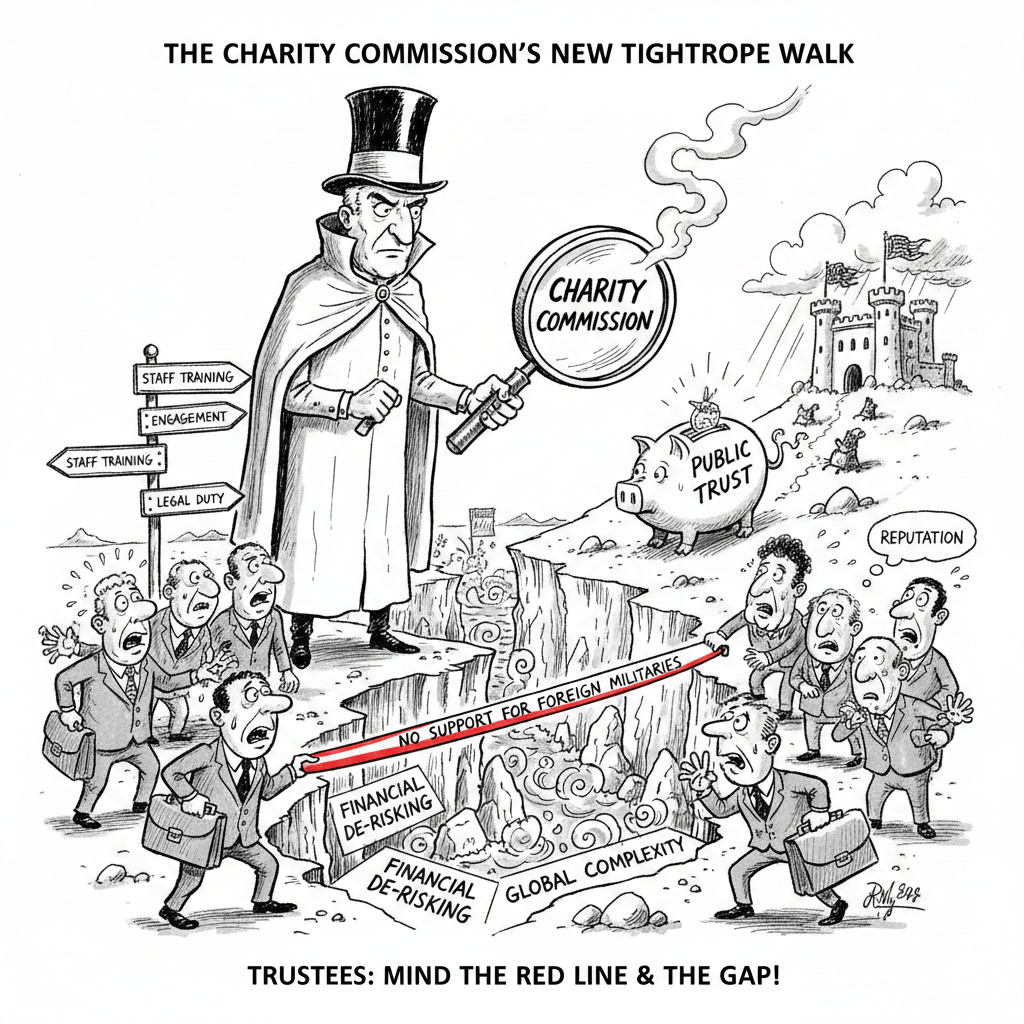
A regulatory shot across the bows has put the UK charity sector on high alert following a series of stark Official Warnings from the Charity Commission. Recent actions against organisations like Chabad Lubavitch and Mizrachi UK, sanctioned for fundraising in support of the Israeli Defence Forces (IDF), have cast a harsh spotlight on the legal and reputational risks facing charities operating in relation to international conflicts. These cases highlight the importance of understanding what constitutes ‘foreign military support’ and ‘terrorist financing’ under UK law, helping trustees identify activities that are clearly outside legal boundaries. Since the escalation of conflict in the Middle East in October 2023, the Commission has launched over 200 regulatory cases, signalling an era of heightened scrutiny for any charity whose work touches, directly or indirectly, the world’s most volatile regions. For trustees across the country, the message is stark: navigating this complex environment demands a level of diligence and legal clarity that has never been more critical.
The Bright Red Line: When Support Becomes Unlawful
The recent regulatory actions against Chabad Lubavitch and Mizrachi UK provide a crucial, real-world case study for all charity trustees, drawing a clear and unambiguous line in the sand regarding the legal boundaries of charitable purpose. These cases serve as a powerful clarification of what constitutes permissible activity, particularly when it intersects with the actions of foreign armed forces.
The investigations centred on fundraising activities that strayed beyond the confines of established charitable law in England and Wales. Chabad Lubavitch was found to have set up a fundraising page for an individual soldier in the IDF, raising approximately £2,280. Of the £2,280 raised, £937 was sent directly to the individual soldier—with trustees unable to account for its final use—while the remainder was spent on purchasing and sending non-lethal military equipment to the same individual. Similarly, Mizrachi UK used its website and social media channels to promote a fundraising appeal to provide equipment to soldiers serving in a foreign military. The probe into Mizrachi UK also examined allegations that it had provided a platform for speakers known for inflammatory rhetoric, further risking the charity’s reputation.
In its findings, the Charity Commission established a definitive legal position that leaves no room for interpretation, stating unequivocally that ‘providing aid or military supplies to any foreign armed force is not a charitable purpose, and no charity can legally undertake such activity.’ This position applies broadly across all types of charities, regardless of size or focus, emphasising that any activity supporting foreign military forces is outside legal boundaries. Helen Earner, the Commission’s Director for Regulatory Services, further clarified that it is ‘not lawful, or acceptable, for a charity to raise funds to support a soldier of a foreign military.’ Understanding this universal stance helps trustees evaluate their own activities and avoid inadvertent breaches, ensuring their operations remain within legal limits and align with their charitable purpose.
The Commission identified several specific breaches of trust and charity law, which serve as a warning to the entire sector. These included:
- Acting Outside Charitable Purposes: Both charities undertook fundraising for purposes that are not legally charitable in the UK.
- Mismanagement and Misconduct: The actions were deemed to constitute misconduct and/or mismanagement in the administration of a charity.
- Failure to Safeguard Reputation: Promoting military fundraisers and hosting controversial speakers were seen as actions that risked damaging the charities’ reputations and undermining public trust.
- Misuse of Charity Resources: The use of charity platforms, websites, and social media to promote an inappropriate appeal was found to constitute a breach of duty.
- Lack of Financial Accountability: In one case, trustees were unable to account for how a portion of donated funds sent directly to an individual soldier had been spent.
These specific breaches demonstrate a pattern of governance failure, turning the focus from isolated errors to the fundamental principles of risk management that all trustees are legally bound to master.
The Trustee’s Playbook: A Risk-Based Approach is Non-Negotiable
While the recent warnings are stark, they are not the result of new legislation. Instead, they are rooted in long-standing legal duties and international standards that underpin charity governance in the UK. For trustees, these cases serve as a critical reminder that a robust, proportionate, and evidence-based risk management framework is not a bureaucratic exercise, but a non-negotiable legal and ethical obligation.
At the heart of this framework lie the core legal duties of trustees. Under charity law, trustees must comply with the principles of duty of care and duty of prudence. This means they are legally required to exercise reasonable care and skill to protect the charity’s funds, assets, and reputation from undue risk. Crucially, they must ensure that all funds are used exclusively for the charity’s stated purposes. Failure to do so is not merely poor practice; it is a breach of charity law.
To translate these duties into practical action, Charity Commission guidance centres on three fundamental principles of due diligence, which are in line with standards set by the Financial Action Task Force (FATF), the global standard-setter for combating terrorist financing:
-
‘Know Your Donor’: Trustees must take reasonable steps to verify the provenance of funds, particularly significant donations, to ensure they are not from illegal or inappropriate sources.
-
‘Know Your Beneficiaries’: Trustees must be clear about who their charity is helping and ensure that they fall within the charity’s stated purposes and that funds are not being diverted.
-
‘Know Your Partner’: When working with other organisations, trustees must conduct proper checks to be confident in their partner’s identity, credentials, capability, and good standing.
These principles underpin the “risk-based approach” mandated by both the Charity Commission and FATF. This approach is fundamentally different from a “one-size-fits-all” model, which FATF explicitly identifies as bad practice. A risk-based approach requires trustees to identify and assess the specific risks their charity faces and then apply mitigation measures that are proportionate to those risks. A small, local charity will have a very different risk profile from a large international NGO operating in a conflict zone, and their compliance efforts should reflect that reality. Applying disproportionately heavy measures can lead to negative unintended consequences, such as financial institutions engaging in “de-risking”—the wholesale denial of banking services to entire categories of non-profits—which can cripple legitimate humanitarian work. The key, therefore, is for diligence to be tailored, intelligent, and defensible—transforming compliance from a box-ticking exercise into a state of genuine organisational resilience in the face of mounting external pressures.
From Theory to Practice: Identifying the Red Flags in a Complex World
To be effective, high-level risk management principles must be translated into actionable intelligence that enables trustees and staff to recognise specific warning signs in their day-to-day operations. Effective governance depends not just on having policies, but on the ability to spot the red flags that indicate potential misuse, diversion, or abuse of charitable funds.
Synthesising guidance from the UK Charity Commission and international bodies, a clear picture of suspicious indicators emerges. This operational vigilance must also account for an evolving global threat landscape, with international risk assessments highlighting new typologies that UK trustees must be alert to. Trustees should be particularly vigilant in three key areas.
Suspicious Donations and Donors
While most donations are made in good faith, charities must be alert to attempts to use them as a channel for illicit funds. Key red flags include:
-
Unusual or substantial one-off donations, or a series of smaller donations, from sources that cannot be easily identified or verified.
-
Donations with complex or unusual conditions attached, especially those that require the charity to act merely as a conduit to transfer funds to another organisation or individual.
-
Requests to return the principal sum of a donation after a short period, often with the charity retaining the interest.
-
Anonymous donations whose context or amount raises concern.
-
Donations are solicited through modern online methods like crowdfunding, which can obscure the ultimate source of funds and attract both witting and unwitting supporters of terrorist causes from across the globe.
Vetting Partners and Projects
When working with other organisations, especially in high-risk environments, thorough due diligence is essential to prevent funds from being diverted. Warning signs include:
-
Project proposals that are vague, lack financial detail, or are difficult to monitor.
-
Difficulty in verifying an organisation’s identity, legal status, or track record, particularly given the rise of ‘sham charities’—entities established under the guise of humanitarian work but designed from their inception to funnel money to illicit groups.
-
Unusual payment requests, such as cash payments, payments to a third-party account, or payments into an account in a country different from where the partner or project is based.
-
A partner’s reluctance to provide monitoring reports or agree to site visits.
-
Proposals that involve delegating significant work to other, unknown organisations.
Beneficiary and End-Use Verification
Ensuring aid reaches its intended recipients is a core trustee duty, but this can be challenging in chaotic environments. Indicators of potential fraud or diversion include:
-
Beneficiary lists that appear to have been manipulated, containing duplicate names, multiple manual corrections, or suspiciously identical details.
-
Evidence that third parties have demanded payment or bribes for placing individuals on aid distribution lists.
-
Discrepancies between the number of beneficiaries reported and the amount of aid requested or distributed.
-
Missing or falsified receipts and invoices for goods and services intended for beneficiaries.
-
Reports from the local community indicate that aid is being sold or is not reaching those most in need.
Recognising these tactical red flags is the first line of defence in a world where regulatory pressure on non-profit financing is intensifying globally.
The Global Context: A Widening Net of Scrutiny and the De-Risking Dilemma
The intensified focus on compliance within the UK is not occurring in a vacuum. It is part of a broader, and often fraught, international trend where governments are increasing their scrutiny of cross-border funding and the activities of non-profit organisations (NPOs). This global dynamic creates a complex and challenging operating environment for charities with an international footprint.
Across the world, a fundamental tension exists between the legitimate interest of states to counter terrorism and prevent malign foreign influence, and the imperative to protect and enable a vibrant, independent civil society. Laws originally designed to combat specific threats, such as the US Foreign Agents Registration Act (FARA), are increasingly cited by other governments as justification for their own, often more restrictive, regulations on non-profits. This creates a domino effect, where measures intended for one purpose can be used to legitimise broader crackdowns on civil society, complicating the work of international charities and their local partners.
This heightened regulatory environment has fuelled the critical challenge of “de-risking.” As described by the Financial Action Task Force (FATF) and the US Treasury, de-risking occurs when financial institutions, wary of the regulatory burdens and potential penalties associated with serving high-risk clients, choose to terminate or restrict services to entire categories of customers. NPOs working in or sending funds to conflict zones or fragile states are frequently the primary victims of this practice. The consequences are severe and counterproductive. De-risking can drive financial flows underground into less transparent channels, making it harder for law enforcement to track illicit activity. Most damagingly, it can block or delay legitimate, life-saving humanitarian aid, preventing funds from reaching communities in desperate need.
This reality brings the challenge full circle, connecting the pressures of global geopolitics directly to the risk register in a UK charity’s boardroom.
Conclusion: Safeguarding Trust in Turbulent Times
The Charity Commission’s recent enforcement actions represent an unambiguous call to action for the entire UK charity sector. This period of heightened scrutiny confirms that robust, evidence-based due diligence and a genuinely proportionate, risk-based approach are no longer optional extras but are central to organisational survival and credibility. The bright red line drawn around support for foreign militaries is a lesson for all, reminding trustees that their primary legal duty is to their charity’s specific purposes, as defined by UK law. In an era of increasing global complexity, politicisation of aid, and the ever-present threat of financial de-risking, the imperative for impeccable governance has never been greater. Trustees must urgently review and strengthen their risk management policies, invest in staff and board member training, and proactively engage with financial institutions and regulators to preserve vital access to the banking system. Navigating this difficult terrain is essential not only to protect a charity’s assets and reputation, but to uphold public trust—the ultimate and most precious currency of the charitable sector.